
augeo - augmented reality
The Latin verb augeo (augere, auxi, auctum) belongs to the second conjugation and carries the core meaning 'to increase', 'to enlarge', or 'to enhance'. Its semantic flexibility allows it to operate in both literal and figurative domains, making it a frequent and nuanced presence in classical Latin literature.
In Cicero’s prose, augeo often appears in contexts of rhetorical amplification and civic virtue. He writes of rem publicam augere, referring to the expansion or strengthening of the state, a phrase that underscores the Roman ideal of public service and political legacy. In De Officiis, Cicero uses augeo to describe the enrichment of character or reputation, as in augeri honore or scientia augere aliquem, where the verb conveys moral or intellectual elevation. This figurative use reflects Cicero’s philosophical concern with human excellence and the cultivation of dignity.
Virgil employs augeo more sparingly but with poetic precision. In the Aeneid, the verb can describe the growth of divine influence or the swelling of emotion, such as animum augere, where it evokes the intensification of courage or resolve. The verb’s perfect passive participle auctus is particularly resonant in epic contexts, often describing heroes or cities that have been 'enlarged' or 'honoured' by fate or divine intervention.
Livy, in his historical narrative, uses augeo to chart the expansion of Roman power. Phrases like imperium augeri or auctae copiae mark moments of military or political growth, aligning the verb with Rome’s historical trajectory. The verb thus becomes a linguistic marker of progress and consolidation.
Ovid, ever attuned to transformation, uses augeo to describe changes in form or status. In the Metamorphoses, it may signal the physical enlargement of a character or the intensification of a condition, such as augetur dolor, where grief is shown to swell beyond bounds.
Across genres, augeo serves as a dynamic verb that articulates processes of increase, whether material, emotional, or symbolic. Its adaptability and clarity make it a staple of Latin expression, capable of conveying both grandeur and subtlety.
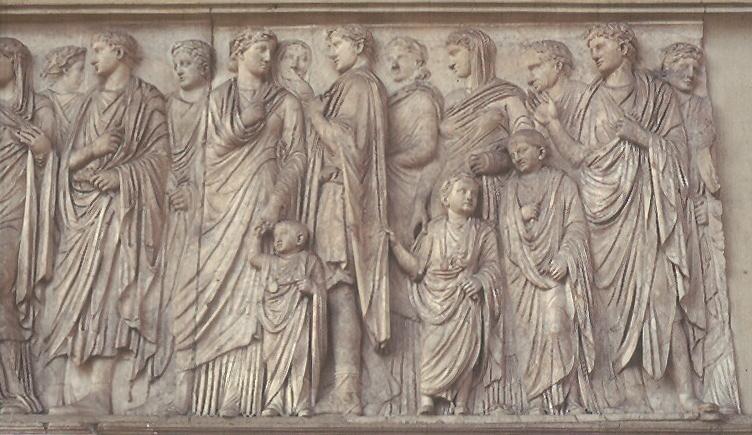
Today's Image
Ara Pacis: processional frieze showing members of the Imperial household (south face)
Source: Structure of Roman Family
Red and Green Vocab
The words in red and green are found among the 3057 Most Common Words in the Classical Latin texts that we will explore on CentumVerba.com and are essential to your understanding of the texts of Caesar, Vergil and Cicero. The green words appear frequently (at least five times) among Vergil's Aeneid (books I-VI), Caesar de bello Gallico (books I-V) and in Cicero's works - in Catilinam (books I-IV), de lege Manilia (also known as de Imperio Cn. Pompei), and pro Achia. These works constituted the curriculum for Latin over 4 years in American High Schools at the start of the 20th Century. The bulk of my information is taken from The Vocabulary of High School Latin by Gonzalez Lodge. I have added to these 2000 words from varioius other sources to compile my own list of The 3057 Most Common Latin Words.
The black words do not appear frequently in Classical Latin.
The red words are the first occurrences of these words in this author and this word will appear as green the next time you encounter it.
If you are serious about building your vocabulary then you should learn the red words as they occur and you should already know the green ones!
I have provided a FLASHCARD set to help - see below.
How To Read the Interactive Text
To Read the Interactive Text Below Without a Dictionary-
On a Computer: you hover over a word and get all the possible parts of speech; declensions; and conjugations of every word.
Red and Green Vocab
The words in red and green are found among the 3057 Most Common Words in the Classical Latin texts that we will explore on CentumVerba.com and are essential to your understanding of the texts of Caesar, Vergil and Cicero. The green words appear frequently (at least five times) among Vergil's Aeneid (books I-VI), Caesar de bello Gallico (books I-V) and in Cicero's works - in Catilinam (books I-IV), de lege Manilia (also known as de Imperio Cn. Pompei), and pro Achia. These works constituted the curriculum for Latin over 4 years in American High Schools at the start of the 20th Century. The bulk of my information is taken from The Vocabulary of High School Latin by Gonzalez Lodge. I have added to these 2000 words from varioius other sources to compile my own list of The 3057 Most Common Latin Words.
The black words do not appear frequently in Classical Latin.
The red words are the first occurrences of these words in this author and this word will appear as green the next time you encounter it.
If you are serious about building your vocabulary then you should learn the red words as they occur and you should already know the green ones!
I have provided a FLASHCARD set to help - see below.
How To Read the Interactive Text
To Read the Interactive Text Below Without a Dictionary-
On a Phone or Tablet: don't 'hover' -'tap' the word. To remove the 'definition box' you 'tap' to the side of the text box.
INTERACTIVE DICTIONARY FREE TEXT
[4] His rebus et suam rem familiarem auxisse et facultates ad largiendum magnas comparasse;
You Need to be a Member to Access the Interactive Dictionary
[5] magnum numerum equitatus suo sumptu semper alere et circum se habere, [6] neque solum domi, sed etiam apud finitimas civitates largiter posse,
atque huius potentiae causa matrem in Biturigibus homini illic nobilissimo ac potentissimo conlocasse;
[7] ipsum ex Helvetiis uxorem habere, sororum ex matre et propinquas suas nuptum in alias civitates conlocasse.
[8] Favere et cupere Helvetiis propter eam adfinitatem, odisse etiam suo nomine Caesarem et Romanos, quod eorum adventu potentia eius deminuta et Diviciacus frater in antiquum locum gratiae atque honoris sit restitutus.
[9] Si quid accidat Romanis, summam in spem per Helvetios regni obtinendi venire; imperio populi Romani non modo de regno, sed etiam de ea quam habeat gratia desperare.
You Need to be a Member to Access the Interactive Dictionary
I have prepared online Flashcards at CRAM.com to make learning the vocabulary much easier. I have no financial gain from you using the app as it is FREE to use.
I have created a stack of the 17 new words in this passage.
Here is the link to the FLASHCARDS
USING THE FLASHCARD APP:
To make the most of the online Flashcards use the "Click or use spacebar to begin" and the Latin word should appear. (The 'Shuffle' button will take the cards out of alphabetical order.) Type 'H' to get the conjugation / declension of the word if you want to see it. 'H' takes tyou back to the word. Click 'See Answer' or use the Spacebar to see the English.
If you were correct or close enough then select "I was right" or else "I was wrong". After you have completed the set it will start again but it will only display the ones you got wrong.
Continue through this process to learn all the words. I hope this is helpful!
Recent Comments