
imperium - absolute power
The Latin word imperium in Caesar’s writings denotes a complex and potent concept: the legal and military authority vested in a Roman magistrate or commander. Derived from imperare, meaning 'to command', imperium in Caesar’s usage is not abstract power but a concrete jurisdiction—often territorial, always hierarchical, and deeply tied to Roman political identity.
In the Commentarii de Bello Gallico and Commentarii de Bello Civili, imperium appears frequently in contexts where Caesar asserts or defends his right to command. For instance, when he crosses the Rubicon in 49 BCE, he does so under the claim of imperium, challenging the Senate’s attempt to strip him of it. This act, though not described with dramatic flourish in his own account, is framed by the legal and symbolic weight of imperium—a power granted by the people and validated by military success.
Caesar also uses imperium to distinguish between levels of command. He refers to his legates as possessing imperium within delegated bounds, but his own imperium is superior—imperium maius—allowing him to override decisions and direct campaigns. This hierarchical nuance is crucial in understanding Roman command structures, where imperium was not merely held but ranked.
Moreover, imperium in Caesar’s narrative serves as a legitimizing force. His actions in Gaul, his decisions in civil war, and his eventual dictatorship are all framed as exercises of rightful imperium. He rarely defends his choices in moral terms; instead, he appeals to the legality and necessity of his imperium, portraying it as the stabilizing axis of Roman governance amid chaos.
Thus, imperium in Caesar’s literature is both a legal instrument and a rhetorical tool. It defines his role, justifies his actions, and situates his authority within the Roman tradition of command. Far from being a static term, imperium in Caesar’s hands becomes a dynamic expression of power—earned, contested, and ultimately reshaped by his career.
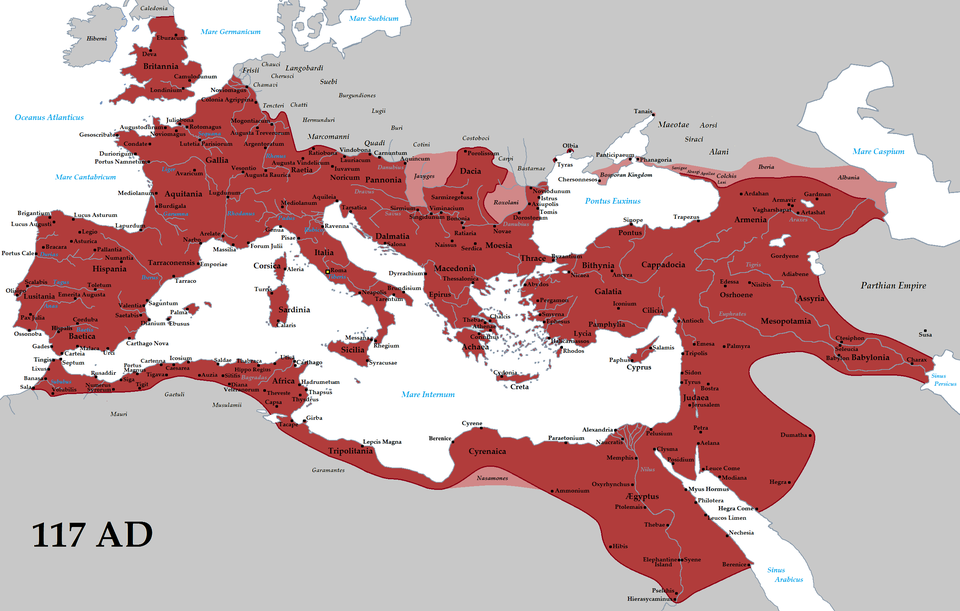
Today's Image
Roman Empire in AD 117 at its greatest territorial extent, at the time of Trajan's death
Here is a text only version. (See below for an interactive version)
[...9] imperio populi Romani non modo de regno, sed etiam de ea quam habeat gratia desperare. [10] Reperiebat etiam in quaerendo Caesar, quod proelium equestre adversum paucis ante diebus esset factum, initium eius fugae factum a Dumnorige atque eius equitibus (nam equitatui, quem auxilio Caesari Haedui miserant, Dumnorix praeerat): eorum fuga reliquum esse equitatum perterritum.
CAPUT XIX
Quibus rebus cognitis, cum ad has suspiciones certissimae res accederent, quod per fines Sequanorum Helvetios traduxisset, quod obsides inter eos dandos curasset, quod ea omnia non modo iniussu suo et civitatis sed etiam inscientibus ipsis fecisset, quod a magistratu Haeduorum accusaretur, satis esse causae arbitrabatur quare in eum aut ipse animadverteret aut civitatem animadvertere iuberet.
Need Help Understanding the Latin?
You might find it helpful to start with the Side-by-Side Version which allows you to see my own very literal translation of the text which is almost a word-for-word translation - in an attempt to make it easier to understand the Latin!
Finally come back to this page - Classical Text and you should be able to better understand and competently read the original Latin text.
Vocabulary Version
I have prepared a Vocabulary Version of the passage (link at bottom of the page) which highlights the 3057 Most Common Words in the texts of Vergil, Caesar and Cicero that we will explore on CentumVerba.com
If you are serious about building your vocabulary, the FLASHCARD set should help you learn them.
How To Read the Interactive Text
To Read the Interactive Text Below Without a Dictionary-
On a Computer: you hover over a word and get all the possible parts of speech; declensions; and conjugations of every word.
Need Help Understanding the Latin?
You might find it helpful to start with the Side-by-Side Version which allows you to see my own very literal translation of the text which is almost a word-for-word translation - in an attempt to make it easier to understand the Latin!
Finally come back to this page - Classical Text and you should be able to better understand and competently read the original Latin text.
Vocabulary Version
I have prepared a Vocabulary Version of the passage (link at bottom of the page) which highlights the 3057 Most Common Words in the texts of Vergil, Caesar and Cicero that we will explore on CentumVerba.com
If you are serious about building your vocabulary, the FLASHCARD set should help you learn them.
How To Read the Interactive Text
To Read the Interactive Text Below Without a Dictionary-
On a Phone or Tablet: don't 'hover' -'tap' the word. To remove the 'definition box' you 'tap' to the side of the text box.
Dictionary-Free Interactive Text
[...9] imperio populi Romani non modo de regno, sed etiam de ea quam habeat gratia desperare.
You Need to be a Member to Access the Interactive Dictionary
Reperiebat etiam in quaerendo Caesar, quod proelium equestre adversum paucis ante diebus esset factum, initium eius fugae factum a Dumnorige atque eius equitibus
(nam equitatui, quem auxilio Caesari Haedui miserant, Dumnorix praeerat): eorum fuga reliquum esse equitatum perterritum.
CAPUT XIX
Quibus rebus cognitis, cum ad has suspiciones certissimae res accederent, quod per fines Sequanorum Helvetios traduxisset, quod obsides inter eos dandos curasset,
quod ea omnia non modo iniussu suo et civitatis sed etiam inscientibus ipsis fecisset, quod a magistratu Haeduorum accusaretur,
satis esse causae arbitrabatur quare in eum aut ipse animadverteret aut civitatem animadvertere iuberet.
INTERACTIVE DICTIONARY-FREE TEXT
[...9] imperio populi Romani non modo de regno, sed etiam de ea quam habeat gratia desperare.
You Need to be a Member to Access the Interactive Dictionary
Reperiebat etiam in quaerendo Caesar, quod proelium equestre adversum paucis ante diebus esset factum, initium eius fugae factum a Dumnorige atque eius equitibus
(nam equitatui, quem auxilio Caesari Haedui miserant, Dumnorix praeerat): eorum fuga reliquum esse equitatum perterritum.
CAPUT XIX
Quibus rebus cognitis, cum ad has suspiciones certissimae res accederent, quod per fines Sequanorum Helvetios traduxisset, quod obsides inter eos dandos curasset,
quod ea omnia non modo iniussu suo et civitatis sed etiam inscientibus ipsis fecisset, quod a magistratu Haeduorum accusaretur,
satis esse causae arbitrabatur quare in eum aut ipse animadverteret aut civitatem animadvertere iuberet.
Recent Comments