
factum - the deed is done
The Latin noun factum—derived from the verb facere (to do, to make)—has played a significant role in both classical and ecclesiastical literature. In classical Latin, factum primarily referred to an action, deed, or event. It was commonly used in legal and philosophical texts, particularly in Roman law, where it signified actions with legal implications and was central to the formulation of legal principles. Philosophers such as Cicero and Seneca employed factum to discuss moral actions and ethical considerations, often contrasting it with dictum (spoken word) to emphasize the importance of deeds over mere words.
In ecclesiastical Latin, factum retained its meaning of 'deed' but took on additional theological and doctrinal significance. Medieval and Renaissance ecclesiastical writings frequently used factum in discussions of divine acts, miracles, and historical events within the Church. The term appeared in sermons, hagiographies, and chronicles, often to describe the deeds of saints or the workings of divine providence. The theological interpretation of factum was particularly evident in discussions of Christ’s actions, where it was used to highlight the significance of His deeds in fulfilling divine will.
Additionally, factum was employed in ecclesiastical legal contexts, particularly in canon law, where it referred to documented actions or established facts in legal proceedings. The term was crucial in the formulation of doctrinal arguments, reinforcing the importance of historical and factual evidence in theological discourse.
Over time, factum evolved in its usage, adapting to the linguistic and cultural shifts within the Church while maintaining its core meaning. Its presence in both classical and ecclesiastical literature underscores its versatility and enduring relevance in Latin writings across different periods and contexts.
The images for these posts on Mark's gospel
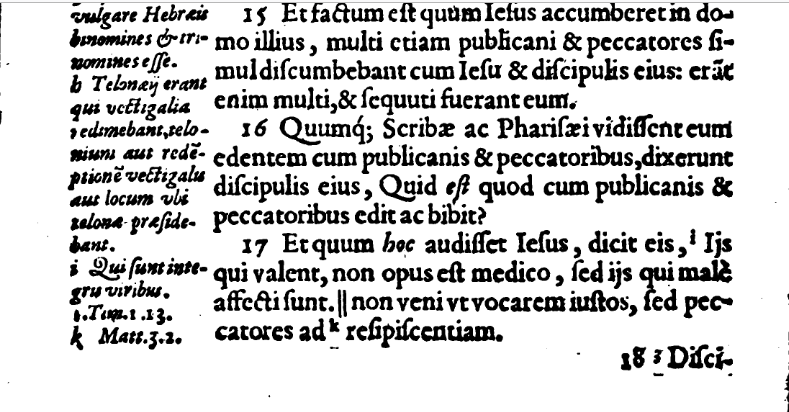
Screenshots taken from the Nouum Testamentum of Théodore de Bèze, (1519-1605) ( Londini : Thomas Vautrollerius, typographus, 1587 )
Accessed from the Post Reformation Digital Library
Red and Green Vocab
The words in red and green are found among the 3057 Most Common Words in the Classical Latin texts that we will explore on CentumVerba.com and are essential to your understanding of the texts of Caesar, Vergil and Cicero. The green words appear frequently (at least five times) among Vergil's Aeneid (books I-VI), Caesar de bello Gallico (books I-V) and in Cicero's works - in Catilinam (books I-IV), de lege Manilia (also known as de Imperio Cn. Pompei), and pro Achia. These works constituted the curriculum for Latin over 4 years in American High Schools at the start of the 20th Century. The bulk of my information is taken from The Vocabulary of High School Latin by Gonzalez Lodge. I have added to these 2000 words from varioius other sources to compile my own list of The 3057 Most Common Latin Words.
The black words do not appear frequently in Classical Latin.
The red words are the first occurrences of these words in this author and this word will appear as green the next time you encounter it.
If you are serious about building your vocabulary then you should learn the red words as they occur and you should already know the green ones!
I have provided a FLASHCARD set to help - see below.
How To Read the Interactive Text
To Read the Interactive Text Below Without a Dictionary-
On a Computer: you hover over a word and get all its possible parts of speech; declensions; and conjugations.
On a Tablet: 'Tap' the word to see the definition, and to remove the 'definition box' you simply 'Tap' anywhere to the side.
Red and Green Vocab
The words in red and green are found among the 3057 Most Common Words in the Classical Latin texts that we will explore on CentumVerba.com and are essential to your understanding of the texts of Caesar, Vergil and Cicero. The green words appear frequently (at least five times) among Vergil's Aeneid (books I-VI), Caesar de bello Gallico (books I-V) and in Cicero's works - in Catilinam (books I-IV), de lege Manilia (also known as de Imperio Cn. Pompei), and pro Achia. These works constituted the curriculum for Latin over 4 years in American High Schools at the start of the 20th Century. The bulk of my information is taken from The Vocabulary of High School Latin by Gonzalez Lodge. I have added to these 2000 words from varioius other sources to compile my own list of The 3057 Most Common Latin Words.
The black words do not appear frequently in Classical Latin.
The red words are the first occurrences of these words in this author and this word will appear as green the next time you encounter it.
If you are serious about building your vocabulary then you should learn the red words as they occur and you should already know the green ones!
I have provided a FLASHCARD set to help - see below.
How To Read the Interactive Text
To Read the Interactive Text Below Without a Dictionary-
On a Phone or Tablet: ''TAP' the word to see the definition, and to remove the 'definition box' you simply 'TAP' anywhere to the side.
INTERACTIVE DICTIONARY FREE TEXT
Caput 2
15 Et factum est, cum accumberet in domo illius, et multi publicani et peccatores simul discumbebant cum Iesu et discipulis eius erant enim multi et sequebantur eum.
You Need to be at least a Trial Member to Access the Interactive Dictionary
16 Et scribae pharisaeorum, videntes quia manducaret cum peccatoribus et publicanis, dicebant discipulis eius Quare cum publicanis et peccatoribus manducat?
17 Et Iesus hoc audito ait illis Non necesse habent sani medicum, sed qui male habent non veni vocare iustos sed peccatores
18 Et erant discipuli Ioannis et pharisaei ieiunantes. Et veniunt et dicunt illi Cur discipuli Ioannis et discipuli pharisaeorum ieiunant, tui autem discipuli non ieiunant?
19 Et ait illis Iesus Numquid possunt convivae nuptiarum, quamdiu sponsus cum illis est, ieiunare? Quanto tempore habent secum sponsum, non possunt ieiunare
I have prepared online Flashcards at CRAM.com to make learning the vocabulary much easier. I have no financial gain as the app is FREE to use.
I have created a stack of the 8 new words in this passage.
YOU NEED TO SIGN UP AS A TRIAL MEMBER TO ACCESS THE FLASHCARDS
Here is the link to the FLASHCARDS
I have prepared online Flashcards at CRAM.com to make learning the vocabulary much easier. I have no financial gain as the app is FREE to use.
I have created a stack of the 8 new words in this passage.
YOU NEED TO SIGN UP AS A TRIAL MEMBER TO ACCESS THE FLASHCARDS
Here is the link to the FLASHCARDS
USING THE FLASHCARD APP:
To make the most of the online Flashcards use the "Click or use spacebar to begin" and the Latin word should appear. (The 'Shuffle' button will take the cards out of alphabetical order.) Type 'H' to get the conjugation / declension of the word if you want to see it. 'H' takes tyou back to the word. Click 'See Answer' or use the Spacebar to see the English.
If you were correct or close enough then select "I was right" or else "I was wrong". After you have completed the set it will start again but it will only display the ones you got wrong.
Continue through this process to learn all the words. I hope this is helpful!
Recent Comments