
suus - belonging to oneself
The Latin possessive determiner suus holds a distinctive place in Latin grammar and meaning, marking possession in a way that differs from other possessive adjectives. Suus, sua, suum translates to ‘his own,’ ‘her own,’ or ‘their own,’ emphasizing ownership specific to the subject of the sentence. This distinction is crucial for clarity in Latin communication.
Unlike other possessive adjectives (meus for ‘my,’ tuus for ‘your,’ and eius for ‘his/her/its’), suus always refers back to the subject of the sentence. For instance, in ‘Marcus suum librum legit,’ meaning ‘Marcus reads his own book,’ suum indicates that the book belongs to Marcus. If eius were used instead (‘Marcus eius librum legit’), the sentence would imply that Marcus is reading someone else’s book. This distinction ensures precise understanding of possession.
In Latin literature and philosophy, suus is frequently used to stress personal ownership, agency, and self-referential concepts. Roman authors, including Cicero and Seneca, applied suus to reinforce notions of self-governance, individual duty, and moral responsibility. The phrase ‘suum cuique’, meaning ‘to each their own,’ encapsulates a fundamental principle of fairness and justice in Roman thought.
The relevance of suus extends beyond grammar, influencing the development of Romance languages. While modern languages like Spanish, Italian, and French use evolved possessive forms, Latin’s distinction between reflexive and non-reflexive possession helped shape these linguistic conventions.
Even today, scholars and students of Latin rely on suus to navigate complex sentence structures and philosophical texts, ensuring precise interpretation. This possessive determiner exemplifies Latin’s clarity in expression, reinforcing both individual identity and grammatical precision in a way that remains linguistically significant.
The images for these posts on Mark's gospel
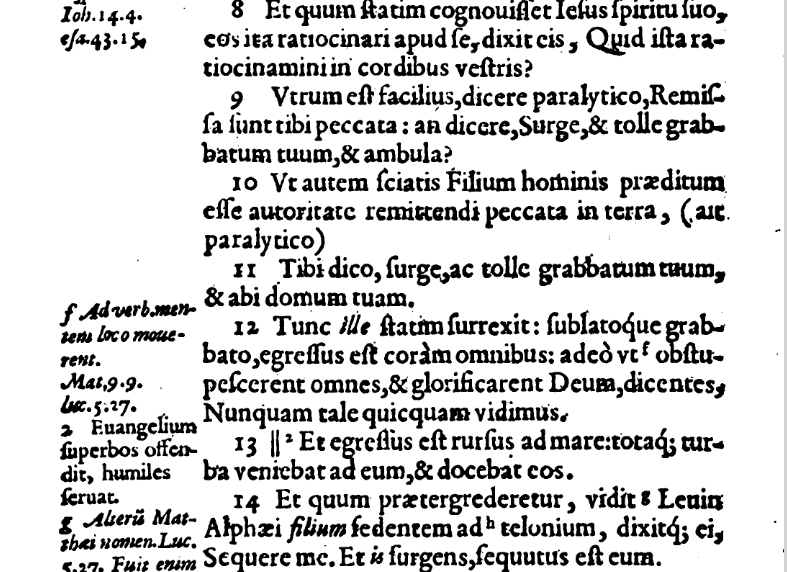
Screenshots taken from the Nouum Testamentum of Théodore de Bèze, (1519-1605) ( Londini : Thomas Vautrollerius, typographus, 1587 )
Accessed from the Post Reformation Digital Library
Red and Green Vocab
The words in red and green are found among the 3057 Most Common Words in the Classical Latin texts that we will explore on CentumVerba.com and are essential to your understanding of the texts of Caesar, Vergil and Cicero. The green words appear frequently (at least five times) among Vergil's Aeneid (books I-VI), Caesar de bello Gallico (books I-V) and in Cicero's works - in Catilinam (books I-IV), de lege Manilia (also known as de Imperio Cn. Pompei), and pro Achia. These works constituted the curriculum for Latin over 4 years in American High Schools at the start of the 20th Century. The bulk of my information is taken from The Vocabulary of High School Latin by Gonzalez Lodge. I have added to these 2000 words from varioius other sources to compile my own list of The 3057 Most Common Latin Words.
The black words do not appear frequently in Classical Latin.
The red words are the first occurrences of these words in this author and this word will appear as green the next time you encounter it.
If you are serious about building your vocabulary then you should learn the red words as they occur and you should already know the green ones!
I have provided a FLASHCARD set to help - see below.
How To Read the Interactive Text
To Read the Interactive Text Below Without a Dictionary-
On a Computer: you hover over a word and get all its possible parts of speech; declensions; and conjugations.
On a Tablet: 'Tap' the word to see the definition, and to remove the 'definition box' you simply 'Tap' anywhere to the side.
Red and Green Vocab
The words in red and green are found among the 3057 Most Common Words in the Classical Latin texts that we will explore on CentumVerba.com and are essential to your understanding of the texts of Caesar, Vergil and Cicero. The green words appear frequently (at least five times) among Vergil's Aeneid (books I-VI), Caesar de bello Gallico (books I-V) and in Cicero's works - in Catilinam (books I-IV), de lege Manilia (also known as de Imperio Cn. Pompei), and pro Achia. These works constituted the curriculum for Latin over 4 years in American High Schools at the start of the 20th Century. The bulk of my information is taken from The Vocabulary of High School Latin by Gonzalez Lodge. I have added to these 2000 words from varioius other sources to compile my own list of The 3057 Most Common Latin Words.
The black words do not appear frequently in Classical Latin.
The red words are the first occurrences of these words in this author and this word will appear as green the next time you encounter it.
If you are serious about building your vocabulary then you should learn the red words as they occur and you should already know the green ones!
I have provided a FLASHCARD set to help - see below.
How To Read the Interactive Text
To Read the Interactive Text Below Without a Dictionary-
On a Phone or Tablet: ''TAP' the word to see the definition, and to remove the 'definition box' you simply 'TAP' anywhere to the side.
INTERACTIVE DICTIONARY FREE TEXT
Caput 2
8 Quo statim cognito Iesus spiritu suo quia sic cogitarent intra se, dicit illis Quid ista cogitatis in cordibus vestris?
You Need to be at least a Trial Member to Access the Interactive Dictionary
9 Quid est facilius, dicere paralytico Dimittuntur peccata tua, an dicere Surge et tolle grabatum tuum et ambula?
10 Ut autem sciatis quia potestatem habet Filius hominis interra interra dimittendi peccata ait paralytico
11 Tibi dico Surge, tolle grabatum tuum et vade in domum tuam
12 Et surrexit et protinus sublato grabato abiit coram omnibus, ita ut admirarentur omnes et glorificarent Deum dicentes Numquam sic vidimus!
13 Et egressus est rursus ad mare omnisque turba veniebat ad eum, et docebat eos.
14 Et cum praeteriret, vidit Levin Alphaei sedentem ad teloneum et ait illi Sequere me. Et surgens secutus est eum.
I have prepared online Flashcards at CRAM.com to make learning the vocabulary much easier. I have no financial gain as the app is FREE to use.
I have created a stack of the 15 new words in this passage.
YOU NEED TO SIGN UP AS A TRIAL MEMBER TO ACCESS THE FLASHCARDS
Here is the link to the FLASHCARDS
USING THE FLASHCARD APP:
To make the most of the online Flashcards use the "Click or use spacebar to begin" and the Latin word should appear. (The 'Shuffle' button will take the cards out of alphabetical order.) Type 'H' to get the conjugation / declension of the word if you want to see it. 'H' takes tyou back to the word. Click 'See Answer' or use the Spacebar to see the English.
If you were correct or close enough then select "I was right" or else "I was wrong". After you have completed the set it will start again but it will only display the ones you got wrong.
Continue through this process to learn all the words. I hope this is helpful!
Recent Comments