
iterum - here we go again for a second time
The Latin adverb iterum is a fascinating word that conveys the sense of repetition or recurrence. Translated into English, it generally means 'again' or 'a second time.' This simple yet powerful word played an important role in Latin literature, philosophy, and everyday speech, often reinforcing the idea of an action being performed more than once.
Iterum comes from the root iter, meaning 'journey" or 'way.' While iter is primarily a noun referring to a path or course taken, iterum evolved into an adverb indicating a return or repetition of an action. This connection subtly implies movement, whether physical or abstract, toward something that has already occurred.
Throughout classical Latin texts, iterum is found in numerous contexts. Roman orators, such as Cicero, used the word to emphasize repeated arguments or actions. Poets, including Virgil and Ovid, employed it to highlight recurring events in mythology and human experience. The historical writings of Livy and Tacitus also feature iterum when describing battles fought again or political struggles revisited.
In Latin grammar, iterum functions as a standard adverb, modifying verbs to indicate repetition. For example, iterum dici means 'he says it again," while iterum venit translates to 'he comes again.' This usage allows Latin speakers to concisely express actions that happen more than once without needing complex phrasing.
The influence of iterum extends beyond classical Latin into later Romance languages. While modern Italian, Spanish, and French use different words for 'again' (di nuovo, otra vez, and encore, respectively), the Latin root survives in certain contexts. Even in English, echoes of iterum exist in words like 'reiterate,' which combines the Latin re- ('again') with iterare ('to repeat').
Today, scholars and enthusiasts studying Latin continue to encounter iterum in texts, inscriptions, and even modern adaptations of ancient phrases. Its presence in Latin underscores the importance of repetition in human thought and expression, making it a small but significant linguistic tool that connects past and present.
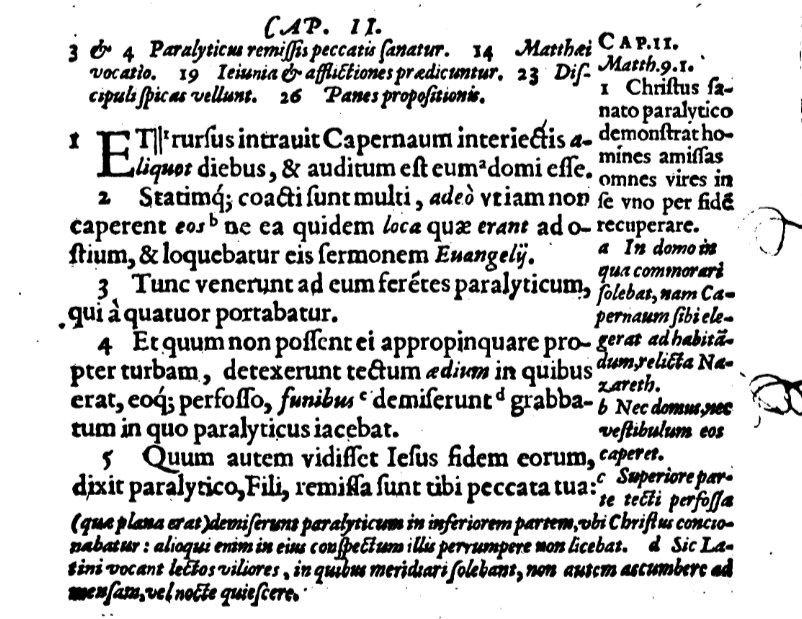
The images for these posts on Mark's gospel
Screenshots taken from the Nouum Testamentum of Théodore de Bèze, (1519-1605) ( Londini : Thomas Vautrollerius, typographus, 1587 )
Accessed from the Post Reformation Digital Library
Red and Green Vocab
The words in red and green are found among the 3057 Most Common Words in the Classical Latin texts that we will explore on CentumVerba.com and are essential to your understanding of the texts of Caesar, Vergil and Cicero. The green words appear frequently (at least five times) among Vergil's Aeneid (books I-VI), Caesar de bello Gallico (books I-V) and in Cicero's works - in Catilinam (books I-IV), de lege Manilia (also known as de Imperio Cn. Pompei), and pro Achia. These works constituted the curriculum for Latin over 4 years in American High Schools at the start of the 20th Century. The bulk of my information is taken from The Vocabulary of High School Latin by Gonzalez Lodge. I have added to these 2000 words from varioius other sources to compile my own list of The 3057 Most Common Latin Words.
The black words do not appear frequently in Classical Latin.
The red words are the first occurrences of these words in this author and this word will appear as green the next time you encounter it.
If you are serious about building your vocabulary then you should learn the red words as they occur and you should already know the green ones!
I have provided a FLASHCARD set to help - see below.
How To Read the Interactive Text
To Read the Interactive Text Below Without a Dictionary-
On a Computer: you hover over a word and get all its possible parts of speech; declensions; and conjugations.
On a Tablet: 'Tap' the word to see the definition, and to remove the 'definition box' you simply 'Tap' anywhere to the side.
Red and Green Vocab
The words in red and green are found among the 3057 Most Common Words in the Classical Latin texts that we will explore on CentumVerba.com and are essential to your understanding of the texts of Caesar, Vergil and Cicero. The green words appear frequently (at least five times) among Vergil's Aeneid (books I-VI), Caesar de bello Gallico (books I-V) and in Cicero's works - in Catilinam (books I-IV), de lege Manilia (also known as de Imperio Cn. Pompei), and pro Achia. These works constituted the curriculum for Latin over 4 years in American High Schools at the start of the 20th Century. The bulk of my information is taken from The Vocabulary of High School Latin by Gonzalez Lodge. I have added to these 2000 words from varioius other sources to compile my own list of The 3057 Most Common Latin Words.
The black words do not appear frequently in Classical Latin.
The red words are the first occurrences of these words in this author and this word will appear as green the next time you encounter it.
If you are serious about building your vocabulary then you should learn the red words as they occur and you should already know the green ones!
I have provided a FLASHCARD set to help - see below.
How To Read the Interactive Text
To Read the Interactive Text Below Without a Dictionary-
On a Phone or Tablet: ''TAP' the word to see the definition, and to remove the 'definition box' you simply 'TAP' anywhere to the side.
INTERACTIVE DICTIONARY FREE TEXT
Caput 2
1 Et iterum intravit Capharnaum post dies, et auditum est quod in domo esset.
2 Et convenerunt multi, ita ut non amplius caperentur neque ad ianuam, et loquebatur eis verbum.
You Need to be at least a Trial Member to Access the Interactive Dictionary
3 Et veniunt ferentes ad eum paralyticum, qui a quattuor portabatur.
4 Et cum non possent offerre eum illi prae turba, nudaverunt tectum, ubi erat, et perfodientes summittunt grabatum, in quo paralyticus iacebat.
5 Cum vidisset autem Iesus fidem illorum, ait paralytico Fili, dimittuntur peccata tua
6 Erant autem illic quidam de scribis sedentes et cogitantes in cordibus suis
7 Quid hic sic loquitur? Blasphemat! Quis potest dimittere peccata nisi solus Deus?
I have prepared online Flashcards at CRAM.com to make learning the vocabulary much easier. I have no financial gain as the app is FREE to use.
I have created a stack of the 20 new words in this passage.
YOU NEED TO SIGN UP AS A TRIAL MEMBER TO ACCESS THE FLASHCARDS
Here is the link to the FLASHCARDS
USING THE FLASHCARD APP:
To make the most of the online Flashcards use the "Click or use spacebar to begin" and the Latin word should appear. (The 'Shuffle' button will take the cards out of alphabetical order.) Type 'H' to get the conjugation / declension of the word if you want to see it. 'H' takes tyou back to the word. Click 'See Answer' or use the Spacebar to see the English.
If you were correct or close enough then select "I was right" or else "I was wrong". After you have completed the set it will start again but it will only display the ones you got wrong.
Continue through this process to learn all the words. I hope this is helpful!
Recent Comments