
tu- It's all about you!
The Latin pronoun tu (you) is a second-person singular pronoun used to address one person directly. It is an important element in Latin grammar, distinguishing between the speaker and the person being spoken to. Tu is a personal pronoun, and its usage varies depending on its grammatical function within a sentence.
In the nominative case, tu serves as the subject of the sentence, as in tu amicus es (you are a friend). In the genitive case, tui is used to indicate possession, as in memor tui sum (I remember you). The dative case, tibi, indicates the indirect object, as in donum tibi do (I give you a gift). The accusative case, te, marks the direct object, as in te video (I see you). Finally, the ablative case, also te, is used in various constructions, such as cum te (with you).
Tu played a significant role in both everyday communication and literary contexts in ancient Rome. Its use in addressing individuals in a familiar or respectful manner highlights the social nuances of Latin. The pronoun tu has influenced the development of second-person singular pronouns in Romance languages, such as tu in Spanish, Italian, and French, preserving its function and form through centuries of linguistic evolution.
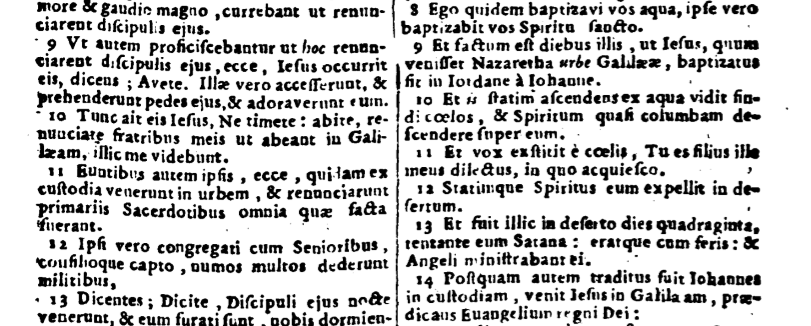
The images for these posts on Mark's gospel
Screenshots taken from the Nouum Testamentum of Théodore de Bèze, (1519-1605) ( Londini : Thomas Vautrollerius, typographus, 1587 )
Accessed from the Post Reformation Digital Library
The words in red and green are found among the 3057 Most Common Words in the Classical Latin texts that we will explore on CentumVerba.com and are essential to your understanding of the texts of Caesar, Vergil and Cicero. The green words appear frequently (at least five times) among Vergil's Aeneid (books I-VI), Caesar de bello Gallico (books I-V) and in Cicero's works - in Catilinam (books I-IV), de lege Manilia (also known as de Imperio Cn. Pompei), and pro Achia. These works constituted the curriculum for Latin over 4 years in American High Schools at the start of the 20th Century. The bulk of my information is taken from The Vocabulary of High School Latin by Gonzalez Lodge. I have added to these 2000 words from varioius other sources to compile my own list of The 3057 Most Common Latin Words.
The black words do not appear frequently in Classical Latin.
The red words are the first occurrences of these words in this author and this word will appear as green the next time you encounter it.
If you are serious about building your vocabulary then you should learn the red words as they occur and you should already know the green ones!
I have provided a FLASHCARD set to help - see below.
To Read the Interactive Text Below Without a Dictionary-
On a Computer:
Hover over a word to get all its possible parts of speech, declensions, or conjugations.
On a Tablet:
'TAP' the word to see the definition, and to remove the 'definition box' you simply 'TAP' anywhere to the side.
tu - It's all about you!
The Latin pronoun tu (you) is a second-person singular pronoun used to address one person directly. It is an important element in Latin grammar, distinguishing between the speaker and the person being spoken to. Tu is a personal pronoun, and its usage varies depending on its grammatical function within a sentence.
In the nominative case, tu serves as the subject of the sentence, as in tu amicus es (you are a friend). In the genitive case, tui is used to indicate possession, as in memor tui sum (I remember you). The dative case, tibi, indicates the indirect object, as in donum tibi do (I give you a gift). The accusative case, te, marks the direct object, as in te video (I see you). Finally, the ablative case, also te, is used in various constructions, such as cum te (with you).
Tu played a significant role in both everyday communication and literary contexts in ancient Rome. Its use in addressing individuals in a familiar or respectful manner highlights the social nuances of Latin. The pronoun tu has influenced the development of second-person singular pronouns in Romance languages, such as tu in Spanish, Italian, and French, preserving its function and form through centuries of linguistic evolution.
The images for these posts on Mark's gospel
Screenshots taken from the Nouum Testamentum of Théodore de Bèze, (1519-1605) ( Londini : Thomas Vautrollerius, typographus, 1587 )
Accessed from the Post Reformation Digital Library
The words in red and green are found among the 3057 Most Common Words in the Classical Latin texts that we will explore on CentumVerba.com and are essential to your understanding of the texts of Caesar, Vergil and Cicero. The green words appear frequently (at least five times) among Vergil's Aeneid (books I-VI), Caesar de bello Gallico (books I-V) and in Cicero's works - in Catilinam (books I-IV), de lege Manilia (also known as de Imperio Cn. Pompei), and pro Achia. These works constituted the curriculum for Latin over 4 years in American High Schools at the start of the 20th Century. The bulk of my information is taken from The Vocabulary of High School Latin by Gonzalez Lodge. I have added to these 2000 words from varioius other sources to compile my own list of The 3057 Most Common Latin Words.
The black words do not appear frequently in Classical Latin.
The red words are the first occurrences of these words in this author and this word will appear as green the next time you encounter it.
If you are serious about building your vocabulary then you should learn the red words as they occur and you should already know the green ones!
I have provided a FLASHCARD set to help - see below.
To Read the Interactive Text Below Without a Dictionary-
On a Phone or Tablet: don't 'hover' -'tap' the word. To remove the 'definition box' you 'tap' to the side of the text box.
INTERACTIVE DICTIONARY FREE TEXT
8 ego baptizavi vos aqua ille vero baptizabit vos Spiritu Sancto.
9 Et factum est in diebus illis venit Iesus a Nazareth Galilaeae et baptizatus est in Iordane a Iohanne
10 et statim ascendens de aqua vidit apertos caelos et Spiritum tamquam columbam descendentem et manentem in ipso
11 et vox facta est de caelis tu es Filius meus dilectus in te complacui.
12 Et statim Spiritus expulit eum in desertum.
13 et erat in deserto quadraginta diebus et quadraginta noctibus et tentabatur a Satana. Eratque cum bestiis et angeli ministrabant illi.
14 Postquam autem traditus est Ioannes venit Iesus in Galilæam. Prædicans evangelium regni Dei
15 et dicens quoniam impletum est tempus et appropinquavit regnum Dei
I have prepared online Flashcards at CRAM.com to make learning the vocabulary much easier. I have no financial gain from you using the app as it is FREE to use.
I have created a stack of the 26 new words in this passage.
Here is the link to the FLASHCARDS
I have prepared online Flashcards at CRAM.com to make learning the vocabulary much easier. I have no financial gain from you using the app as it is FREE to use.
I have created a stack of the 26 new words in this passage.
Here is the link to the FLASHCARDS
USING THE FLASHCARD APP:
To make the most of the online Flashcards use the "Click or use spacebar to begin" and the Latin word should appear. (The 'Shuffle' button will take the cards out of alphabetical order.) Type 'H' to get the conjugation / declension of the word if you want to see it. 'H' takes tyou back to the word. Click 'See Answer' or use the Spacebar to see the English.
If you were correct or close enough then select "I was right" or else "I was wrong". After you have completed the set it will start again but it will only display the ones you got wrong.
Continue through this process to learn all the words. I hope this is helpful!
Recent Comments