
initium - a beginning?
The Latin word initium holds rich significance, particularly in the context of Vulgate Latin—the version of the Bible translated by St. Jerome in the late 4th century CE. Derived from the root inire (to go into, to begin), initium primarily means beginning, commencement, or origin. In classical Latin literature, initium is frequently used to signify a beginning, origin, or starting point. It often reflects the themes of inception, causality, or the foundation of something significant, appearing in a variety of contexts from philosophy to history and poetry. Its usage highlights the Roman interest in exploring the nature of beginnings, whether in the realm of human actions, natural phenomena, or metaphysical concepts.
In the Vulgate, initium is a pivotal term used to translate the Greek word archē in key passages of scripture. A notable example is the opening of the Book of Genesis: In principio creavit Deus caelum et terram (Genesis 1:1). Although principium is used here, initium appears in other contexts to describe beginnings, emphasizing its interchangeable but nuanced role in conveying the concept of origins or commencements. Its use underscores the sacred idea of divine creation, the start of time, and the foundation of all things—an important theological theme.
The word initium also reflects the linguistic shift seen in Vulgate Latin, where St. Jerome favored clarity and accessibility to reach a broader audience. By incorporating words like initium, he ensured the text resonated with both the educated elite and the common Roman populace. This deliberate choice contributed to the Vulgate's linguistic influence on Medieval Latin and the vernacular languages that followed.
Beyond the Bible, initium held philosophical and literary importance in Roman thought. Writers such as Cicero and Seneca used it to explore the nature of beginnings, causality, and change, often tying it to human endeavor or cosmic order. In Vulgate Latin, however, initium transcends its classical usage, becoming a bridge between human understanding and divine mystery—a timeless reflection on the genesis of all existence. For example, Cicero uses initium in his philosophical works to discuss the starting point of ideas or actions. In De Finibus Bonorum et Malorum, he examines ethical principles and often reflects on the initium of virtuous behavior, linking it to rational thought and moral reasoning. Similarly, in De Natura Deorum, he uses initium when discussing the origins of the universe, tying it to broader cosmological debates.
Historians like Livy employ initium to mark the beginnings of events or the foundations of cities, such as the initium of Rome itself. In poetic contexts, such as in the works of Virgil or Ovid, initium may appear in descriptions of the genesis of a story or the unfolding of a natural or mythological process. For instance, Virgil might use initium to poetically describe the origin of a hero’s journey, underscoring the weight of destiny or divine intervention. The term also appears in legal and rhetorical texts, where it might indicate the starting point of an argument, a law, or a procedure. In all these instances, initium conveys not just the temporal beginning but often carries a sense of purpose, foundation, or causation that aligns with Roman philosophical and cultural values. Its versatile use underscores its importance in articulating the concepts of commencement and origin across classical literature.
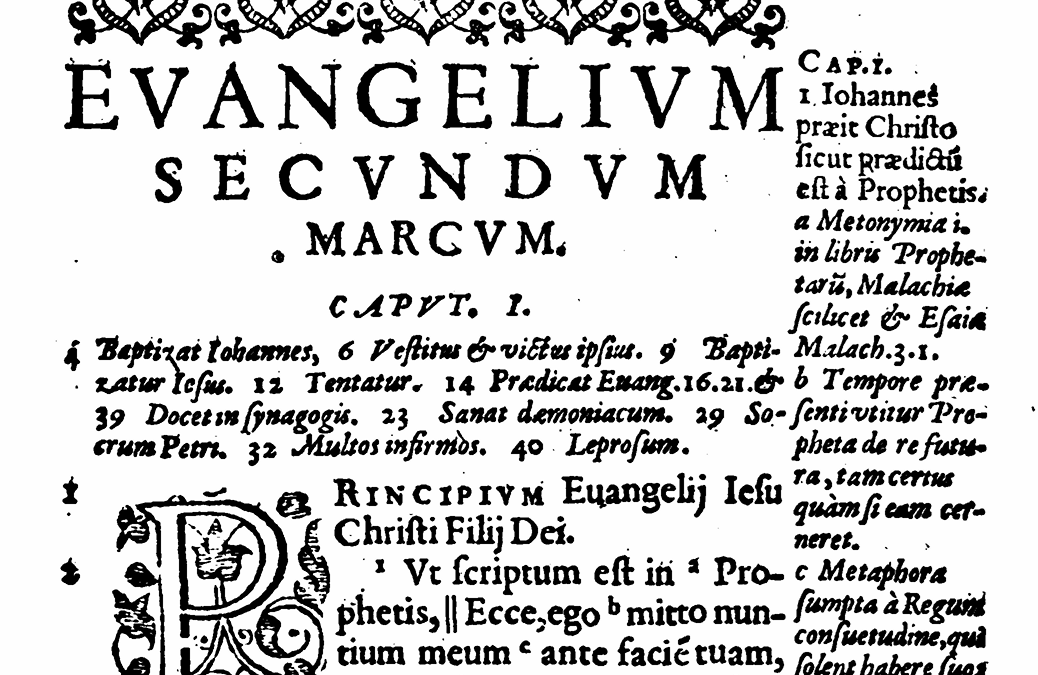
The images for these posts on Mark's gospel
Screenshots taken from the Nouum Testamentum of Théodore de Bèze, (1519-1605) ( Londini : Thomas Vautrollerius, typographus, 1587 )
Accessed from the Post Reformation Digital Library
The words in red and green are found among the 3057 Most Common Words in the Classical Latin texts that we will explore on CentumVerba.com and are essential to your understanding of the texts of Caesar, Vergil and Cicero. The green words appear frequently (at least five times) among Vergil's Aeneid (books I-VI), Caesar de bello Gallico (books I-V) and in Cicero's works - in Catilinam (books I-IV), de lege Manilia (also known as de Imperio Cn. Pompei), and pro Achia. These works constituted the curriculum for Latin over 4 years in American High Schools at the start of the 20th Century. The bulk of my information is taken from The Vocabulary of High School Latin by Gonzalez Lodge. I have added to these 2000 words from varioius other sources to compile my own list of The 3057 Most Common Latin Words.
The black words do not appear frequently in Classical Latin.
The red words are the first occurrences of these words in this author and this word will appear as green the next time you encounter it.
If you are serious about building your vocabulary then you should learn the red words as they occur and you should already know the green ones!
I have provided a FLASHCARD set to help - see below.
To Read the Interactive Text Below Without a Dictionary-
On a Computer:
Hover over a word to get all its possible parts of speech, declensions, or conjugations.
On a Tablet:
'TAP' the word to see the definition, and to remove the 'definition box' you simply 'TAP' anywhere to the side.
initium - a beginning?
The Latin word initium holds rich significance, particularly in the context of Vulgate Latin—the version of the Bible translated by St. Jerome in the late 4th century CE. Derived from the root inire (to go into, to begin), initium primarily means beginning, commencement, or origin. In classical Latin literature, initium is frequently used to signify a beginning, origin, or starting point. It often reflects the themes of inception, causality, or the foundation of something significant, appearing in a variety of contexts from philosophy to history and poetry. Its usage highlights the Roman interest in exploring the nature of beginnings, whether in the realm of human actions, natural phenomena, or metaphysical concepts.
In the Vulgate, initium is a pivotal term used to translate the Greek word archē in key passages of scripture. A notable example is the opening of the Book of Genesis: In principio creavit Deus caelum et terram (Genesis 1:1). Although principium is used here, initium appears in other contexts to describe beginnings, emphasizing its interchangeable but nuanced role in conveying the concept of origins or commencements. Its use underscores the sacred idea of divine creation, the start of time, and the foundation of all things—an important theological theme.
The word initium also reflects the linguistic shift seen in Vulgate Latin, where St. Jerome favored clarity and accessibility to reach a broader audience. By incorporating words like initium, he ensured the text resonated with both the educated elite and the common Roman populace. This deliberate choice contributed to the Vulgate's linguistic influence on Medieval Latin and the vernacular languages that followed.
Beyond the Bible, initium held philosophical and literary importance in Roman thought. Writers such as Cicero and Seneca used it to explore the nature of beginnings, causality, and change, often tying it to human endeavor or cosmic order. In Vulgate Latin, however, initium transcends its classical usage, becoming a bridge between human understanding and divine mystery—a timeless reflection on the genesis of all existence. For example, Cicero uses initium in his philosophical works to discuss the starting point of ideas or actions. In De Finibus Bonorum et Malorum, he examines ethical principles and often reflects on the initium of virtuous behavior, linking it to rational thought and moral reasoning. Similarly, in De Natura Deorum, he uses initium when discussing the origins of the universe, tying it to broader cosmological debates.
Historians like Livy employ initium to mark the beginnings of events or the foundations of cities, such as the initium of Rome itself. In poetic contexts, such as in the works of Virgil or Ovid, initium may appear in descriptions of the genesis of a story or the unfolding of a natural or mythological process. For instance, Virgil might use initium to poetically describe the origin of a hero’s journey, underscoring the weight of destiny or divine intervention. The term also appears in legal and rhetorical texts, where it might indicate the starting point of an argument, a law, or a procedure. In all these instances, initium conveys not just the temporal beginning but often carries a sense of purpose, foundation, or causation that aligns with Roman philosophical and cultural values. Its versatile use underscores its importance in articulating the concepts of commencement and origin across classical literature.
The images for these posts on Mark's gospel
Screenshots taken from the Nouum Testamentum of Théodore de Bèze, (1519-1605) ( Londini : Thomas Vautrollerius, typographus, 1587 )
Accessed from the Post Reformation Digital Library
The words in red and green are found among the 3057 Most Common Words in the Classical Latin texts that we will explore on CentumVerba.com and are essential to your understanding of the texts of Caesar, Vergil and Cicero. The green words appear frequently (at least five times) among Vergil's Aeneid (books I-VI), Caesar de bello Gallico (books I-V) and in Cicero's works - in Catilinam (books I-IV), de lege Manilia (also known as de Imperio Cn. Pompei), and pro Achia. These works constituted the curriculum for Latin over 4 years in American High Schools at the start of the 20th Century. The bulk of my information is taken from The Vocabulary of High School Latin by Gonzalez Lodge. I have added to these 2000 words from varioius other sources to compile my own list of The 3057 Most Common Latin Words.
The black words do not appear frequently in Classical Latin.
The red words are the first occurrences of these words in this author and this word will appear as green the next time you encounter it.
If you are serious about building your vocabulary then you should learn the red words as they occur and you should already know the green ones!
I have provided a FLASHCARD set to help - see below.
To Read the Interactive Text Below Without a Dictionary-
On a Phone or Tablet: don't 'hover' -'tap' the word. To remove the 'definition box' you 'tap' to the side of the text box.
INTERACTIVE DICTIONARY FREE TEXT
1 Initium Evangelii Iesu Christi Filii Dei
2 sicut scriptum est in Esaia propheta ecce mitto angelum meum ante faciem tuam qui praeparabit viam tuam
3 Vox clamantis in deserto parate viam Domini rectas facite semitas eius
4 Fuit Ioannes in deserto baptizans et praedicans baptismum poenitentiae in remissionem peccatorum
5 et egrediebatur ad illum omnis Iudaeae regio et Hierosolymitae universi et baptizabantur ab illo in Iordane flumine confitentes peccata sua
6 et erat Ioannes vestitus pilis cameli et zona pellicea circa lumbos eius et lucustas et mel silvestre edebat
7 et praedicabat dicens Venit fortior post me cuius non sum dignus procumbens solvere corrigiam calceamentorum eius
I have prepared online Flashcards at CRAM.com to make learning the vocabulary much easier. I have no financial gain from you using the app as it is FREE to use.
I have created a stack of the 45 new words in this passage.
Here is the link to the FLASHCARDS
If that is too many words at once here is that list split into two:
USING THE FLASHCARD APP:
To make the most of the online Flashcards use the "Click or use spacebar to begin" and the Latin word should appear. (The 'Shuffle' button will take the cards out of alphabetical order.) Type 'H' to get the conjugation / declension of the word if you want to see it. 'H' takes tyou back to the word. Click 'See Answer' or use the Spacebar to see the English.
If you were correct or close enough then select "I was right" or else "I was wrong". After you have completed the set it will start again but it will only display the ones you got wrong.
Continue through this process to learn all the words. I hope this is helpful!
Recent Comments