
Orontes
The first ship to be lost is that of Orontes and his Lycians. The violent storm sent by Aeolous and Juno leads to the shipwreck of many of Aeneas' fleet. According to Leslie S Smith this was not until the seventh year of his wanderings. Aeneas himself brought seven ships safely to anchorage – the that were saved from the rocks (line 108), three saved from Syrtes (ln 110) and the seventh was the flagship of Aeneas.
Orontes
There is not much known about Orontes apart from the fact that he was one of the commanders of Aeneas' ships and that it was crewed by Lycians. There was a river-god of Syria in West Asia from whom our Orontes needs to be dissociated. Likewise the River Orontes which flowed into the Mediterranean Sea near the city of Antioch. There were several passenger ships and naval ships named after Orontes but this is more likely after the sea-god than our man.
Source: theoigreekmythology
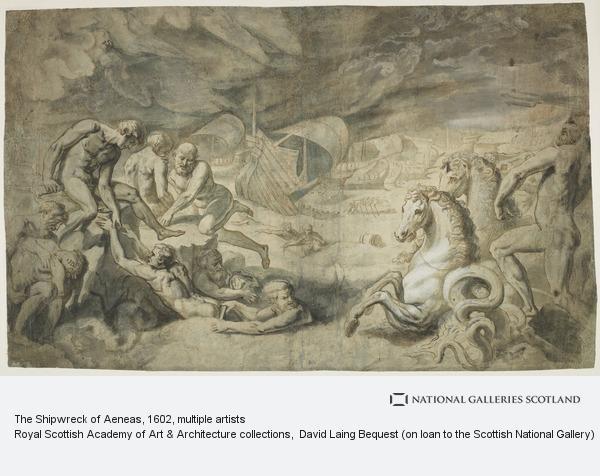
Today's Artwork is the "The Shipwreck of Aeneas"
Artist: Multiple Artists (1602)
From the David Laing Bequest (Scottish National Gallery)
Here is a text only version. (See below for an interactive version)
Franguntur remi; tum prora avertit, et undis
105 dat latus; insequitur cumulo praeruptus aquae mons.
Hi summo in fluctu pendent; his unda dehiscens
terram inter fluctus aperit; furit aestus harenis.
Tris Notus abreptas in saxa latentia torquet—
saxa vocant Itali mediis quae in fluctibus aras
110 dorsum immane mari summo —tris Eurus ab alto
in brevia et Syrtis urguet, miserabile visu,
inliditque vadis atque aggere cingit harenae.
Unam, quae Lycios fidumque vehebat Oronten,
ipsius ante oculos ingens a vertice pontus
115 in puppim ferit: excutitur pronusque magister
volvitur in caput; ast illam ter fluctus ibidem
torquet agens circum, et rapidus vorat aequore vortex.
Orontes
The first ship to be lost is that of Orontes and his Lycians. The violent storm sent by Aeolous and Juno leads to the shipwreck of many of Aeneas' fleet. According to Leslie S Smith this was not until the seventh year of his wanderings. Aeneas himself brought seven ships safely to anchorage – the that were saved from the rocks (line 108), three saved from Syrtes (ln 110) and the seventh was the flagship of Aeneas.
Orontes
There is not much known about Orontes apart from the fact that he was one of the commanders of Aeneas' ships and that it was crewed by Lycians. There was a river-god of Syria in West Asia from whom our Orontes needs to be dissociated. Likewise the River Orontes which flowed into the Mediterranean Sea near the city of Antioch. There were several passenger ships and naval ships named after Orontes but this is more likely after the sea-god than our man.
Source: theoigreekmythology
Today's Artwork is the "The Shipwreck of Aeneas"
Artist: Multiple Artists (1602)
From the David Laing Bequest (Scottish National Gallery)
Here is a text only version. (See below for an interactive version)
Franguntur remi; tum prora avertit, et undis
105 dat latus; insequitur cumulo praeruptus aquae mons.
Hi summo in fluctu pendent; his unda dehiscens
terram inter fluctus aperit; furit aestus harenis.
Tris Notus abreptas in saxa latentia torquet—
saxa vocant Itali mediis quae in fluctibus aras—
110 dorsum immane mari summo; tris Eurus ab alto
in brevia et Syrtis urguet, miserabile visu,
inliditque vadis atque aggere cingit harenae.
Unam, quae Lycios fidumque vehebat Oronten,
ipsius ante oculos ingens a vertice pontus
115 in puppim ferit: excutitur pronusque magister
volvitur in caput; ast illam ter fluctus ibidem
torquet agens circum, et rapidus vorat aequore vortex.
Need Help Understanding the Latin?
You might find it helpful to start with the Side-by-Side Version which allows you to see my own very literal translation of the text which is almost a word-for-word translation - in an attempt to make it easier to understand the Latin!
Finally come back to this page - Classical Text and you should be able to better understand and competently read the original Latin text.
Vocabulary Version
I have prepared a Vocabulary Version of the passage (link at bottom of the page) which highlights the 3057 Most Common Words in the texts of Vergil, Caesar and Cicero that we will explore on CentumVerba.com
If you are serious about building your vocabulary, the FLASHCARD set should help you learn them.
How To Read the Interactive Text
To Read the Interactive Text Below Without a Dictionary-
On a Computer: you hover over a word and get all the possible parts of speech; declensions; and conjugations of every word.
Need Help Understanding the Latin?
You might find it helpful to start with the Side-by-Side Version which allows you to see my own very literal translation of the text which is almost a word-for-word translation - in an attempt to make it easier to understand the Latin!
Finally come back to this page - Classical Text and you should be able to better understand and competently read the original Latin text.
Vocabulary Version
I have prepared a Vocabulary Version of the passage (link at bottom of the page) which highlights the 3057 Most Common Words in the texts of Vergil, Caesar and Cicero that we will explore on CentumVerba.com
If you are serious about building your vocabulary, the FLASHCARD set should help you learn them.
How To Read the Interactive Text
To Read the Interactive Text Below Without a Dictionary-
On a Phone or Tablet: don't 'hover' -'tap' the word. To remove the 'definition box' you 'tap' to the side of the text box.
INTERACTIVE DICTIONARY FREE TEXT
Franguntur remi; tum prora avertit, et undis
dat latus; insequitur cumulo praeruptus aquae mons.
Hi summo in fluctu pendent; his unda dehiscens
terram inter fluctus aperit; furit aestus harenis.
You Need to be a Member to Access the Interactive Dictionary
Tris Notus abreptas in saxa latentia torquet—
saxa vocant Itali mediis quae in fluctibus aras
dorsum immane mari summo— tris Eurus ab alto
in brevia et Syrtis urguet, miserabile visu,
inliditque vadis atque aggere cingit harenae.
Unam, quae Lycios fidumque vehebat Oronten,
ipsius ante oculos ingens a vertice pontus
in puppim ferit: excutitur pronusque magister
volvitur in caput; ast illam ter fluctus ibidem
torquet agens circum, et rapidus vorat aequore vortex.
Recent Comments