
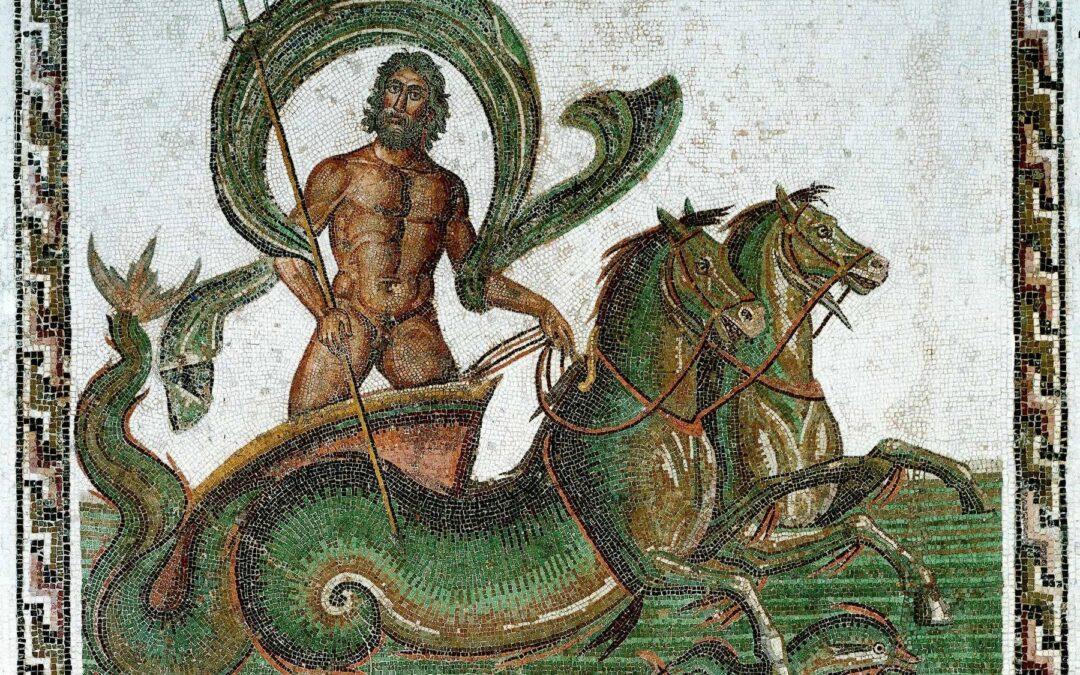
Neptunus
Neptune (latin name Neptunus) appears in the middle of the storm that is causing all the problems for Aeneas and his fleet.
Neptunus was the Roman god of waters and seas, who controlled winds and storms. Also known as Neptunus Equester, he was recognized as a god of horses and horsemanship, as well as patron of horse racing, a popular form of entertainment for the ancient Romans.
In terms of his characteristics and mythology, Neptune was an exact copy of the Greek deity Poseidon. Neptune was a later addition to the Roman pantheon. Though he lacked political power within the Roman pantheon, Neptunus still commanded the fear and respect of a people whose fortunes were intimately tied to the seas. His importance increased in the second and third centuries BC as Roman hegemony spread throughout the Mediterranean. https://mythopedia.com
Neptune rebukes the winds let loose by his sister Juno.
Today's Artwork: A velificans of Neptune in his seahorse-drawn triumphal chariot from the mid-3rd century AD -
From the Sousse Archaeological Museum.
Here is a text only version. (See below for an interactive version)
Adparent rari nantes in gurgite vasto,
arma virum, tabulaeque, et Troia gaza per undas.
Iam validam Ilionei navem, iam fortis Achati,
et qua vectus Abas, et qua grandaevus Aletes,
vicit hiems; laxis laterum compagibus omnes
accipiunt inimicum imbrem, rimisque fatiscunt.
Interea magno misceri murmure pontum,
emissamque hiemem sensit Neptunus, et imis
stagna refusa vadis, graviter commotus; et alto
prospiciens, summa placidum caput extulit unda.
Disiectam Aeneae, toto videt aequore classem,
fluctibus oppressos Troas caelique ruina,
nec latuere doli fratrem Iunonis et irae.
Eurum ad se Zephyrumque vocat, dehinc talia fatur:
“Tantane vos generis tenuit fiducia vestri?
Iam caelum terramque meo sine numine, venti,
miscere, et tantas audetis tollere moles?
Need Help Understanding the Latin?
You might find it helpful to start with the Side-by-Side Version which allows you to see my own very literal translation of the text which is almost a word-for-word translation - in an attempt to make it easier to understand the Latin!
Finally come back to this page - Classical Text and you should be able to better understand and competently read the original Latin text.
Vocabulary Version
I have prepared a Vocabulary Version of the passage (link at bottom of the page) which highlights the 3057 Most Common Words in the texts of Vergil, Caesar and Cicero that we will explore on CentumVerba.com
If you are serious about building your vocabulary, the FLASHCARD set should help you learn them.
How To Read the Interactive Text
To Read the Interactive Text Below Without a Dictionary-
On a Computer: you hover over a word and get all the possible parts of speech; declensions; and conjugations of every word.
Need Help Understanding the Latin?
You might find it helpful to start with the Side-by-Side Version which allows you to see my own very literal translation of the text which is almost a word-for-word translation - in an attempt to make it easier to understand the Latin!
Finally come back to this page - Classical Text and you should be able to better understand and competently read the original Latin text.
Vocabulary Version
I have prepared a Vocabulary Version of the passage (link at bottom of the page) which highlights the 3057 Most Common Words in the texts of Vergil, Caesar and Cicero that we will explore on CentumVerba.com
If you are serious about building your vocabulary, the FLASHCARD set should help you learn them.
How To Read the Interactive Text
To Read the Interactive Text Below Without a Dictionary-
On a Phone or Tablet: don't 'hover' -'tap' the word. To remove the 'definition box' you 'tap' to the side of the text box.
INTERACTIVE DICTIONARY FREE TEXT
Adparent rari nantes in gurgite vasto,
arma virum, tabulaeque, et Troia gaza per undas.
Iam validam Ilionei navem, iam fortis Achati,
et qua vectus Abas, et qua grandaevus Aletes,
vicit hiems; laxis laterum compagibus omnes
accipiunt inimicum imbrem, rimisque fatiscunt.
You Need to be a Member to Access the Interactive Dictionary
accipiunt inimicum imbrem, rimisque fatiscunt.
Interea magno misceri murmure pontum,
emissamque hiemem sensit Neptunus, et imis
stagna refusa vadis, graviter commotus; et alto
prospiciens, summa placidum caput extulit unda.
Disiectam Aeneae, toto videt aequore classem,
fluctibus oppressos Troas caelique ruina,
nec latuere doli fratrem Iunonis et irae.
Eurum ad se Zephyrumque vocat, dehinc talia fatur:
“Tantane vos generis tenuit fiducia vestri?
Iam caelum terramque meo sine numine, venti,
miscere, et tantas audetis tollere moles?
Recent Comments