
mulier - the merry wives
The Latin noun mulier, meaning ‘woman’, is a term of social and cultural significance in classical Latin literature. Unlike femina, which can denote a woman more generally or biologically, mulier often carries connotations of social role, marital status, or moral character. Its use varies across genres, reflecting Roman attitudes toward gender, virtue, and domestic life.
In prose, particularly in historical and rhetorical texts, mulier is frequently used to describe women in relation to public or private events. Livy often uses mulier when recounting episodes involving Roman matrons, such as the Sabine women or Lucretia. In these contexts, mulier highlights the woman’s role within the household or the state, often as a moral exemplar or a figure of civic consequence. Cicero, in his speeches, uses mulier both neutrally and pejoratively, depending on the rhetorical aim. When defending or attacking character, the term can imply dignity or impropriety.
In poetry, mulier appears less frequently than femina or more poetic terms like puella, but its presence is often deliberate. In satire, Juvenal uses mulier to critique Roman women’s behaviour, portraying them as vain, manipulative, or morally lax. The term here is weighted with social judgement, reflecting anxieties about gender and power. In contrast, Horace occasionally uses mulier in a more neutral or ironic tone, often to comment on relationships or domestic arrangements.
Philosophical writers such as Seneca use mulier in discussions of ethics and virtue, sometimes to illustrate Stoic ideals or failings. The term may be used to contrast emotional instability with rational control, though Seneca also acknowledges the capacity of mulieres for moral strength.
Overall, mulier in classical Latin literature is a socially charged term, often used to define a woman’s place within Roman moral and civic frameworks. Its usage reflects broader cultural values and the complexities of gendered identity in Roman thought.
The images for these posts on Mark's gospel
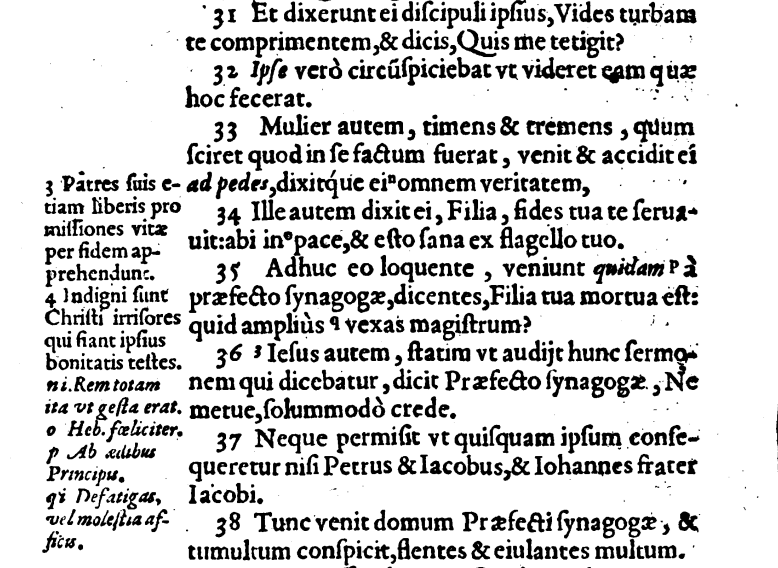
Screenshots taken from the Nouum Testamentum of Théodore de Bèze, (1519-1605) ( Londini : Thomas Vautrollerius, typographus, 1587 )
Accessed from the Post Reformation Digital Library
Red and Green Vocab
The words in red and green are found among the 3057 Most Common Words in the Classical Latin texts that we will explore on CentumVerba.com and are essential to your understanding of the texts of Caesar, Vergil and Cicero. The green words appear frequently (at least five times) among Vergil's Aeneid (books I-VI), Caesar de bello Gallico (books I-V) and in Cicero's works - in Catilinam (books I-IV), de lege Manilia (also known as de Imperio Cn. Pompei), and pro Achia. These works constituted the curriculum for Latin over 4 years in American High Schools at the start of the 20th Century. The bulk of my information is taken from The Vocabulary of High School Latin by Gonzalez Lodge. I have added to these 2000 words from varioius other sources to compile my own list of The 3057 Most Common Latin Words.
The black words do not appear frequently in Classical Latin.
The red words are the first occurrences of these words in this author and this word will appear as green the next time you encounter it.
If you are serious about building your vocabulary then you should learn the red words as they occur and you should already know the green ones!
I have provided a FLASHCARD set to help - see below.
How To Read the Interactive Text
To Read the Interactive Text Below Without a Dictionary-
On a Computer: you hover over a word and get all its possible parts of speech; declensions; and conjugations.
On a Tablet: 'Tap' the word to see the definition, and to remove the 'definition box' you simply 'Tap' anywhere to the side.
Red and Green Vocab
The words in red and green are found among the 3057 Most Common Words in the Classical Latin texts that we will explore on CentumVerba.com and are essential to your understanding of the texts of Caesar, Vergil and Cicero. The green words appear frequently (at least five times) among Vergil's Aeneid (books I-VI), Caesar de bello Gallico (books I-V) and in Cicero's works - in Catilinam (books I-IV), de lege Manilia (also known as de Imperio Cn. Pompei), and pro Achia. These works constituted the curriculum for Latin over 4 years in American High Schools at the start of the 20th Century. The bulk of my information is taken from The Vocabulary of High School Latin by Gonzalez Lodge. I have added to these 2000 words from varioius other sources to compile my own list of The 3057 Most Common Latin Words.
The black words do not appear frequently in Classical Latin.
The red words are the first occurrences of these words in this author and this word will appear as green the next time you encounter it.
If you are serious about building your vocabulary then you should learn the red words as they occur and you should already know the green ones!
I have provided a FLASHCARD set to help - see below.
How To Read the Interactive Text
To Read the Interactive Text Below Without a Dictionary-
On a Phone or Tablet: ''TAP' the word to see the definition, and to remove the 'definition box' you simply 'TAP' anywhere to the side.
INTERACTIVE DICTIONARY FREE TEXT
Caput V
32 Et circumspiciebat videre eam, quae hoc fecerat.
You Need to be at least a Trial Member to Access the Interactive Dictionary
33 Mulier autem timens et tremens, sciens quod factum esset in se, venit et procidit ante eum et dixit ei omnem veritatem.
34 Ille autem dixit ei Filia, fides tua te salvam fecit. Vade in pace et esto sana a plaga tua.
35 Adhuc eo loquente, veniunt ab archisynagogo dicentes Filia tua mortua est quid ultra vexas magistrum?
36 Iesus autem, verbo, quod dicebatur, audito, ait archisynagogo Noli timere tantummodo crede!
37 Et non admisit quemquam sequi se nisi Petrum et Iacobum et Ioannem fratrem Iacobi.
38 Et veniunt ad domum archisynagogi et videt tumultum et flentes et eiulantes multum,
INTERACTIVE DICTIONARY FREE TEXT
Caput V
24 Et abiit cum illo. Et sequebatur eum turba multa et comprimebant illum.
You Need to be at least a Trial Member to Access the Interactive Dictionary
25 Et mulier, quae erat in profluvio sanguinis annis duodecim
26 et fuerat multa perpessa a compluribus medicis et erogaverat omnia sua nec quidquam profecerat, sed magis deterius habebat,
27 cum audisset de Iesu, venit in turba retro et tetigit vestimentum eius
28 dicebat enim Si vel vestimenta eius tetigero, salva ero.
29 Et confestim siccatus est fons sanguinis eius, et sensit corpore quod sanata esset a plaga.
30 Et statim Iesus cognoscens in semetipso virtutem, quae exierat de eo, conversus ad turbam aiebat Quis tetigit vestimenta mea?
31 Et dicebant ei discipuli sui Vides turbam comprimentem te et dicis Quis me tetigit?
I have prepared online Flashcards at CRAM.com to make learning the vocabulary much easier. I have no financial gain as the app is FREE to use.
I have created a stack of the 8 new words in this passage.
YOU NEED TO SIGN UP AS A TRIAL MEMBER TO ACCESS THE FLASHCARDS
Here is the link to the FLASHCARDS
I have prepared online Flashcards at CRAM.com to make learning the vocabulary much easier. I have no financial gain as the app is FREE to use.
I have created a stack of the 8 new words in this passage.
YOU NEED TO SIGN UP AS A TRIAL MEMBER TO ACCESS THE FLASHCARDS
Here is the link to the FLASHCARDS
USING THE FLASHCARD APP:
To make the most of the online Flashcards use the "Click or use spacebar to begin" and the Latin word should appear. (The 'Shuffle' button will take the cards out of alphabetical order.) Type 'H' to get the conjugation / declension of the word if you want to see it. 'H' takes tyou back to the word. Click 'See Answer' or use the Spacebar to see the English.
If you were correct or close enough then select "I was right" or else "I was wrong". After you have completed the set it will start again but it will only display the ones you got wrong.
Continue through this process to learn all the words. I hope this is helpful!
Recent Comments