
deprecor - pleading heart?
The Latin verb deprecor carries the sense of pleading, entreating, or seeking to avert something through prayer or supplication. It is a compound of de- and precor, intensifying the act of praying or begging, often with an undertone of urgency or desperation. In classical literature, deprecor is employed in both religious and rhetorical contexts, reflecting its dual role in public and private appeals.
In epic poetry, deprecor frequently appears in moments of crisis or divine petition. Virgil uses deprecor in the Aeneid when characters seek to appease gods or avert disaster. The verb underscores the vulnerability of mortals before divine will, and its use often marks a turning point in narrative tension. The act of deprecari is not passive; it is a deliberate, often ritualised attempt to influence fate or divine judgement.
Cicero, in his orations, uses deprecor with rhetorical precision. In legal and political speeches, it functions as a tool of persuasion, allowing the speaker to present himself as humble or conciliatory. For example, when Cicero says hoc a vobis deprecor, he is not merely asking but framing his request as a moral appeal, invoking shared values and civic duty. The verb thus becomes a strategic device, blending emotion with argument.
Ovid’s use of deprecor in the Metamorphoses often accompanies scenes of transformation, where characters plead for mercy or escape. The verb heightens the emotional intensity, especially when the plea is ignored or tragically fulfilled. In elegiac poetry, deprecor can also express romantic supplication, as lovers beg for forgiveness or favour, adding a layer of intimacy and pathos.
Overall, deprecor in classical Latin is a verb of layered significance. It conveys not just the act of asking, but the emotional and social weight behind the request—whether in the forum, the temple, or the bedroom. Its presence signals a moment of human vulnerability, framed by hope, fear, or persuasion.
The images for these posts on Mark's gospel
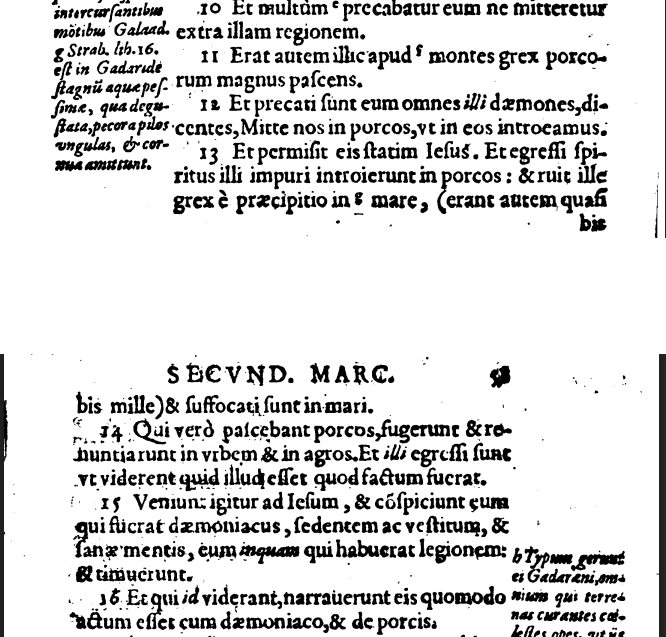
Screenshots taken from the Nouum Testamentum of Théodore de Bèze, (1519-1605) ( Londini : Thomas Vautrollerius, typographus, 1587 )
Accessed from the Post Reformation Digital Library
JUMP To Dictionary Free Interactive Text
Here is a text only version.
EVANGELIUM MARCUM
CAPUT V
10 Et deprecabatur eum multum, ne se expelleret extra regionem.
11 Erat autem ibi circa montem grex porcorum magnus pascens
12 et deprecati sunt eum dicentes Mitte nos in porcos, ut in eos introeamus.
13 Et concessit eis. Et exeuntes spiritus immundi introierunt in porcos. Et magno impetu grex ruit per praecipitium in mare, ad duo milia, et suffocabantur in mari.
14 Qui autem pascebant eos, fugerunt et nuntiaverunt in civitatem et in agros et egressi sunt videre quid esset facti.
15 Et veniunt ad Iesum et vident illum, qui a daemonio vexabatur, sedentem, vestitum et sanae mentis, eum qui legionem habuerat, et timuerunt.
16 Et qui viderant, narraverunt illis qualiter factum esset ei, qui daemonium habuerat, et de porcis.
How To Read the Interactive Text Without a Dictionary
On a Computer:
Hover over a word to get all its possible parts of speech, declensions, or conjugations.
On a Tablet:
'TAP' the word to see the definition, and to remove the 'definition box' you simply 'TAP' anywhere to the side.
How To Read the Interactive Text
'Tap' the word to see the definition and to remove the 'definition box' you simply 'tap' antwhere to the side.
EVANGELIUM MARCUM
CAPUT V
10 Et deprecabatur eum multum, ne se expelleret extra regionem.
You Need to be at least a Trial Member to Access the Interactive Dictionary
11 Erat autem ibi circa montem grex porcorum magnus pascens
12 et deprecati sunt eum dicentes Mitte nos in porcos, ut in eos introeamus.
13 Et concessit eis. Et exeuntes spiritus immundi introierunt in porcos. Et magno impetu grex ruit per praecipitium in mare, ad duo milia, et suffocabantur in mari.
14 Qui autem pascebant eos, fugerunt et nuntiaverunt in civitatem et in agros et egressi sunt videre quid esset facti.
15 Et veniunt ad Iesum et vident illum, qui a daemonio vexabatur, sedentem, vestitum et sanae mentis, eum qui legionem habuerat, et timuerunt.
16 Et qui viderant, narraverunt illis qualiter factum esset ei, qui daemonium habuerat, et de porcis.
Recent Comments