
fretum - dire straits
The Latin noun fretum refers to a strait or narrow sea channel, often turbulent or dangerous, and is typically used to describe maritime passages between landmasses. Its semantic field includes both geographical and metaphorical dimensions, making it a versatile term in classical literature.
In epic poetry, fretum frequently appears in contexts of travel, exile, or divine intervention. Virgil uses fretum in the Aeneid to evoke the perilous waters Aeneas must cross, such as the Sicilian straits, where Scylla and Charybdis threaten sailors. Here, fretum is not merely a physical obstacle but a symbol of fate and divine challenge. The word’s phonetic texture—short, sharp, and forceful—mirrors the violence of the sea it describes.
In prose, Caesar employs fretum more pragmatically, as in his Commentarii de Bello Gallico, when describing the crossing of the English Channel. The term serves a logistical function, marking a boundary between Roman and foreign territory. Cicero, though less concerned with geography, occasionally uses fretum metaphorically to describe political turbulence or rhetorical tension, as in fretum contentionis—a strait of conflict—suggesting a narrowing of discourse into a volatile exchange.
Poets like Ovid and Lucan exploit fretum for its dramatic potential. In Ovid’s Metamorphoses, transformations often occur near or across fretum, emphasising liminality and change. Lucan’s Pharsalia uses fretum to underscore the chaos of civil war, where the sea becomes a mirror of internal strife.
Thus, fretum in classical Latin is more than a topographical term; it is a literary device that conveys danger, transition, and the tension between worlds—whether geographic, emotional, or political. Its recurrence across genres attests to its evocative power and adaptability in the Latin lexicon.
The images for these posts on Mark's gospel
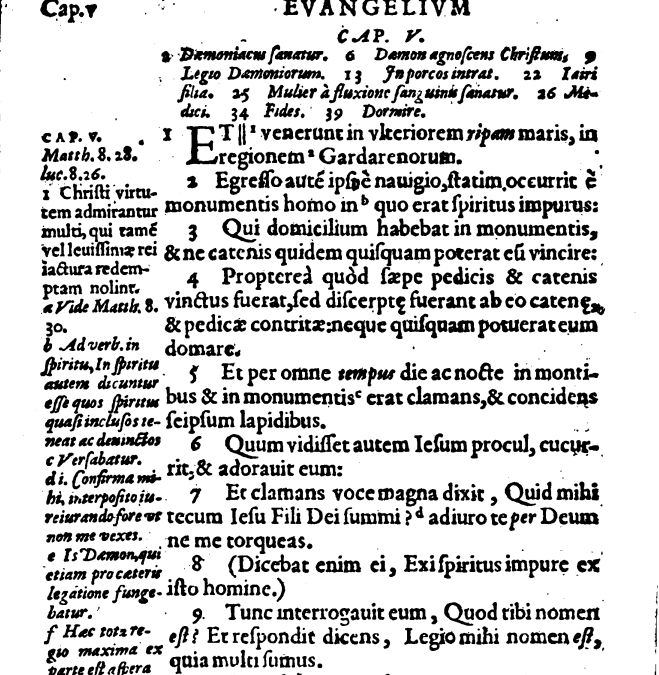
Screenshots taken from the Nouum Testamentum of Théodore de Bèze, (1519-1605) ( Londini : Thomas Vautrollerius, typographus, 1587 )
Accessed from the Post Reformation Digital Library
JUMP To Dictionary Free Interactive Text
Here is a text only version.
EVANGELIUM MARCUM
CAPUT V
1 Et venerunt trans fretum maris in regionem Gerasenorum.
2 Et exeunte eo de navi, statim occurrit ei de monumentis homo in spiritu immundo,
3 qui domicilium habebat in monumentis et neque catenis iam quisquam eum poterat ligare,
4 quoniam saepe compedibus et catenis vinctus dirupisset catenas et compedes comminuisset, et nemo poterat eum domare
5 et semper nocte ac die in monumentis et in montibus erat clamans et concidens se lapidibus.
6 Et videns Iesum a longe cucurrit et adoravit eum
7 et clamans voce magna dicit Quid mihi et tibi, Iesu, fili Dei Altissimi? Adiuro te per Deum, ne me torqueas.
8 Dicebat enim illi Exi, spiritus immunde, ab homine.
9 Et interrogabat eum Quod tibi nomen est? Et dicit ei Legio nomen mihi est, quia multi sumus.
How To Read the Interactive Text Without a Dictionary
On a Computer:
Hover over a word to get all its possible parts of speech, declensions, or conjugations.
On a Tablet:
'TAP' the word to see the definition, and to remove the 'definition box' you simply 'TAP' anywhere to the side.
How To Read the Interactive Text
'Tap' the word to see the definition and to remove the 'definition box' you simply 'tap' antwhere to the side.
EVANGELIUM MARCUM
CAPUT V
1 Et venerunt trans fretum maris in regionem Gerasenorum.
You Need to be at least a Trial Member to Access the Interactive Dictionary
2 Et exeunte eo de navi, statim occurrit ei de monumentis homo in spiritu immundo,
3 qui domicilium habebat in monumentis et neque catenis iam quisquam eum poterat ligare,
4 quoniam saepe compedibus et catenis vinctus dirupisset catenas et compedes comminuisset, et nemo poterat eum domare
5 et semper nocte ac die in monumentis et in montibus erat clamans et concidens se lapidibus.
6 Et videns Iesum a longe cucurrit et adoravit eum
7 et clamans voce magna dicit Quid mihi et tibi, Iesu, fili Dei Altissimi? Adiuro te per Deum, ne me torqueas.
8 Dicebat enim illi Exi, spiritus immunde, ab homine.
9 Et interrogabat eum Quod tibi nomen est? Et dicit ei Legio nomen mihi est, quia multi sumus.
Recent Comments