
contra - opposition, critique, and deliberate resistance
The Latin preposition and adverb contra—meaning ‘against’, ‘opposite’, or ‘in return’—is a word of confrontation, spatial and ideological. Compact yet loaded, contra threads through Latin literature with rhetorical energy, used to define opposition, critique, or deliberate resistance. It operates both in physical contexts and metaphorical realms, drawing lines where conflict brews or contrast is sharp.
In epic poetry, contra frequently appears in martial descriptions. Virgil’s warriors fight contra hostem with deliberate intensity; the word establishes not just direction, but animosity. It marks the front lines where intention meets obstacle. In these settings, contra is never neutral—it signals defiance. Its placement within hexameter verse adds emphasis, giving weight to opposition both literal and symbolic.
Cicero uses contra with surgical precision in his speeches. In in Catilinam, his denunciations hinge on phrases like contra rem publicam to stress threats to state stability. Here, contra becomes a pillar in his persuasive scaffolding, underscoring legal and moral dissent. The rhythm of his argument often rests on this word to clarify divergence between justice and corruption.
Satirists such as Juvenal deploy contra to puncture hypocrisy. In describing behavior contra mores, the word brings normative force: the target is not just out of step, but in violation. The choice of contra heightens indignation, situating ethical critique in pointed contrast to expected conduct.
In historiography, Tacitus exploits contra to explore political tension. Factions rise contra imperium, characters act contra spem, decisions are made contra consilium. These expressions expose gaps between intent and outcome, authority and dissent. The adverb becomes an interpretive tool: not just recording actions, but framing consequences.
Poets also explore emotional terrain through contra. Ovid uses contra in relational discord, contrasting love with betrayal, longing with denial. In this context, contra structures emotional dualities, showing feeling as force met by resistance.
Thus contra serves as more than a marker of direction—it is a pivot of opposition, conflict, and clarity throughout Latin literature.
The images for these posts on Mark's gospel
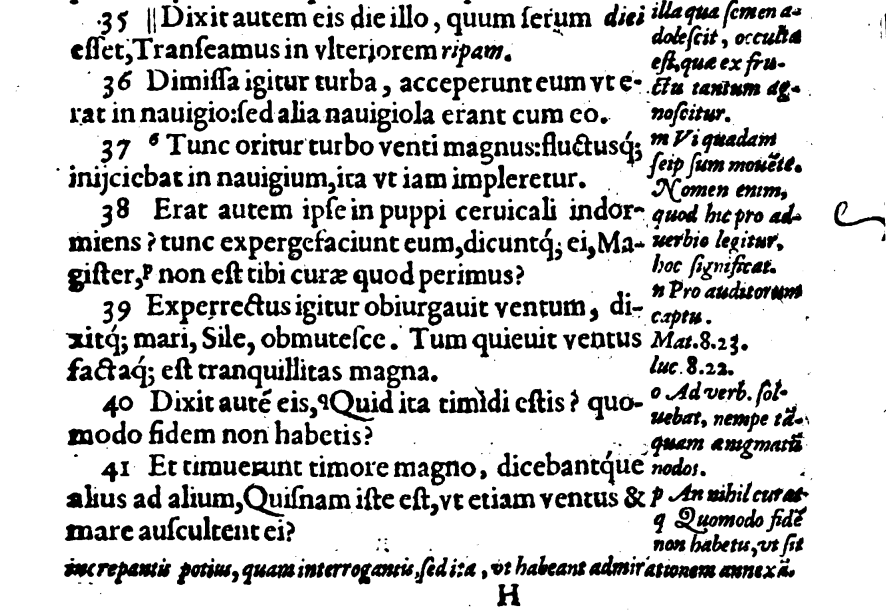
Screenshots taken from the Nouum Testamentum of Théodore de Bèze, (1519-1605) ( Londini : Thomas Vautrollerius, typographus, 1587 )
Accessed from the Post Reformation Digital Library
Red and Green Vocab
The words in red and green are found among the 3057 Most Common Words in the Classical Latin texts that we will explore on CentumVerba.com and are essential to your understanding of the texts of Caesar, Vergil and Cicero. The green words appear frequently (at least five times) among Vergil's Aeneid (books I-VI), Caesar de bello Gallico (books I-V) and in Cicero's works - in Catilinam (books I-IV), de lege Manilia (also known as de Imperio Cn. Pompei), and pro Achia. These works constituted the curriculum for Latin over 4 years in American High Schools at the start of the 20th Century. The bulk of my information is taken from The Vocabulary of High School Latin by Gonzalez Lodge. I have added to these 2000 words from varioius other sources to compile my own list of The 3057 Most Common Latin Words.
The black words do not appear frequently in Classical Latin.
The red words are the first occurrences of these words in this author and this word will appear as green the next time you encounter it.
If you are serious about building your vocabulary then you should learn the red words as they occur and you should already know the green ones!
I have provided a FLASHCARD set to help - see below.
How To Read the Interactive Text
To Read the Interactive Text Below Without a Dictionary-
On a Computer: you hover over a word and get all its possible parts of speech; declensions; and conjugations.
On a Tablet: 'Tap' the word to see the definition, and to remove the 'definition box' you simply 'Tap' anywhere to the side.
Red and Green Vocab
The words in red and green are found among the 3057 Most Common Words in the Classical Latin texts that we will explore on CentumVerba.com and are essential to your understanding of the texts of Caesar, Vergil and Cicero. The green words appear frequently (at least five times) among Vergil's Aeneid (books I-VI), Caesar de bello Gallico (books I-V) and in Cicero's works - in Catilinam (books I-IV), de lege Manilia (also known as de Imperio Cn. Pompei), and pro Achia. These works constituted the curriculum for Latin over 4 years in American High Schools at the start of the 20th Century. The bulk of my information is taken from The Vocabulary of High School Latin by Gonzalez Lodge. I have added to these 2000 words from varioius other sources to compile my own list of The 3057 Most Common Latin Words.
The black words do not appear frequently in Classical Latin.
The red words are the first occurrences of these words in this author and this word will appear as green the next time you encounter it.
If you are serious about building your vocabulary then you should learn the red words as they occur and you should already know the green ones!
I have provided a FLASHCARD set to help - see below.
How To Read the Interactive Text
To Read the Interactive Text Below Without a Dictionary-
On a Phone or Tablet: ''TAP' the word to see the definition, and to remove the 'definition box' you simply 'TAP' anywhere to the side.
INTERACTIVE DICTIONARY FREE TEXT
Caput IV
35 Et ait illis illa die, cum sero esset factum Transeamus contra.
You Need to be at least a Trial Member to Access the Interactive Dictionary
36 Et dimittentes turbam, assumunt eum, ut erat in navi et aliae naves erant cum illo.
37 Et exoritur procella magna venti, et fluctus se mittebant in navem, ita ut iam impleretur navis.
38 Et erat ipse in puppi supra cervical dormiens et excitant eum et dicunt ei Magister, non ad te pertinet quia perimus?
39 Et exsurgens comminatus est vento et dixit mari Tace, obmutesce! Et cessavit ventus, et facta est tranquillitas magna.
40 Et ait illis Quid timidi estis? Necdum habetis fidem?
41 Et timuerunt magno timore et dicebant ad alterutrum Quis putas est iste, quia et ventus et mare oboediunt ei?
I have prepared online Flashcards at CRAM.com to make learning the vocabulary much easier. I have no financial gain as the app is FREE to use.
I have created a stack of the 19 new words in this passage.
YOU NEED TO SIGN UP AS A TRIAL MEMBER TO ACCESS THE FLASHCARDS
Here is the link to the FLASHCARDS
USING THE FLASHCARD APP:
To make the most of the online Flashcards use the "Click or use spacebar to begin" and the Latin word should appear. (The 'Shuffle' button will take the cards out of alphabetical order.) Type 'H' to get the conjugation / declension of the word if you want to see it. 'H' takes tyou back to the word. Click 'See Answer' or use the Spacebar to see the English.
If you were correct or close enough then select "I was right" or else "I was wrong". After you have completed the set it will start again but it will only display the ones you got wrong.
Continue through this process to learn all the words. I hope this is helpful!
Recent Comments