
animus - it's all in the mind
In Latin, animus is a rich and multifaceted noun meaning 'mind', 'spirit', 'soul', or 'intellect'. It belongs to the second declension and is masculine: animus, animi, animo, animum, animo in the singular; animi, animorum, animis, animos, animis in the plural. Etymologically, animus derives from the Proto-Indo-European root meaning 'to breathe', linking it to the concept of life force or vital energy. It is closely related to anima, which often refers to the breath or soul in a more passive or emotional sense, while animus conveys active mental and moral faculties.
In classical literature, animus appears in a wide range of contexts. Cicero frequently uses it in philosophical works to denote reason, conscience, and moral judgment. In De Officiis, he writes of the importance of a noble animus in public service, equating it with virtue and integrity. Similarly, in Tusculan Disputations, animus is the seat of rational thought and the immortal part of the human being.
In epic poetry, animus often reflects emotional states or inner resolve. Virgil’s Aeneid uses animus to describe both the courage of warriors and the turmoil of grief. For example, Aeneas’s animus is tested repeatedly as he balances duty and personal loss. The word thus becomes a lens through which readers understand character motivation and psychological depth.
Roman dramatists like Plautus and Terence use animus in everyday speech to express feelings, intentions, or moods. Phrases such as bono animo esse ('to be of good spirit') or animus est in dubio ('the mind is in doubt') show its flexibility in colloquial Latin.
In legal and rhetorical contexts, animus denotes intent or disposition. Terms like animus nocendi ('intent to harm') and animus furandi ('intent to steal') appear in Roman law and persist in modern legal language.
The legacy of animus endures in modern languages. English words like 'unanimous', 'magnanimous', and 'pusillanimous' all derive from it, reflecting qualities of spirit and character. In psychology, especially in Jungian theory, animus represents the masculine aspect of the female psyche, paired with anima.
Ultimately, animus in Latin literature is not just a word—it is a window into Roman thought, encompassing intellect, emotion, will, and identity. It captures the essence of what it meant to be human in the Roman worldview.
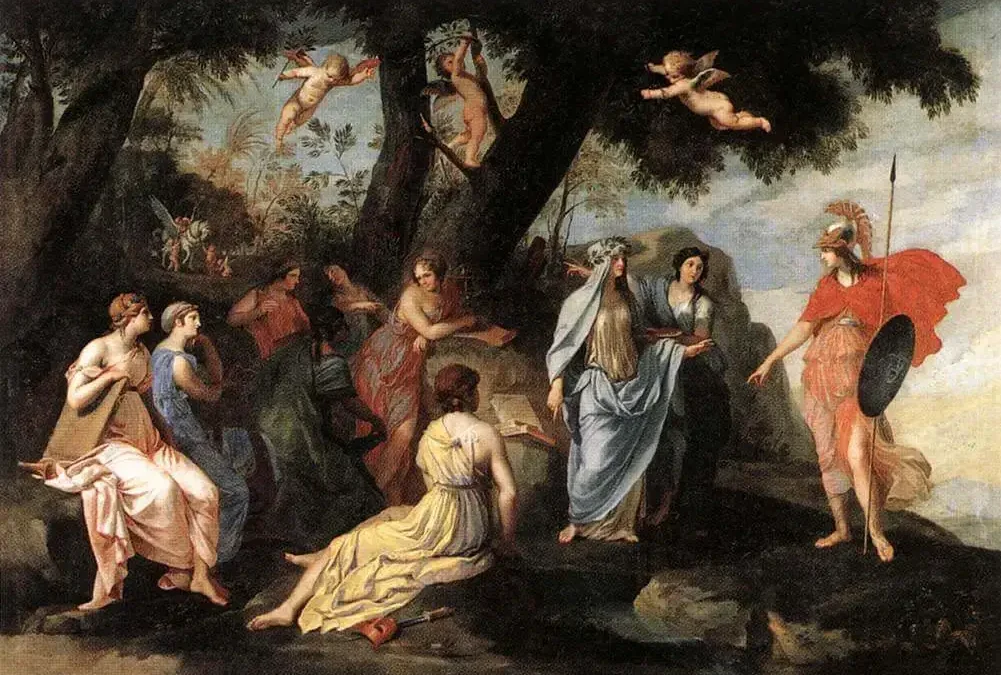
Today's Artwork: Minerva and the muses
Painted by: Jacques Stella (1596–1657)
Oil on canvas
Source: Louvre Musuem Paris
Here is a text only version. (See below for an interactive version)
17 Dum tamen ea geruntur, Argonautae, qui ad mare relicti erant, animo anxio reditum Iasonis exspectabant; bene enim intellegebant id negotium summi esse periculi. Postquam igitur ad occasum solis frustra exspectaverant, de eius salute desperare coeperunt nec dubitabant quin aliqui casus accidisset. Quae cum ita essent, maturandum sibi censuerunt, ut auxilium duci ferrent, et dum proficisci parant lumen quoddam subito conspiciunt mirum in modum inter silvas refulgens.
Magno opere mirati quae causa esset eius rei ad locum concurrunt. Quo cum venissent, Iasoni et Medeae advenientibus io occurrerunt et vellus aureum luminis eius causam esse cognoverunt. Omni timore sublato, magno cum gaudio ducem suum exceperunt et dis gratias libenter rettulerunt quod res ita feliciter evenisset.
How To Read the Interactive Text
To Read the Interactive Text Below Without a Dictionary-
On a Computer: you hover over a word and get all the possible parts of speech; declensions; and conjugations of every word.
How To Read the Interactive Text
To Read the Interactive Text Below Without a Dictionary-
On a Phone or Tablet: don't 'hover' -'tap' the word. To remove the 'definition box' you 'tap' to the side of the text box.
INTERACTIVE DICTIONARY FREE TEXT
17 Dum tamen ea geruntur, Argonautae, qui ad mare relicti erant, animo anxio reditum Iasonis exspectabant;
You Need to be a Member to Access the Interactive Dictionary
bene enim intellegebant id negotium summi esse periculi.
Postquam igitur ad occasum solis frustra exspectaverant, de eius salute desperare coeperunt nec dubitabant quin aliqui casus accidisset.
Quae cum ita essent, maturandum sibi censuerunt, ut auxilium duci ferrent, et dum proficisci parant lumen quoddam subito conspiciunt mirum in modum inter silvas refulgens.
Magno opere mirati quae causa esset eius rei ad locum concurrunt.
Quo cum venissent, Iasoni et Medeae advenientibus io occurrerunt et vellus aureum luminis eius causam esse cognoverunt.
Omni timore sublato, magno cum gaudio ducem suum exceperunt et dis gratias libenter rettulerunt quod res ita feliciter evenisset.
Recent Comments