
gero - bear it or wear it!
In Latin, gero is a third-conjugation verb meaning 'to carry', 'to bear', 'to wear', or more broadly, 'to conduct', 'to manage', or 'to wage'. Its principal parts are gero, gerere, gessi, gestum, and it is highly versatile, appearing across genres from epic poetry to legal texts. The root is linked to Proto-Italic gezō, and its semantic range reflects both physical and abstract actions.
In military contexts, gero is famously used in the phrase bellum gerere—'to wage war'. Caesar employs this construction frequently in Commentarii de Bello Gallico, where Roman generals bellum gerunt against Gallic tribes. The verb conveys not just physical combat but strategic leadership and sustained engagement.
In civic and political literature, gero denotes the exercise of office or responsibility. Cicero uses rem publicam gerere to mean 'to manage the state', emphasizing the moral and administrative duties of magistrates. Similarly, munus gerere refers to performing official duties, and dictaturam gerere indicates holding the office of dictator.
In poetic and dramatic texts, gero can describe wearing garments or adopting roles. In Virgil’s Aeneid, characters arma gerunt—they bear arms or wear armor—signifying readiness for battle. Ovid uses gerere in transformation scenes, where figures formam gerunt—they take on new shapes or appearances.
The verb also appears reflexively as se gerere, meaning 'to conduct oneself' or 'to behave'. This usage is common in moral and philosophical writings, where authors discuss how one ought to se bene gerere—to behave well or honorably.
Derived nouns like gestum (a deed or exploit) and gestio (eager desire or emotional display) reflect the verb’s evolution into expressions of action and feeling. English inherits gero through words like 'gesture', 'gestation', and 'digest', all rooted in the idea of carrying or conducting something internally or externally.
Ultimately, gero is a dynamic and foundational verb in Latin, encapsulating the Roman ideals of action, duty, and presence—whether on the battlefield, in the forum, or within the self. Its flexibility and depth make it a cornerstone of Latin expression.
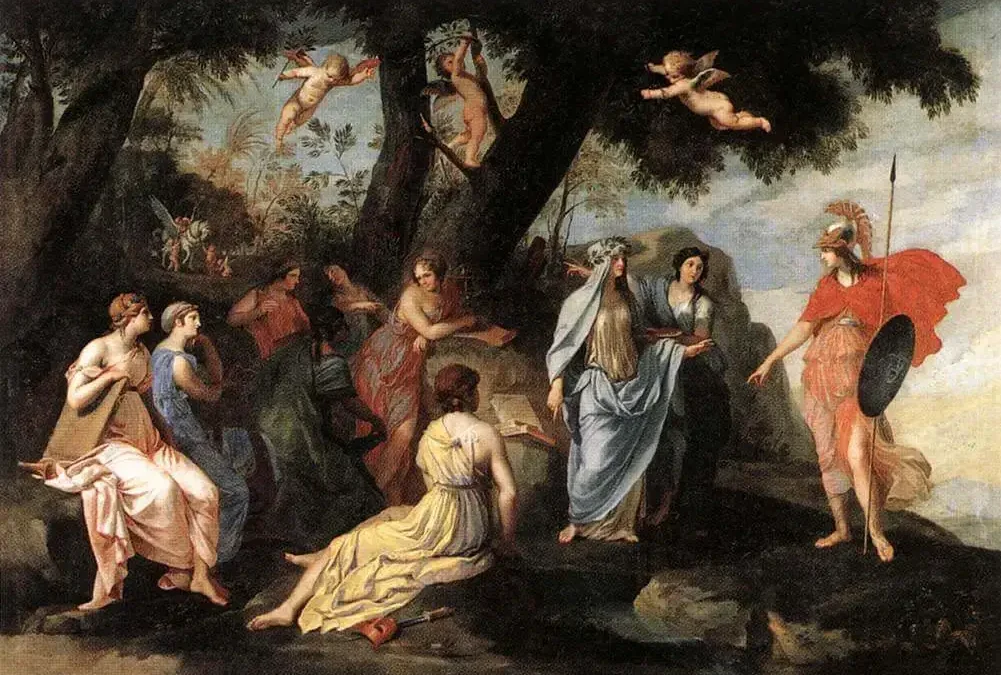
Today's Artwork: Minerva and the muses
Painted by: Jacques Stella (1596–1657) Oil on canvas
Source: Louvre Musuem Paris
gero - bear it or wear it!
The Latin noun dies (genitive diei) belongs to the rare fifth declension and denotes the period of daylight or a calendar day. Although most fifth-declension nouns are feminine, dies can be either masculine or feminine: classical authors often treat it as masculine when referring to any generic day, but as feminine when speaking of a fixed date or a festive occasion. Its full paradigm runs: nominative dies, vocative dies, accusative diem, genitive diei, dative diei, ablative die; plural nominative dies, vocative dies, accusative dies, genitive dierum, dative and ablative diebus.
Beyond its basic sense of ’day’, dies carries temporal nuances in prose and poetry. Cicero uses dies to mark politically or legally significant days—dies fasti (days on which legal business is permitted) versus dies nefasti (days of religious prohibition). In Virgil’s epic, dies often acquires somber or ominous undertones: the coming dies of battle or divine judgment. Poets might even lengthen the vowel or shift accent to satisfy metrical constraints, treating dies as two syllables (’di-ēs’) when necessary.
The Romans also paired dies with adjectives and prepositions to form set expressions. Dies natalis named birthdays or anniversaries, later giving us our word ’nativity’. Dies solis designated Sunday in the early Imperial calendar. Dies irae, the famous medieval hymn, invokes the apocalyptic day of wrath. Military and civic life revolved around marking dies on fasti calendars carved into stone or painted on wood—so that every dies carried both civic rhythm and religious meaning.
From dies sprang a host of English derivatives via Latin adjectival and noun forms. ’Diurnal’ (pertaining to the day) and ’diary’ (a day-by-day journal) both derive from Latin diurnus and diarium, themselves rooted in dies. ’Meridian’ (midday) comes from meridies, literally ’mid-day’. Dies even features in legalese: dies a quo (the day from which) and dies ad quem (the day to which) define time limits in contracts.
In the Romance languages, dies evolved into forms such as Spanish ’día’, Portuguese ’dia’, Romanian ’zi’, and Occitan ’dia’, showing how dies has illuminated both our calendars and our vocabularies for two millennia.
Today's Artwork: Minerva and the muses
Painted by: Jacques Stella (1596–1657) Oil on canvas
Source: Louvre Musuem Paris
Here is a text only version. (See below for an interactive version)
17 Dum tamen ea geruntur, Argonautae, qui ad mare relicti erant, animo anxio reditum Iasonis exspectabant; bene enim intellegebant id negotium summi esse periculi. Postquam igitur ad occasum solis frustra exspectaverant, de eius salute desperare coeperunt nec dubitabant quin aliqui casus accidisset. Quae cum ita essent, maturandum sibi censuerunt, ut auxilium duci ferrent, et dum proficisci parant lumen quoddam subito conspiciunt mirum in modum inter silvas refulgens.
Magno opere mirati quae causa esset eius rei ad locum concurrunt. Quo cum venissent, Iasoni et Medeae advenientibus io occurrerunt et vellus aureum luminis eius causam esse cognoverunt. Omni timore sublato, magno cum gaudio ducem suum exceperunt et dis gratias libenter rettulerunt quod res ita feliciter evenisset.
Red and Green Vocab
The words in red and green are found among the 3057 Most Common Words in the Classical Latin texts that we will explore on CentumVerba.com and are essential to your understanding of the texts of Caesar, Vergil and Cicero. The green words appear frequently (at least five times) among Vergil's Aeneid (books I-VI), Caesar de bello Gallico (books I-V) and in Cicero's works - in Catilinam (books I-IV), de lege Manilia (also known as de Imperio Cn. Pompei), and pro Achia. These works constituted the curriculum for Latin over 4 years in American High Schools at the start of the 20th Century. The bulk of my information is taken from The Vocabulary of High School Latin by Gonzalez Lodge. I have added to these 2000 words from varioius other sources to compile my own list of The 3057 Most Common Latin Words.
The black words do not appear frequently in Classical Latin.
The red words are the first occurrences of these words in this author and this word will appear as green the next time you encounter it.
If you are serious about building your vocabulary then you should learn the red words as they occur and you should already know the green ones!
I have provided a FLASHCARD set to help - see below.
How To Read the Interactive Text
To Read the Interactive Text Below Without a Dictionary-
On a Computer: you hover over a word and get all the possible parts of speech; declensions; and conjugations of every word.
Red and Green Vocab
The words in red and green are found among the 3057 Most Common Words in the Classical Latin texts that we will explore on CentumVerba.com and are essential to your understanding of the texts of Caesar, Vergil and Cicero. The green words appear frequently (at least five times) among Vergil's Aeneid (books I-VI), Caesar de bello Gallico (books I-V) and in Cicero's works - in Catilinam (books I-IV), de lege Manilia (also known as de Imperio Cn. Pompei), and pro Achia. These works constituted the curriculum for Latin over 4 years in American High Schools at the start of the 20th Century. The bulk of my information is taken from The Vocabulary of High School Latin by Gonzalez Lodge. I have added to these 2000 words from varioius other sources to compile my own list of The 3057 Most Common Latin Words.
The black words do not appear frequently in Classical Latin.
The red words are the first occurrences of these words in this author and this word will appear as green the next time you encounter it.
If you are serious about building your vocabulary then you should learn the red words as they occur and you should already know the green ones!
I have provided a FLASHCARD set to help - see below.
How To Read the Interactive Text
To Read the Interactive Text Below Without a Dictionary-
On a Phone or Tablet: don't 'hover' -'tap' the word. To remove the 'definition box' you 'tap' to the side of the text box.
INTERACTIVE DICTIONARY FREE TEXT
17 Dum tamen ea geruntur, Argonautae, qui ad mare relicti erant, animo anxio reditum Iasonis exspectabant;
You Need to be a Member to Access the Interactive Dictionary
quo in loco Medea vellus celatum esse demonstravit.
Eo cum venissent Iason in terram egressus est et sociis ad mare relictis qui praesidio navi essent ipse cum Medea in silvas viam cepit.
Pauca millia passuum per silvam progressus vellus quod quaerebat ex arbore suspensum vidit.
Id tamen auferre res erat summae difficultatis; non modo enim locus ipse egregie et natura et arte munitus erat, sed etiam draco quidam specie terribili arborem custodiebat.
At Medea, quae, ut supra demonstravimus, medicinae summam scientiam habuit, ramum quem ex arbore proxima deripuerat veneno infecit.
Hoc facto ad locum appropinquavit et draconem, qui faucibus apertis adventum exspectabat, veneno sparsit.
Proinde, dum draco somno oppressus dormit, Iason vellus aureum ex arbore deripuit et cum Medea quam celerrime pedem rettulit.
INTERACTIVE DICTIONARY FREE TEXT
16 Postridie eius diei Iason cum sociis suis orta luce navem deduxit et tempestatem idoneam nacti ad eum locum remis contenderunt, You Need to be a Member to Access the Interactive Dictionary
quo in loco Medea vellus celatum esse demonstravit.
Eo cum venissent Iason in terram egressus est et sociis ad mare relictis qui praesidio navi essent ipse cum Medea in silvas viam cepit.
Pauca millia passuum per silvam progressus vellus quod quaerebat ex arbore suspensum vidit.
Id tamen auferre res erat summae difficultatis; non modo enim locus ipse egregie et natura et arte munitus erat, sed etiam draco quidam specie terribili arborem custodiebat.
At Medea, quae, ut supra demonstravimus, medicinae summam scientiam habuit, ramum quem ex arbore proxima deripuerat veneno infecit.
Hoc facto ad locum appropinquavit et draconem, qui faucibus apertis adventum exspectabat, veneno sparsit.
Proinde, dum draco somno oppressus dormit, Iason vellus aureum ex arbore deripuit et cum Medea quam celerrime pedem rettulit.
I have prepared online Flashcards at CRAM.com to make learning the vocabulary much easier. I have no financial gain from you using the app as it is FREE to use.
I have created a stack of the 5 new words in this passage.
YOU NEED TO SIGN UP AS A TRIAL MEMBER TO ACCESS THE FLASHCARDS
Here is the link to the FLASHCARDS
USING THE FLASHCARD APP:
To make the most of the online Flashcards use the "Click or use spacebar to begin" and the Latin word should appear. (The 'Shuffle' button will take the cards out of alphabetical order.) Type 'H' to get the conjugation / declension of the word if you want to see it. 'H' takes tyou back to the word. Click 'See Answer' or use the Spacebar to see the English.
If you were correct or close enough then select "I was right" or else "I was wrong". After you have completed the set it will start again but it will only display the ones you got wrong.
Continue through this process to learn all the words. I hope this is helpful!
Recent Comments