
lux
The Latin noun lux (gen. lucis) belongs to the third declension and means ‘light,’ ‘daylight,’ or ‘brightness,’ both in a physical and metaphorical sense. As a fundamental concept in Roman literature, philosophy, and religion, lux is a recurring theme in poetic, rhetorical, and technical texts.
In Virgil’s Aeneid, lux often signifies divine favour or destiny illuminating Aeneas’s path (e.g. ‘prima et tellure suo…lux’); Ovid employs it to contrast the harshness of exile with the hope of return (‘lux in tenebris’). Cicero uses lux metaphorically in philosophical works to describe the enlightenment of reason against the ‘darkness’ of ignorance.
Beyond vocabulary, lux shaped cultural and philosophical metaphors. During the Enlightenment, ‘light’ became a symbol of reason and knowledge, echoing Latin’s metaphorical use of lux as clarity and truth. This symbolism persists in mottos like Lux et Veritas (‘Light and Truth’) and Post tenebras lux (‘After darkness, light’), used by universities and reform movements alike.
The Latin word lux has had a luminous impact on many modern languages—especially English, French, Spanish, and Italian—through both direct descendants and metaphorical extensions.
In English, lux gave rise to a family of words rooted in the Latin verb lucere (‘to shine’):
- Lucid – clear or easy to understand, originally ‘full of light.’
- Elucidate – to make something clear, literally ‘to bring into the light.’
- Translucent – allowing light to pass through diffusely.
- Lucifer – originally ‘light-bringer,’ referring to the morning star before its theological shift.
- Illuminate, luminous, and luminary also trace back to lux and its related forms.
Lux also appears in mottos and institutional devices: Yale University’s ‘Lux et Veritas’ (‘Light and Truth’), various civic arms bearing a shining torch, and architectural references to ‘lux’ in daylighting design. Across genres and millennia, lux remains more than a word: it’s a symbol of vision, knowledge, and hope—an enduring testament to the power of illumination in human thought.
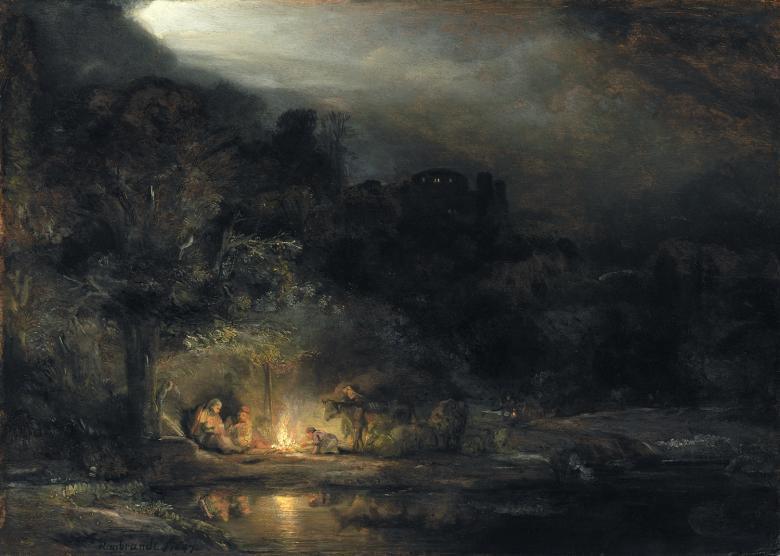
Today's Artwork: Landscape with the Rest on the Flight into Egypt
Painted by: Rembrandt van Rijn (1606-1669)
Oil on wood panel
Source: National Gallery of Ireland
Here is a text only version. (See below for an interactive version)
16 Postridie eius diei Iason cum sociis suis orta luce navem deduxit et tempestatem idoneam nacti ad eum locum remis contenderunt, quo in loco Medea vellus celatum esse demonstravit. Eo cum venissent Iason in terram egressus est et sociis ad mare relictis qui praesidio navi essent ipse cum Medea in silvas viam cepit. Pauca millia passuum per silvam progressus vellus quod quaerebat ex arbore suspensum vidit. Id tamen auferre res erat summae difficultatis; non modo enim locus ipse egregie et natura et arte munitus erat, sed etiam draco quidam specie terribili arborem custodiebat.
At Medea, quae, ut supra demonstravimus, medicinae summam scientiam habuit, ramum quem ex arbore proxima deripuerat veneno infecit. Hoc facto ad locum appropinquavit et draconem, qui faucibus apertis adventum exspectabat, veneno sparsit. Proinde, dum draco somno oppressus dormit, Iason vellus aureum ex arbore deripuit et cum Medea quam celerrime pedem rettulit.
How To Read the Interactive Text
To Read the Interactive Text Below Without a Dictionary-
On a Computer: you hover over a word and get all the possible parts of speech; declensions; and conjugations of every word.
How To Read the Interactive Text
To Read the Interactive Text Below Without a Dictionary-
On a Phone or Tablet: don't 'hover' -'tap' the word. To remove the 'definition box' you 'tap' to the side of the text box.
INTERACTIVE DICTIONARY FREE TEXT
16 Postridie eius diei Iason cum sociis suis orta luce navem deduxit et tempestatem idoneam nacti ad eum locum remis contenderunt,
You Need to be a Member to Access the Interactive Dictionary
quo in loco Medea vellus celatum esse demonstravit.
Eo cum venissent Iason in terram egressus est et sociis ad mare relictis qui praesidio navi essent ipse cum Medea in silvas viam cepit.
Pauca millia passuum per silvam progressus vellus quod quaerebat ex arbore suspensum vidit.
Id tamen auferre res erat summae difficultatis; non modo enim locus ipse egregie et natura et arte munitus erat, sed etiam draco quidam specie terribili arborem custodiebat.
At Medea, quae, ut supra demonstravimus, medicinae summam scientiam habuit, ramum quem ex arbore proxima deripuerat veneno infecit.
Hoc facto ad locum appropinquavit et draconem, qui faucibus apertis adventum exspectabat, veneno sparsit.
Proinde, dum draco somno oppressus dormit, Iason vellus aureum ex arbore deripuit et cum Medea quam celerrime pedem rettulit.
Recent Comments