
ante - Let's up it!
The Latin preposition ante (meaning 'before' or 'in front of') is fundamental in both spatial and temporal contexts. Derived from an ancient Indo-European root signifying precedence, ante plays a crucial role in Classical Latin prose, particularly in the works of Cicero.
In spatial usage, ante governs the accusative case to indicate position or movement. Cicero employs it in legal and rhetorical contexts, often referring to persons standing 'before' a judge or audience. In courtroom speeches, phrases like 'ante tribunal' ('before the tribunal') reinforce the imagery of legal confrontation and deliberation.
Beyond physical placement, ante is frequently used in temporal constructions to denote sequence. Cicero's philosophical and political texts often discuss historical events, laws, and societal customs within a framework of precedence, where ante clarifies chronological relationships. A common formulation, such as 'ante hoc tempus' ('before this time'), reflects Cicero’s meticulous structuring of arguments—linking past and present with precision.
In rhetorical strategy, Cicero leverages ante to contrast past conditions with contemporary challenges. In Pro Caelio, for instance, he juxtaposes earlier moral standards with modern decadence, using constructions like 'antea virtus vigebat' ('before, virtue thrived'). This positioning of ante serves a persuasive function—inviting listeners to compare and evaluate the decline of Roman values.
Furthermore, ante appears in fixed phrases and expressions. Cicero uses 'ante omnia' ('before all things') to emphasize priorities in legal and philosophical discourse. Likewise, phrases such as 'ante oculos' ('before the eyes') often appear in oratory to direct audience focus toward vivid mental imagery.
The enduring influence of ante extends beyond Latin into modern Romance languages, where its descendants—such as French avant and Italian prima—preserve its sense of anteriority. Even in English, words like 'antecedent' and 'antechamber' reflect its legacy.
In Cicero’s works, ante is more than a grammatical connector—it is an instrument of argumentation, timekeeping, and persuasion. Whether guiding legal reasoning or reinforcing moral contrasts, its presence consistently shapes meaning with clarity and force. As a rhetorical device, it ensures that what came before is never forgotten, making history and precedent integral to every discourse Cicero crafts.
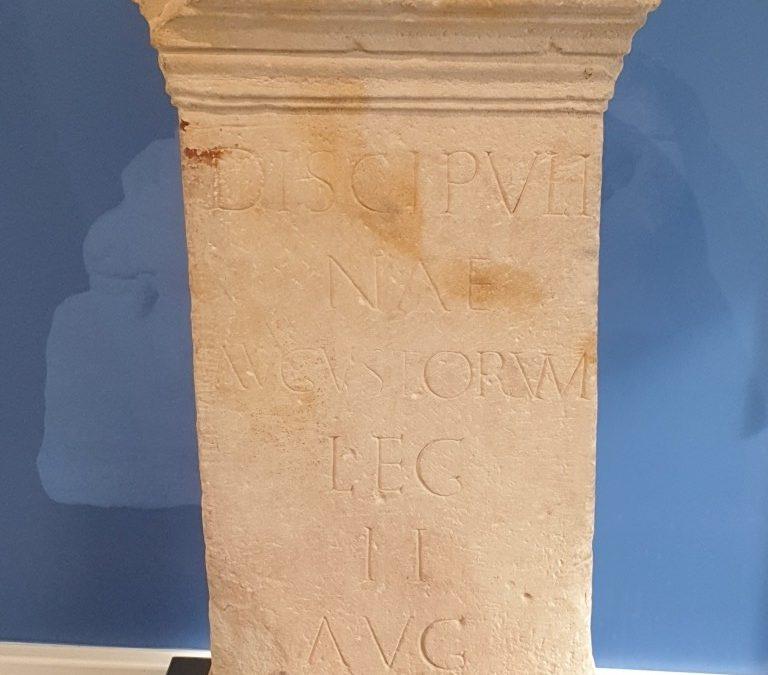
Today's Image: Altar Stone of Legio Secundae Augusta – The Second Augustan Legion
Source: My own Photo
Here is a text only version
venisti paulo ante in senatum. quis te ex hac tanta frequentia, tot ex tuis amicis ac necessariis salutavit? si hoc post hominum memoriam contigit nemini, vocis exspectas contumeliam, cum sis gravissimo iudicio taciturnitatis oppressus? quid, quod adventu tuo ista subsellia vacuefacta sunt, quod omnes consulares qui tibi persaepe ad caedem constituti fuerunt, simul atque adsedisti, partem istam subselliorum nudam atque inanem reliquerunt, quo tandem animo tibi ferendum putas?
[17] servi mehercule mei si me isto pacto metuerent ut te metuunt omnes cives tui, domum meam relinquendam putarem: tu tibi urbem non arbitraris? et si me meis civibus iniuria suspectum tam graviter atque offensum viderem, carere me aspectu civium quam infestis omnium oculis conspici mallem:
Need Help Understanding the Latin?
You might find it helpful to start with the Side-by-Side Version which allows you to see my own very literal translation of the text which is almost a word-for-word translation - in an attempt to make it easier to understand the Latin!
Finally come back to this page - Classical Text and you should be able to better understand and competently read the original Latin text.
Vocabulary Version
I have prepared a Vocabulary Version of the passage (link at bottom of the page) which highlights the 3057 Most Common Words in the texts of Vergil, Caesar and Cicero that we will explore on CentumVerba.com
If you are serious about building your vocabulary, the FLASHCARD set should help you learn them.
How To Read the Interactive Text
To Read the Interactive Text Below Without a Dictionary-
On a Computer: you hover over a word and get all the possible parts of speech; declensions; and conjugations of every word.
Need Help Understanding the Latin?
You might find it helpful to start with the Side-by-Side Version which allows you to see my own very literal translation of the text which is almost a word-for-word translation - in an attempt to make it easier to understand the Latin!
Finally come back to this page - Classical Text and you should be able to better understand and competently read the original Latin text.
Vocabulary Version
I have prepared a Vocabulary Version of the passage (link at bottom of the page) which highlights the 3057 Most Common Words in the texts of Vergil, Caesar and Cicero that we will explore on CentumVerba.com
If you are serious about building your vocabulary, the FLASHCARD set should help you learn them.
How To Read the Interactive Text
To Read the Interactive Text Below Without a Dictionary-
On a Phone or Tablet: don't 'hover' -'tap' the word. To remove the 'definition box' you 'tap' to the side of the text box.
INTERACTIVE DICTIONARY FREE TEXT
venisti paulo ante in senatum. quis te ex hac tanta frequentia, tot ex tuis amicis ac necessariis salutavit?
You Need to be a Member to Access the Interactive Dictionary
Become a Member
si hoc post hominum memoriam contigit nemini, vocis exspectas contumeliam, cum sis gravissimo iudicio taciturnitatis oppressus?
quid, quod adventu tuo ista subsellia vacuefacta sunt, quod omnes consulares qui tibi persaepe ad caedem constituti fuerunt, simul atque adsedisti, partem istam subselliorum nudam atque inanem reliquerunt, quo tandem animo tibi ferendum putas?
[17] servi mehercule mei si me isto pacto metuerent ut te metuunt omnes cives tui, domum meam relinquendam putarem: tu tibi urbem non arbitraris?
et si me meis civibus iniuria suspectum tam graviter atque offensum viderem, carere me aspectu civium quam infestis omnium oculis conspici mallem:
Recent Comments