
ex - but not a partner
The Latin preposition ex (sometimes shortened to e before consonants) is a fundamental word meaning 'out of', 'from', or 'by'. Governed by the ablative case, ex denotes separation, origin, or cause, making it an essential tool in Latin prose, particularly in the works of Cicero.
In physical contexts, ex expresses movement away from a place or entity. Cicero frequently uses it in legal and rhetorical descriptions, such as 'ex urbe fugit' ('he fled from the city'). This sense of motion reinforces spatial relationships and often appears in historical narratives and forensic oratory to describe exile, escape, or removal.
Beyond location, ex plays a crucial role in causality and derivation. In political and philosophical discourse, Cicero often uses ex to show that something arises from a particular source, as in 'ex lege nascitur' ('it arises from the law'). Here, ex does not signify mere movement but rather origin and legitimacy, framing ideas and institutions as logically derived from prior conditions.
A particularly notable use of ex occurs in expressions of material composition, where it denotes what something is made from. In Roman legal texts, phrases like 'ex aurō factus' ('made out of gold') specify the nature of objects, reinforcing clarity in contractual and philosophical language.
In rhetoric, ex frequently introduces examples or authorities. Cicero employs phrases like 'ex philosophia' ('from philosophy') to lend credibility to arguments. The preposition in such cases functions as a bridge between concepts, signaling intellectual lineage and reinforcing the structured reasoning that characterizes Roman thought.
Additionally, ex appears in idiomatic expressions, such as 'ex tempore' ('on the spur of the moment') and 'ex re' ('according to the matter'). These phrases indicate immediacy and relevance, sharpening rhetorical precision.
Over time, ex contributed to numerous Romance-language derivatives, including Italian esce ('he/she exits') and French exemple ('example'), preserving its original notion of emergence or origin.
In Cicero’s works, ex is more than a grammatical necessity—it is a conceptual tool. Whether defining movement, lineage, authority, or logic, ex serves as a marker of transformation, grounding ideas in their sources and reinforcing the ordered clarity of Roman argumentation. A word of departure, but also foundation. A small preposition with enduring weight.
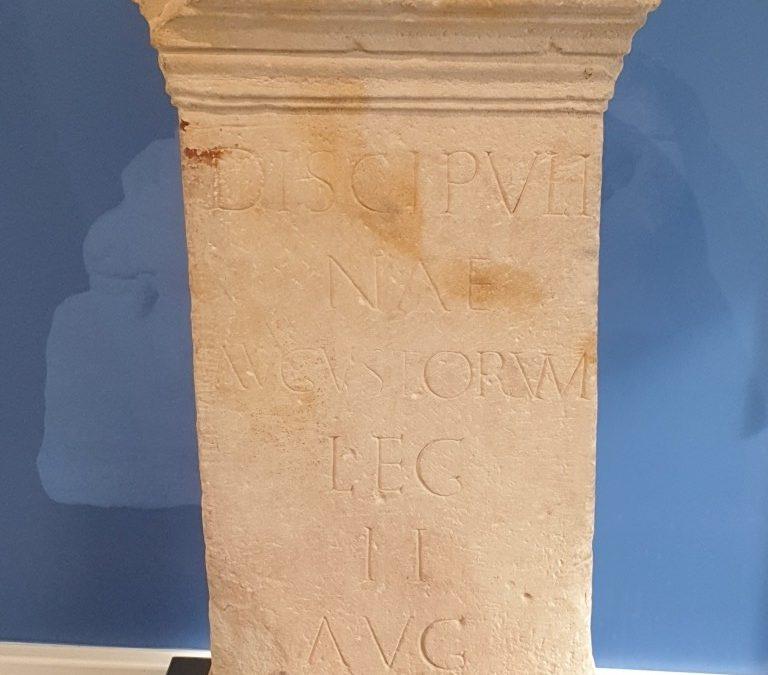
Today's Image: Altar Stone of Legio Secundae Augusta – The Second Augustan Legion
Source: My own Photo
Red and Green Vocab
The words in red and green are found among the 3057 Most Common Words in the Classical Latin texts that we will explore on CentumVerba.com and are essential to your understanding of the texts of Caesar, Vergil and Cicero. The green words appear frequently (at least five times) among Vergil's Aeneid (books I-VI), Caesar de bello Gallico (books I-V) and in Cicero's works - in Catilinam (books I-IV), de lege Manilia (also known as de Imperio Cn. Pompei), and pro Achia. These works constituted the curriculum for Latin over 4 years in American High Schools at the start of the 20th Century. The bulk of my information is taken from The Vocabulary of High School Latin by Gonzalez Lodge. I have added to these 2000 words from varioius other sources to compile my own list of The 3057 Most Common Latin Words.
The black words do not appear frequently in Classical Latin.
The red words are the first occurrences of these words in this author and this word will appear as green the next time you encounter it.
If you are serious about building your vocabulary then you should learn the red words as they occur and you should already know the green ones!
I have provided a FLASHCARD set to help - see below.
How To Read the Interactive Text
To Read the Interactive Text Below Without a Dictionary-
On a Computer: you hover over a word and get all the possible parts of speech; declensions; and conjugations of every word.
Red and Green Vocab
The words in red and green are found among the 3057 Most Common Words in the Classical Latin texts that we will explore on CentumVerba.com and are essential to your understanding of the texts of Caesar, Vergil and Cicero. The green words appear frequently (at least five times) among Vergil's Aeneid (books I-VI), Caesar de bello Gallico (books I-V) and in Cicero's works - in Catilinam (books I-IV), de lege Manilia (also known as de Imperio Cn. Pompei), and pro Achia. These works constituted the curriculum for Latin over 4 years in American High Schools at the start of the 20th Century. The bulk of my information is taken from The Vocabulary of High School Latin by Gonzalez Lodge. I have added to these 2000 words from varioius other sources to compile my own list of The 3057 Most Common Latin Words.
The black words do not appear frequently in Classical Latin.
The red words are the first occurrences of these words in this author and this word will appear as green the next time you encounter it.
If you are serious about building your vocabulary then you should learn the red words as they occur and you should already know the green ones!
I have provided a FLASHCARD set to help - see below.
How To Read the Interactive Text
To Read the Interactive Text Below Without a Dictionary-
On a Phone or Tablet: don't 'hover' -'tap' the word. To remove the 'definition box' you 'tap' to the side of the text box.
INTERACTIVE DICTIONARY FREE TEXT
venisti paulo ante in senatum. quis te ex hac tanta frequentia, tot ex tuis amicis ac necessariis salutavit?
You Need to be a Member to Access the Interactive Dictionary
si hoc post hominum memoriam contigit nemini, vocis exspectas contumeliam, cum sis gravissimo iudicio taciturnitatis oppressus?
quid, quod adventu tuo ista subsellia vacuefacta sunt, quod omnes consulares qui tibi persaepe ad caedem constituti fuerunt, simul atque adsedisti, partem istam subselliorum nudam atque inanem reliquerunt, quo tandem animo tibi ferendum putas?
[17] servi mehercule mei si me isto pacto metuerent ut te metuunt omnes cives tui, domum meam relinquendam putarem: tu tibi urbem non arbitraris?
et si me meis civibus iniuria suspectum tam graviter atque offensum viderem, carere me aspectu civium quam infestis omnium oculis conspici mallem:
I have prepared online Flashcards at CRAM.com to make learning the vocabulary much easier. I have no financial gain from you using the app as it is FREE to use.
I have created a stack of the 22 new words in this passage.
Here is the link to the FLASHCARDS
USING THE FLASHCARD APP:
To make the most of the online Flashcards use the "Click or use spacebar to begin" and the Latin word should appear. (The 'Shuffle' button will take the cards out of alphabetical order.) Type 'H' to get the conjugation / declension of the word if you want to see it. 'H' takes tyou back to the word. Click 'See Answer' or use the Spacebar to see the English.
If you were correct or close enough then select "I was right" or else "I was wrong". After you have completed the set it will start again but it will only display the ones you got wrong.
Continue through this process to learn all the words. I hope this is helpful!
Recent Comments