
tempus fugit!
tempus, the Latin word for time, is a cornerstone of Roman culture and thought, threading through both everyday life and deeper philosophical musings. The term belongs to the third declension, with its plural form being tempora. It’s used in a variety of expressions and contexts, highlighting the Romans’ nuanced understanding of time.
In ancient Rome, time was a crucial element in daily activities and broader societal structures. The Romans meticulously divided their days into specific periods, marked by the ringing of bells, the passage of the sun, and the changing of seasons. They were keenly aware of the cyclical nature of time, with tempus signifying not just hours and minutes but also the right moment or opportune time, as in the phrase tempus opportunum. This duality shows that Romans viewed time both quantitatively and qualitatively.
The Latin phrase tempus fugit (time flies) epitomizes the fleeting nature of time, a concept that has permeated modern vernacular. This awareness of the transient nature of time was also evident in expressions like carpe diem (seize the day), urging individuals to make the most of their present moments. Philosophically, tempus extended to the idea of tempus aeternum (eternal time), grappling with concepts of infinity and perpetuity.
Literature from the Roman era often used tempus to convey the passage of eras and the weight of historical context. Poets like Ovid and Virgil intricately wove time into their narratives, using it to frame stories within the broader continuum of human history. In Virgil's Aeneid, the hero Aeneas constantly contends with his destiny over time, making tempus a central theme.
The influence of tempus is evident in modern languages, giving rise to words like temporal (relating to time) and contemporary (existing at the same time). Its legacy is also prominent in various fields, from science (temporal data) to technology (time-stamping).
In Roman religion and mythology, tempus was often personified. Saturn, the god of time, was depicted as a powerful deity governing the flow of time and seasons. This personification underscores the importance of time in Roman spirituality and cultural rituals.
In essence, tempus is not merely a word but a profound concept that continues to shape our understanding of the world. It bridges the ancient Roman past with our present and future, illustrating the timeless relevance of this fundamental aspect of human existence. As we continue to explore and understand the complexities of time, tempus remains a vital touchstone in our ongoing journey.
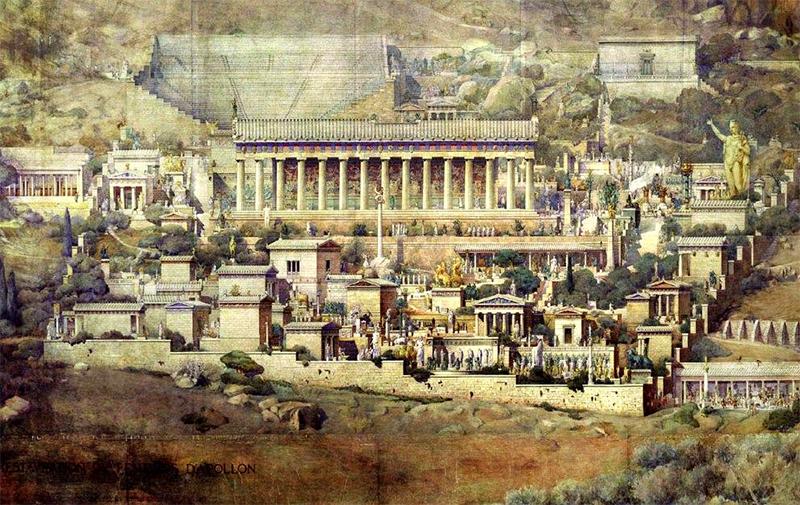
Today's Artwork: Apollo’s Temple at Delphi and the Sacred Way leading up to it.
Painting by: Albert Tournaire 1894
Here is a text only version. (See below for an interactive version)
2. Post breve tempus Pelias, veritus ne regnum suum tanta vi et fraude occupatum amitteret, amicum quendam Delphos misit, qui oraculum consuleret. Ille igitur quam celerrime Delphos se contulit et quam ob causam venisset demonstravit. Respondit oraculum nullum esse in praesentia periculum; monuit tamen Peliam ut, si quis veniret calceum unum gerens, eum caveret.
Post paucos annos accidit ut Pelias magnum sacrificium facturus esset; nuntios in omnis partis dimiserat et certum diem conveniendi dixerat. Die constituto magnus numerus hominum undique ex agris convenit; inter alios autem venit etiam Iason, qui a puero apud Centaurum quendam vixerat. Dum tamen iter facit, calceum alterum in transeundo nescio quo flumine amisit.
To Read the Interactive Text Below Without a Dictionary-
On a Computer: you hover over a word and get all the possible parts of speech; declensions; and conjugations of every word.
The words in red and green are found among the 3057 Most Common Words in Vergil, Caesar and Cicero that we will explore on CentumVerba.com and are essential to your understanding of the Classical Latin texts of Caesar, Vergil and Cicero. These green words appear frequently (at least five times) in Vergil's Aeneid (books I-VI), Caesar de bello Gallico (books I-V) and in Cicero's works - in Catilinam (books I-IV), de lege Manilia (also known as de Imperio Cn. Pompei), and pro Achia. These works constituted the curriculum for Latin over 4 years in American High Schools at the start of the 20th Century. The bulk of my information is taken from The Vocabulary of High School Latin by Gonzalez Lodge. I have added to these 2000 words from varioius other sources to compile my own list of The 3057 Most Common Latin Words.
The red words are the first occurrences of these words in the Aeneid.
If you are serious about building your vocabulary then you should learn the red words as they occur and you should already know the green ones! I have provided a FLASHCARD set to help - see below.
tempus fugit!
tempus, the Latin word for time, is a cornerstone of Roman culture and thought, threading through both everyday life and deeper philosophical musings. The term belongs to the third declension, with its plural form being tempora. It’s used in a variety of expressions and contexts, highlighting the Romans’ nuanced understanding of time.
In ancient Rome, time was a crucial element in daily activities and broader societal structures. The Romans meticulously divided their days into specific periods, marked by the ringing of bells, the passage of the sun, and the changing of seasons. They were keenly aware of the cyclical nature of time, with tempus signifying not just hours and minutes but also the right moment or opportune time, as in the phrase tempus opportunum. This duality shows that Romans viewed time both quantitatively and qualitatively.
The Latin phrase tempus fugit (time flies) epitomizes the fleeting nature of time, a concept that has permeated modern vernacular. This awareness of the transient nature of time was also evident in expressions like carpe diem (seize the day), urging individuals to make the most of their present moments. Philosophically, tempus extended to the idea of tempus aeternum (eternal time), grappling with concepts of infinity and perpetuity.
Literature from the Roman era often used tempus to convey the passage of eras and the weight of historical context. Poets like Ovid and Virgil intricately wove time into their narratives, using it to frame stories within the broader continuum of human history. In Virgil's Aeneid, the hero Aeneas constantly contends with his destiny over time, making tempus a central theme.
The influence of tempus is evident in modern languages, giving rise to words like temporal (relating to time) and contemporary (existing at the same time). Its legacy is also prominent in various fields, from science (temporal data) to technology (time-stamping).
In Roman religion and mythology, tempus was often personified. Saturn, the god of time, was depicted as a powerful deity governing the flow of time and seasons. This personification underscores the importance of time in Roman spirituality and cultural rituals.
In essence, tempus is not merely a word but a profound concept that continues to shape our understanding of the world. It bridges the ancient Roman past with our present and future, illustrating the timeless relevance of this fundamental aspect of human existence. As we continue to explore and understand the complexities of time, tempus remains a vital touchstone in our ongoing journey.
Today's Artwork: Apollo’s Temple at Delphi and the Sacred Way leading up to it.
Painting by: Albert Tournaire 1894
Here is a text only version. (See below for an interactive version)
2. Post breve tempus Pelias, veritus ne regnum suum tanta vi et fraude occupatum amitteret, amicum quendam Delphos misit, qui oraculum consuleret. Ille igitur quam celerrime Delphos se contulit et quam ob causam venisset demonstravit. Respondit oraculum nullum esse in praesentia periculum; monuit tamen Peliam ut, si quis veniret calceum unum gerens, eum caveret.
Post paucos annos accidit ut Pelias magnum sacrificium facturus esset; nuntios in omnis partis dimiserat et certum diem conveniendi dixerat. Die constituto magnus numerus hominum undique ex agris convenit; inter alios autem venit etiam Iason, qui a puero apud Centaurum quendam vixerat. Dum tamen iter facit, calceum alterum in transeundo nescio quo flumine amisit.
The words in red and green are found among the 3057 Most Common Words in Vergil, Caesar and Cicero that we will explore on CentumVerba.com and are essential to your understanding of the Classical Latin texts of Caesar, Vergil and Cicero. These green words appear frequently (at least five times) in Vergil's Aeneid (books I-VI), Caesar de bello Gallico (books I-V) and in Cicero's works - in Catilinam (books I-IV), de lege Manilia (also known as de Imperio Cn. Pompei), and pro Achia. These works constituted the curriculum for Latin over 4 years in American High Schools at the start of the 20th Century. The bulk of my information is taken from The Vocabulary of High School Latin by Gonzalez Lodge. I have added to these 2000 words from varioius other sources to compile my own list of The 3057 Most Common Latin Words.
The red words are the first occurrences of these words in the Aeneid.
If you are serious about building your vocabulary then you should learn the red words as they occur and you should already know the green ones! I have provided a FLASHCARD set to help - see below.
To Read the Interactive Text Below Without a Dictionary-
On a Phone or Tablet: don't 'hover' -'tap' the word. To remove the 'definition box' you 'tap' to the side of the text box.
INTERACTIVE DICTIONARY FREE TEXT
Post breve tempus Pelias, veritus ne regnum suum tanta vi et fraude occupatum amitteret, amicum quendam Delphos misit, qui oraculum consuleret.
Ille igitur quam celerrime Delphos se contulit et quam ob causam venisset demonstravit.
Respondit oraculum nullum esse in praesentia periculum; monuit tamen Peliam ut, si quis veniret calceum unum gerens, eum caveret.
Post paucos annos accidit ut Pelias magnum sacrificium facturus esset; nuntios in omnis partis dimiserat et certum diem conveniendi dixerat.
Die constituto magnus numerus hominum undique ex agris convenit; inter alios autem venit etiam Iason, qui a puero apud Centaurum quendam vixerat.
Dum tamen iter facit, calceum alterum in transeundo nescio quo flumine amisit.
I have prepared online Flashcards at CRAM.com to make learning the vocabulary much easier. I have no financial gain from you using the app as it is FREE to use.
I have created a stack of the 42 new words in this passage. I know that is a lot but you will probably know many already!
Here is the link to the FLASHCARDS
If that is too many words then I have broken it down to 2 lists of 21-
USING THE FLASHCARD APP:
To make the most of the online Flashcards use the "Click or use spacebar to begin" and the Latin word should appear. (The 'Shuffle' button will take the cards out of alphabetical order.) Type 'H' to get the conjugation / declension of the word if you want to see it. 'H' takes you back to the word. Click 'See Answer' or use the Spacebar to see the English.
If you were correct or close enough then select "I was right" or else "I was wrong". After you have completed the set it will start again but it will only display the ones you got wrong.
Continue through this process to learn all the words. I hope this is helpful!
I have prepared online Flashcards at CRAM.com to make learning the vocabulary much easier. I have no financial gain from you using the app as it is FREE to use.
I have created a stack of the 43 new words in this passage. I know that is a lot but you will probably know many already!
Here is the link to the FLASHCARDS
If that is too many words then I have broken it down to 2 lists of 21-
USING THE FLASHCARD APP:
To make the most of the online Flashcards use the "Click or use spacebar to begin" and the Latin word should appear. (The 'Shuffle' button will take the cards out of alphabetical order.) Type 'H' to get the conjugation / declension of the word if you want to see it. 'H' takes you back to the word. Click 'See Answer' or use the Spacebar to see the English.
If you were correct or close enough then select "I was right" or else "I was wrong". After you have completed the set it will start again but it will only display the ones you got wrong.
Continue through this process to learn all the words. I hope this is helpful!
Recent Comments