
pes - what's afoot?
The Latin term pes, meaning foot, plays a fundamental role in ancient language, literature, and culture. Used in both literal and figurative contexts, connects to various aspects of Roman daily life, military affairs, and literary works.
Literally, pes refers to the foot, a crucial part of the human body and a symbol of movement and progress. Romans had a strong appreciation for athleticism and physical fitness, often depicting feet in art and emphasizing their role in sports and physical activities. Pes also extends to the measurement systems, where the Roman foot (pes) served as a standard unit of length. This measurement was integral to Roman engineering and architecture, contributing to the construction of their remarkable infrastructure, including roads, aqueducts, and buildings.
In a military context, pes gains additional significance. Roman soldiers, known for their rigorous discipline and endurance, often marched long distances on foot. The term pedes (plural of pes) referred to infantry soldiers, distinguishing them from cavalry. Roman military strategies heavily relied on the capabilities of these infantrymen, who formed the backbone of their legions.
Moreover, pes features prominently in Roman literature and idioms. Poets and writers often utilized the term metaphorically to convey various concepts. For instance, the phrase pes meus (my foot) could express personal resolve or determination. In poetic meters, pes is essential to scansion, referring to a unit of rhythm that combines long and short syllables in structured patterns.
The influence of pes extends beyond its immediate context. It influenced the development of later languages and remains embedded in modern terminology. The Latin root pes can be traced in numerous English words such as:
pedestrian - pedester (adjective) meaning on foot;
pedal - pedalis (adjective) meaning of or pertaining to the foot, referring to a foot-operated lever
expedition - expeditus (adjective): Derived from ex (out of) and pes (foot), it means unimpeded or ready for action. The word expedition comes from this, signifying a journey with a specific purpose.
impede - impedio (verb): Derived from in (into) and pes, it means to entangle the feet or hinder. The word impede shares this origin, meaning to obstruct progress.
These derivatives of pes highlight its versatile use in language and its influence on modern vocabulary illustrating its enduring legacy.
In summary, pes exemplifies the interconnectedness of language, culture, and daily life in ancient Rome. Its versatility in literal, military, and literary contexts underscores its significance and the Roman attention to details of both practical and symbolic nature.
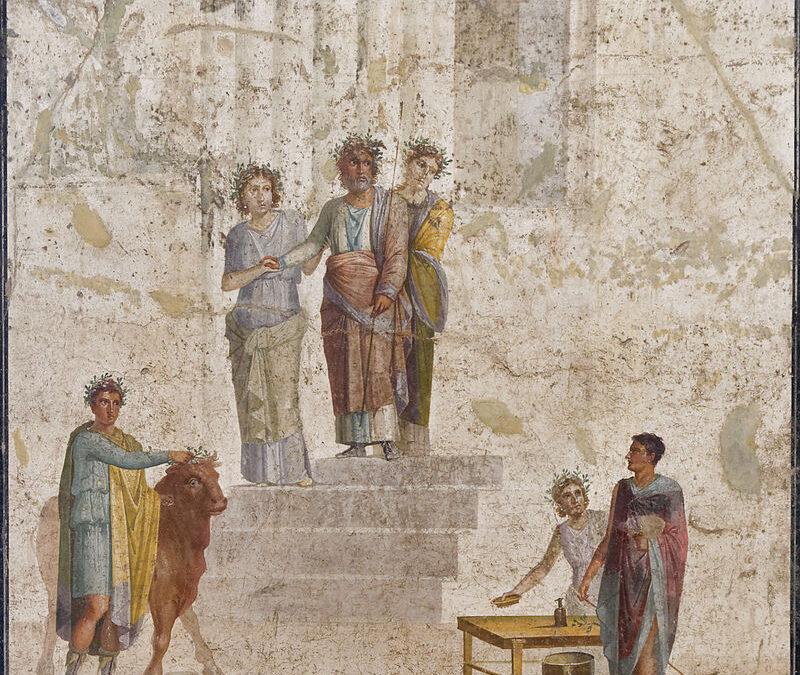
Today's Image: A fresco depicting Roman senator Cicero (106-43 BCE) denouncing Catiline's conspiracy to overthrow the Republic in the Roman senate. (Palazzo Madama, Rome)
Artist: Cesare Maccari (1840-1919)
Location: Palazzo Madama, Rome
Here is a text only version. (See below for an interactive version)
3 Iason igitur, cum calceum amissum nullo modo recipere posset, altero pede nudo in regiam pervenit. Quem cum vidisset Pelias, subito timore adfectus est; intellexit enim hunc esse hominem quem oraculum demonstravisset. Hoc igitur iniit consilium. Rex erat quidam nomine Aeetes, qui regnum Colchidis illo tempore obtinebat.
Huic commissum erat vellus illud aureum quod Phrixus olim ibi reliquerat. Constituit igitur Pelias Iasoni negotium dare ut hoc vellere potiretur; cum enim res esset magni periculi, sperabat eum in itinere periturum esse. Iasonem igitur ad se arcessivit et quid fieri vellet demonstravit. Iason autem, etsi bene intellegebat rem esse difficillimam, negotium libenter suscepit.
To Read the Interactive Text Below Without a Dictionary-
On a Computer: you hover over a word and get all the possible parts of speech; declensions; and conjugations of every word.
The words in red and green are found among the 3057 Most Common Words in Vergil, Caesar and Cicero that we will explore on CentumVerba.com and are essential to your understanding of the Classical Latin texts of Caesar, Vergil and Cicero. These green words appear frequently (at least five times) in Vergil's Aeneid (books I-VI), Caesar de bello Gallico (books I-V) and in Cicero's works - in Catilinam (books I-IV), de lege Manilia (also known as de Imperio Cn. Pompei), and pro Achia. These works constituted the curriculum for Latin over 4 years in American High Schools at the start of the 20th Century. The bulk of my information is taken from The Vocabulary of High School Latin by Gonzalez Lodge. I have added to these 2000 words from varioius other sources to compile my own list of The 3057 Most Common Latin Words.
The red words are the first occurrences of these words in the Aeneid.
If you are serious about building your vocabulary then you should learn the red words as they occur and you should already know the green ones! I have provided a FLASHCARD set to help - see below.
pes - what's afoot?
The Latin term pes, meaning foot, plays a fundamental role in ancient language, literature, and culture. Used in both literal and figurative contexts, connects to various aspects of Roman daily life, military affairs, and literary works.
Literally, pes refers to the foot, a crucial part of the human body and a symbol of movement and progress. Romans had a strong appreciation for athleticism and physical fitness, often depicting feet in art and emphasizing their role in sports and physical activities. Pes also extends to the measurement systems, where the Roman foot (pes) served as a standard unit of length. This measurement was integral to Roman engineering and architecture, contributing to the construction of their remarkable infrastructure, including roads, aqueducts, and buildings.
In a military context, pes gains additional significance. Roman soldiers, known for their rigorous discipline and endurance, often marched long distances on foot. The term pedes (plural of pes) referred to infantry soldiers, distinguishing them from cavalry. Roman military strategies heavily relied on the capabilities of these infantrymen, who formed the backbone of their legions.
Moreover, pes features prominently in Roman literature and idioms. Poets and writers often utilized the term metaphorically to convey various concepts. For instance, the phrase pes meus (my foot) could express personal resolve or determination. In poetic meters, pes is essential to scansion, referring to a unit of rhythm that combines long and short syllables in structured patterns.
The influence of pes extends beyond its immediate context. It influenced the development of later languages and remains embedded in modern terminology. The Latin root pes can be traced in numerous English words such as:
pedestrian - pedester (adjective) meaning on foot;
pedal - pedalis (adjective) meaning of or pertaining to the foot, referring to a foot-operated lever
expedition - expeditus (adjective): Derived from ex (out of) and pes (foot), it means unimpeded or ready for action. The word expedition comes from this, signifying a journey with a specific purpose.
impede - impedio (verb): Derived from in (into) and pes, it means to entangle the feet or hinder. The word impede shares this origin, meaning to obstruct progress.
These derivatives of pes highlight its versatile use in language and its influence on modern vocabulary illustrating its enduring legacy.
In summary, pes exemplifies the interconnectedness of language, culture, and daily life in ancient Rome. Its versatility in literal, military, and literary contexts underscores its significance and the Roman attention to details of both practical and symbolic nature.
Today's Image: A fresco depicting Roman senator Cicero (106-43 BCE) denouncing Catiline's conspiracy to overthrow the Republic in the Roman senate. (Palazzo Madama, Rome)
Artist: Cesare Maccari (1840-1919)
Location: Palazzo Madama, Rome
Here is a text only version. (See below for an interactive version)
3 Iason igitur, cum calceum amissum nullo modo recipere posset, altero pede nudo in regiam pervenit. Quem cum vidisset Pelias, subito timore adfectus est; intellexit enim hunc esse hominem quem oraculum demonstravisset. Hoc igitur iniit consilium. Rex erat quidam nomine Aeetes, qui regnum Colchidis illo tempore obtinebat.
Huic commissum erat vellus illud aureum quod Phrixus olim ibi reliquerat. Constituit igitur Pelias Iasoni negotium dare ut hoc vellere potiretur; cum enim res esset magni periculi, sperabat eum in itinere periturum esse. Iasonem igitur ad se arcessivit et quid fieri vellet demonstravit. Iason autem, etsi bene intellegebat rem esse difficillimam, negotium libenter suscepit.
The words in red and green are found among the 3057 Most Common Words in Vergil, Caesar and Cicero that we will explore on CentumVerba.com and are essential to your understanding of the Classical Latin texts of Caesar, Vergil and Cicero. These green words appear frequently (at least five times) in Vergil's Aeneid (books I-VI), Caesar de bello Gallico (books I-V) and in Cicero's works - in Catilinam (books I-IV), de lege Manilia (also known as de Imperio Cn. Pompei), and pro Achia. These works constituted the curriculum for Latin over 4 years in American High Schools at the start of the 20th Century. The bulk of my information is taken from The Vocabulary of High School Latin by Gonzalez Lodge. I have added to these 2000 words from varioius other sources to compile my own list of The 3057 Most Common Latin Words.
The red words are the first occurrences of these words in the Aeneid.
If you are serious about building your vocabulary then you should learn the red words as they occur and you should already know the green ones! I have provided a FLASHCARD set to help - see below.
To Read the Interactive Text Below Without a Dictionary-
On a Phone or Tablet: don't 'hover' -'tap' the word. To remove the 'definition box' you 'tap' to the side of the text box.
INTERACTIVE DICTIONARY FREE TEXT
3 Iason igitur, cum calceum amissum nullo modo recipere posset, altero pede nudo in regiam pervenit.
Quem cum vidisset Pelias, subito timore adfectus est; intellexit enim hunc esse hominem quem oraculum demonstravisset.
You Need to Sign Up as a Trial Member to Access the Interactive Dictionary
Hoc igitur iniit consilium. Rex erat quidam nomine Aeetes, qui regnum Colchidis illo tempore obtinebat.
Huic commissum erat vellus illud aureum quod Phrixus olim ibi reliquerat.
Constituit igitur Pelias Iasoni negotium dare ut hoc vellere potiretur; cum enim res esset magni periculi, sperabat eum in itinere periturum esse.
Iasonem igitur ad se arcessivit et quid fieri vellet demonstravit.
Iason autem, etsi bene intellegebat rem esse difficillimam, negotium libenter suscepit.
I have prepared online Flashcards at CRAM.com to make learning the vocabulary much easier. I have no financial gain as the app is FREE to use.
I have created a stack of the 22 new words in this passage.
YOU NEED TO SIGN UP AS A TRIAL MEMBER TO ACCESS THE FLASHCARDS
Here is the link to the FLASHCARDS
USING THE FLASHCARD APP:
To make the most of the online Flashcards use the "Click or use spacebar to begin" and the Latin word should appear. (The 'Shuffle' button will take the cards out of alphabetical order.) Type 'H' to get the conjugation / declension of the word if you want to see it. 'H' takes you back to the word. Click 'See Answer' or use the Spacebar to see the English.
If you were correct or close enough then select "I was right" or else "I was wrong". After you have completed the set it will start again but it will only display the ones you got wrong.
Continue through this process to learn all the words. I hope this is helpful!
Recent Comments