
postridie - this time tomorrow?
The Latin adverb postridie means on the next day or the following day. It is derived from the combination of two elements: posterus, meaning next or following, and diē, the ablative form of diēs (day). Together, these components emphasize the idea of an event or action taking place the day after a specific reference point.
In classical Latin, postridie is frequently used to indicate temporal relationships in narratives, helping authors structure events in chronological order. For example, historians like Livy and Tacitus might use it to describe the sequence of military actions, such as when a battle commenced the day after initial preparations. Similarly, Cicero could employ postridie in his correspondence to clarify the timing of visits, meetings, or other scheduled events.
Grammatically, postridie is an indeclinable adverb, meaning its form does not change regardless of the context. It often appears in conjunction with other words that specify the day or occasion being referenced. For instance, phrases like postridie idus Martias translate to on the day after the Ides of March, pinpointing a precise moment in time. Its placement within sentences is typically flexible but tends to precede the verb or clause it modifies.
In addition to historical and literary contexts, postridie is used in legal and official documents to outline schedules, deadlines, or the aftermath of specific events. This practicality highlights its role in ancient Roman society, where accurate timekeeping and documentation were essential.
The adverb also adds richness to Latin storytelling, allowing authors to seamlessly transition between events and enhance the temporal flow of their narratives. Its use reflects the Roman emphasis on order and clarity, both in literature and daily life.
In summary, postridie is a valuable Latin adverb that conveys the concept of the next day with precision and versatility. Its frequent occurrence in classical texts underscores its importance in both the language and culture of ancient Rome.
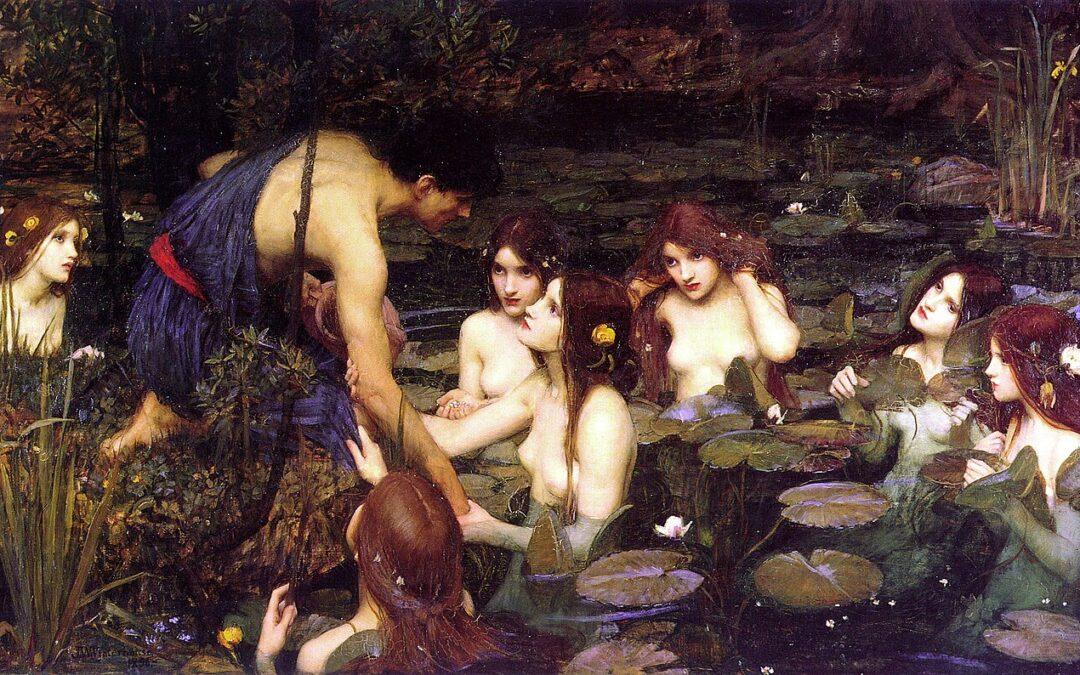
Today's Artwork: Hylas and a group of nymphs
Painting by: John William Waterhouse 1896
Source: Manchester Art Gallery
Here is a text only version. (See below for an interactive version)
7 Postridie eius diei Iason, tempestatem satis idoneam esse arbitratus, summa enim tranquillitas iam consecuta erat, ancoras sustulit et pauca millia passuum progressus, ante noctem Mysiam attigit. Ibi paucas horas in ancoris exspectavit; a nautis enim cognoverat aquae copiam quam secum haberent iam deficere, quam ob causam quidam ex Argonautls in terram egressi aquam quaerebant. Horum in numero erat Hylas quidam, puer forma praestantissima, qui dum fontem quaerit a comitibus paulum secesserat.
Nymphae autem, quae fontem colebant, cum iuvenem vidissent, ei persuadere conatae sunt ut secum maneret; et cum ille negaret se hoc facturum esse puerum vi abstulerunt. Comites eius, postquam Hylam amissum esse senserunt, magno dolore adfecti, diu frustra quaerebant; Hercules autem et Polyphemus, qui vestigia pueri longius secuti erant, ubi tandem ad litus redierunt, Iasonem solvisse cognoverunt.
Here is a text only version. (See below for an interactive version)
7 Postridie eius diei Iason, tempestatem satis idoneam esse arbitratus, summa enim tranquillitas iam consecuta erat, ancoras sustulit et pauca millia passuum progressus, ante noctem Mysiam attigit. Ibi paucas horas in ancoris exspectavit; a nautis enim cognoverat aquae copiam quam secum haberent iam deficere, quam ob causam quidam ex Argonautls in terram egressi aquam quaerebant.
Horum in numero erat Hylas quidam, puer forma praestantissima, qui dum fontem quaerit a comitibus paulum secesserat. Nymphae autem, quae fontem colebant, cum iuvenem vidissent, ei persuadere conatae sunt ut secum maneret; et cum ille negaret se hoc facturum esse puerum vi abstulerunt.
Comites eius, postquam Hylam amissum esse senserunt, magno dolore adfecti, diu frustra quaerebant; Hercules autem et Polyphemus, qui vestigia pueri longius secuti erant, ubi tandem ad litus redierunt, Iasonem solvisse cognoverunt.
Red and Green Vocab
The words in red and green are found among the 3057 Most Common Words in the Classical Latin texts that we will explore on CentumVerba.com and are essential to your understanding of the texts of Caesar, Vergil and Cicero. The green words appear frequently (at least five times) among Vergil's Aeneid (books I-VI), Caesar de bello Gallico (books I-V) and in Cicero's works - in Catilinam (books I-IV), de lege Manilia (also known as de Imperio Cn. Pompei), and pro Achia. These works constituted the curriculum for Latin over 4 years in American High Schools at the start of the 20th Century. The bulk of my information is taken from The Vocabulary of High School Latin by Gonzalez Lodge. I have added to these 2000 words from varioius other sources to compile my own list of The 3057 Most Common Latin Words.
The black words do not appear frequently in Classical Latin.
The red words are the first occurrences of these words in this author and this word will appear as green the next time you encounter it.
If you are serious about building your vocabulary then you should learn the red words as they occur and you should already know the green ones!
I have provided a FLASHCARD set to help - see below.
How To Read the Interactive Text
To Read the Interactive Text Below Without a Dictionary-
On a Computer: you hover over a word and get all its possible parts of speech; declensions; and conjugations.
On a Tablet: 'Tap' the word to see the definition, and to remove the 'definition box' you simply 'Tap' anywhere to the side.
Red and Green Vocab
The words in red and green are found among the 3057 Most Common Words in the Classical Latin texts that we will explore on CentumVerba.com and are essential to your understanding of the texts of Caesar, Vergil and Cicero. The green words appear frequently (at least five times) among Vergil's Aeneid (books I-VI), Caesar de bello Gallico (books I-V) and in Cicero's works - in Catilinam (books I-IV), de lege Manilia (also known as de Imperio Cn. Pompei), and pro Achia. These works constituted the curriculum for Latin over 4 years in American High Schools at the start of the 20th Century. The bulk of my information is taken from The Vocabulary of High School Latin by Gonzalez Lodge. I have added to these 2000 words from varioius other sources to compile my own list of The 3057 Most Common Latin Words.
The black words do not appear frequently in Classical Latin.
The red words are the first occurrences of these words in this author and this word will appear as green the next time you encounter it.
If you are serious about building your vocabulary then you should learn the red words as they occur and you should already know the green ones!
I have provided a FLASHCARD set to help - see below.
How To Read the Interactive Text
To Read the Interactive Text Below Without a Dictionary-
On a Phone or Tablet: ''TAP' the word to see the definition, and to remove the 'definition box' you simply 'TAP' anywhere to the side.
INTERACTIVE DICTIONARY FREE TEXT
7 Postridie eius diei Iason, tempestatem satis idoneam esse arbitratus, summa enim tranquillitas iam consecuta erat, ancoras sustulit et pauca millia passuum progressus, ante noctem Mysiam attigit.
You Need to be a Member to Access the Interactive Dictionary
Ibi paucas horas in ancoris exspectavit; a nautis enim cognoverat aquae copiam quam secum haberent iam deficere, quam ob causam quidam ex Argonautis in terram egressi aquam quaerebant.
Horum in numero erat Hylas quidam, puer forma praestantissima, qui dum fontem quaerit a comitibus paulum secesserat. Nymphae autem, quae fontem colebant, cum iuvenem vidissent, ei persuadere conatae sunt ut secum maneret; et cum ille negaret se hoc facturum esse puerum vi abstulerunt.
Comites eius, postquam Hylam amissum esse senserunt, magno dolore adfecti, diu frustra quaerebant; Hercules autem et Polyphemus, qui vestigia pueri longius secuti erant, ubi tandem ad litus redierunt, Iasonem solvisse cognoverunt.
I have prepared online Flashcards at CRAM.com to make learning the vocabulary much easier. I have no financial gain from you using the app as it is FREE to use.
I have created a stack of the 25 new words in this passage.
YOU NEED TO SIGN UP AS A TRIAL MEMBER TO ACCESS THE FLASHCARDS
Here is the link to the FLASHCARDS
USING THE FLASHCARD APP:
To make the most of the online Flashcards use the "Click or use spacebar to begin" and the Latin word should appear. (The 'Shuffle' button will take the cards out of alphabetical order.) Type 'H' to get the conjugation / declension of the word if you want to see it. 'H' takes tyou back to the word. Click 'See Answer' or use the Spacebar to see the English.
If you were correct or close enough then select "I was right" or else "I was wrong". After you have completed the set it will start again but it will only display the ones you got wrong.
Continue through this process to learn all the words. I hope this is helpful!
Recent Comments