
ita - so, therefore, in this way - thus
The Latin adverb ita is versatile and commonly used to mean thus, so, or in this way. Its primary function is to indicate manner or degree, and it appears frequently in both prose and poetry.
One key use of ita is in comparisons or analogies. It often precedes clauses or phrases that illustrate or explain a point. For example, ita dicit can be translated as he speaks in this way. This demonstrates how ita helps describe the manner of an action.
Ita is also used in emphatic constructions to reinforce statements. For instance, in legal or rhetorical contexts, phrases like ita est (thus it is or it is so) confirm the truth or validity of a statement. Similarly, ita vero (indeed so) is a strong affirmation often used in dialogue.
Another significant usage of ita is as part of conditional clauses or correlatives. For example, in sentences like si ita est (if it is so), ita introduces a condition or consequence. It also functions in paired constructions such as ita...ut..., which translates to in such a way...that... and is commonly used to express result clauses.
Additionally, ita appears in expressions of ritual or formality, especially in religious or ceremonial contexts, where it denotes fidelity or agreement, as in ita fiat (so let it be).
In summary, ita is a fundamental adverb in Latin, offering nuanced meanings tied to manner, emphasis, condition, and formal expression, making it indispensable in classical Latin usage.
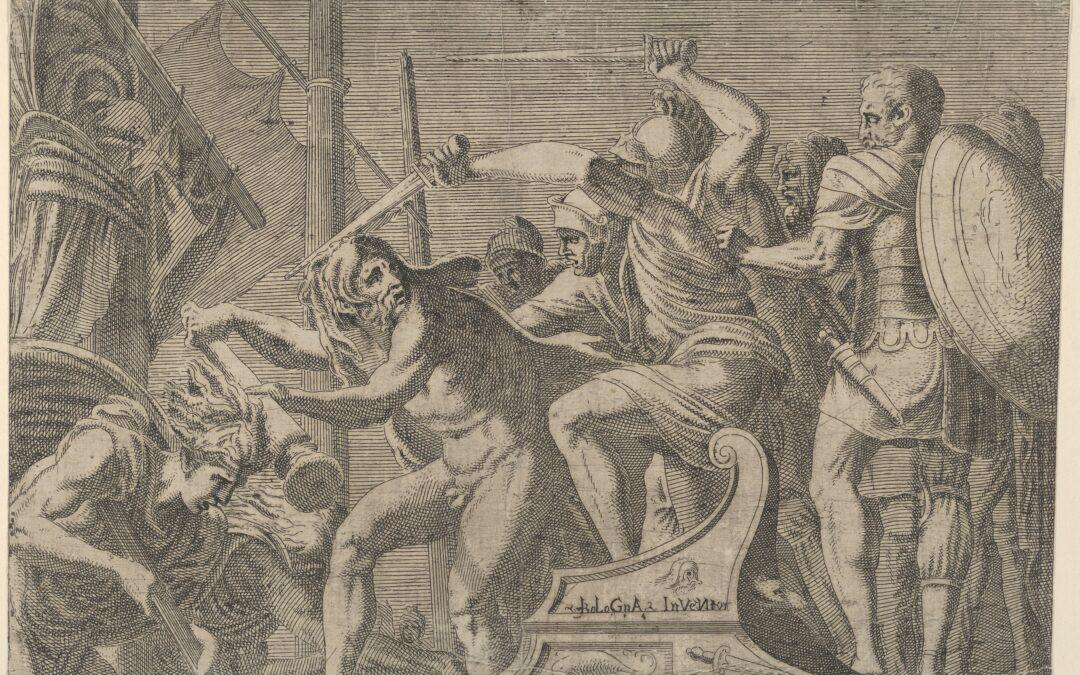
Today's Artwork: Hercules Fighting Aboard The Argonauts' Ship
Painting by: Léon Davent (ca. 1542–45)
Source: Metropolitan Museum of Art
Here is a text only version. (See below for an interactive version)
6. Haud multum post Argonautae, ita enim appellati sunt qui in ista navi vehebantur, insulam quandam nomine Cyzicum attigerunt et e navi egressi a rege illius regionis hospitio excepti sunt.
Paucas horas ibi commorati ad solis occasum rursus solverunt; at postquam pauca millia passuum progressi sunt tanta tempestas subito coorta est ut cursum tenere non possent et in eandem partem insulae unde nuper profecti erant magno cum periculo deicerentur.
Incolae tamen, cum nox esset obscura, Argonautas non agnoscebant et navem inimicam venisse arbitrati, arma rapuerunt et eos egredi prohibebant.
Acriter in litore pugnatum est et rex ipse, qui cum aliis decucurrerat, ab Argonautls occisus est.
Mox tamen, cum iam dilucesceret, senserunt incolae se errare et arma abiecerunt; Argonautae autem, cum viderent regem occisum esse, magnum dolorem perceperunt.
Red and Green Vocab
The words in red and green are found among the 3057 Most Common Words in the Classical Latin texts that we will explore on CentumVerba.com and are essential to your understanding of the texts of Caesar, Vergil and Cicero. The green words appear frequently (at least five times) among Vergil's Aeneid (books I-VI), Caesar de bello Gallico (books I-V) and in Cicero's works - in Catilinam (books I-IV), de lege Manilia (also known as de Imperio Cn. Pompei), and pro Achia. These works constituted the curriculum for Latin over 4 years in American High Schools at the start of the 20th Century. The bulk of my information is taken from The Vocabulary of High School Latin by Gonzalez Lodge. I have added to these 2000 words from varioius other sources to compile my own list of The 3057 Most Common Latin Words.
The black words do not appear frequently in Classical Latin.
The red words are the first occurrences of these words in this author and this word will appear as green the next time you encounter it.
If you are serious about building your vocabulary then you should learn the red words as they occur and you should already know the green ones!
I have provided a FLASHCARD set to help - see below.
How To Read the Interactive Text
To Read the Interactive Text Below Without a Dictionary-
On a Computer: you hover over a word and get all the possible parts of speech; declensions; and conjugations of every word.
Red and Green Vocab
The words in red and green are found among the 3057 Most Common Words in the Classical Latin texts that we will explore on CentumVerba.com and are essential to your understanding of the texts of Caesar, Vergil and Cicero. The green words appear frequently (at least five times) among Vergil's Aeneid (books I-VI), Caesar de bello Gallico (books I-V) and in Cicero's works - in Catilinam (books I-IV), de lege Manilia (also known as de Imperio Cn. Pompei), and pro Achia. These works constituted the curriculum for Latin over 4 years in American High Schools at the start of the 20th Century. The bulk of my information is taken from The Vocabulary of High School Latin by Gonzalez Lodge. I have added to these 2000 words from varioius other sources to compile my own list of The 3057 Most Common Latin Words.
The black words do not appear frequently in Classical Latin.
The red words are the first occurrences of these words in this author and this word will appear as green the next time you encounter it.
If you are serious about building your vocabulary then you should learn the red words as they occur and you should already know the green ones!
I have provided a FLASHCARD set to help - see below.
How To Read the Interactive Text
To Read the Interactive Text Below Without a Dictionary-
On a Phone or Tablet: don't 'hover' -'tap' the word. To remove the 'definition box' you 'tap' to the side of the text box.
INTERACTIVE DICTIONARY FREE TEXT
6 Haud multum post Argonautae, ita enim appellati sunt qui in ista navi vehebantur, insulam quandam nomine Cyzicum attigerunt et e navi egressi a rege illius regionis hospitio excepti sunt.
You Need to be a Member to Access the Interactive Dictionary
Paucas horas ibi commorati ad solis occasum rursus solverunt; at postquam pauca millia passuum progressi sunt tanta tempestas subito coorta est ut cursum tenere non possent et in eandem partem insulae unde nuper profecti erant magno cum periculo deicerentur.
Incolae tamen, cum nox esset obscura, Argonautas non agnoscebant et navem inimicam venisse arbitrati, arma rapuerunt et eos egredi prohibebant. Acriter in litore pugnatum est et rex ipse, qui cum aliis decucurrerat, ab Argonautls occisus est.
Mox tamen, cum iam dilucesceret, senserunt incolae se errare et arma abiecerunt; Argonautae autem, cum viderent regem occisum esse, magnum dolorem perceperunt.
I have prepared online Flashcards at CRAM.com to make learning the vocabulary much easier. I have no financial gain from you using the app as it is FREE to use.
I have created a stack of the 32 new words in this passage.
YOU NEED TO SIGN UP AS A TRIAL MEMBER TO ACCESS THE FLASHCARDS
Here is the link to the FLASHCARDS
USING THE FLASHCARD APP:
To make the most of the online Flashcards use the "Click or use spacebar to begin" and the Latin word should appear. (The 'Shuffle' button will take the cards out of alphabetical order.) Type 'H' to get the conjugation / declension of the word if you want to see it. 'H' takes tyou back to the word. Click 'See Answer' or use the Spacebar to see the English.
If you were correct or close enough then select "I was right" or else "I was wrong". After you have completed the set it will start again but it will only display the ones you got wrong.
Continue through this process to learn all the words. I hope this is helpful!
Recent Comments