
Urbs
Cicero asks "in qua urbe vivimus?" - What city are we living in? Urbs actually occurs three times in this passage in the ablative singular and plural cases (urbe, urbis).
The Latin word urbs (genitive: urbis), meaning city, is a third-declension feminine noun with profound significance in classical literature. Like all third declension nouns it can be difficult to know the gender of urbs, however if you look closely you will see that it is in qua urbe - qua lets you know that it is femimine noun. While it can refer generically to any city, in Roman writings, it often specifically denotes Rome itself, carrying connotations of political power, cultural dominance, and civilization.
In Roman historiography, such as Livy's ab urbe condita, urbs is central as the term for the foundation and growth of Rome. Livy uses urbs to emphasize Rome’s historical and symbolic importance as the epicentre of the Roman world, illustrating its transition from a modest settlement to the mightiest city of antiquity.
In epic poetry, urbs frequently symbolizes destiny and the grandeur of Rome. Virgil’s Aeneid portrays the establishment of an urbs as a fulfillment of divine will. Aeneas's journey is not merely about personal trials but about the destined foundation of Rome as a future urbs, representing order, civilization, and the epicentre of Roman identity. The word embodies the dream of Rome's greatness even in its nascent stages.
Philosophers and poets, such as Horace and Ovid, also explore urbs as a symbol of urban life, often contrasting it with rus (the countryside). Horace, for instance, depicts the hustle and ambition of urbs against the simplicity and peace of rural life, underscoring the complexities of Roman attitudes toward urbanization.
Moreover, urbs serves as a metonym for the Roman state and its values. To Roman authors, the urbs represents not just a physical space but a cultural and ideological construct—law, order, and sophistication. Its usage in classical literature reflects its role as a cornerstone of Roman identity and legacy. The literary depiction of urbs is a testament to the Romans’ self-perception as the architects of civilization, embodying their pride and ambition.
Thank you for joining me in this journey through the classical texts of Rome...
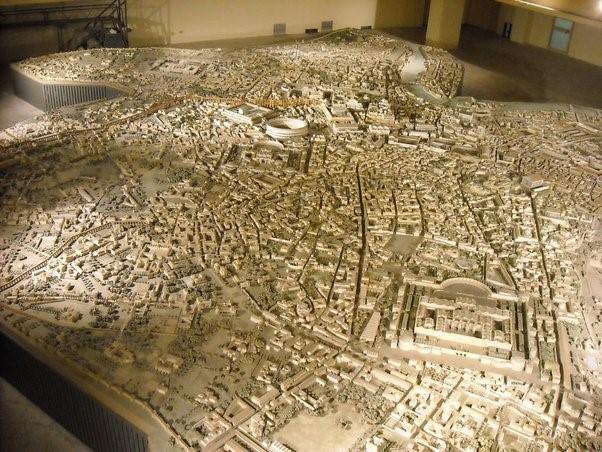
The image for todays post is a picture of a model of ancient Rome that was started in 1933 by the architect Italo Gismondi. Subsequently, the model was expanded to include the entire urban area within the Aurelian Walls and definitively set up in the spaces dedicated to it in the Museum of Roman Civilization inaugurated in 1955.
The model was designed on a 1:250 scale, made of alabaster plaster, with metal armour and vegetable fibres. The entire work consists of about one hundred and fifty frames, assembled, in almost all cases, along the road axes.
The view of the model, positioned at the basement level, can be enjoyed from the gallery above which surrounds it on all sides.Current location: Museum of Roman Civilization
rbs
Cicero asks "in qua urbe vivimus?" - What city are we living in? Urbs actually occurs three times in this passage in the ablative singular and plural cases (urbe, urbis).
The Latin word urbs (genitive: urbis), meaning city, is a third-declension feminine noun with profound significance in classical literature. Like all third declension nouns it can be difficult to know the gender of urbs, however if you look closely you will see that it is in qua urbe - qua lets you know that it is femimine noun. While it can refer generically to any city, in Roman writings, it often specifically denotes Rome itself, carrying connotations of political power, cultural dominance, and civilization.
In Roman historiography, such as Livy's ab urbe condita, urbs is central as the term for the foundation and growth of Rome. Livy uses urbs to emphasize Rome’s historical and symbolic importance as the epicentre of the Roman world, illustrating its transition from a modest settlement to the mightiest city of antiquity.
In epic poetry, urbs frequently symbolizes destiny and the grandeur of Rome. Virgil’s Aeneid portrays the establishment of an urbs as a fulfillment of divine will. Aeneas's journey is not merely about personal trials but about the destined foundation of Rome as a future urbs, representing order, civilization, and the epicentre of Roman identity. The word embodies the dream of Rome's greatness even in its nascent stages.
Philosophers and poets, such as Horace and Ovid, also explore urbs as a symbol of urban life, often contrasting it with rus (the countryside). Horace, for instance, depicts the hustle and ambition of urbs against the simplicity and peace of rural life, underscoring the complexities of Roman attitudes toward urbanization.
Moreover, urbs serves as a metonym for the Roman state and its values. To Roman authors, the urbs represents not just a physical space but a cultural and ideological construct—law, order, and sophistication. Its usage in classical literature reflects its role as a cornerstone of Roman identity and legacy. The literary depiction of urbs is a testament to the Romans’ self-perception as the architects of civilization, embodying their pride and ambition.
Thank you for joining me in this journey through the classical texts of Rome...
The image for todays post is a picture of a model of ancient Rome that was started in 1933 by the architect Italo Gismondi. Subsequently, the model was expanded to include the entire urban area within the Aurelian Walls and definitively set up in the spaces dedicated to it in the Museum of Roman Civilization inaugurated in 1955.
The model was designed on a 1:250 scale, made of alabaster plaster, with metal armour and vegetable fibres. The entire work consists of about one hundred and fifty frames, assembled, in almost all cases, along the road axes.
The view of the model, positioned at the basement level, can be enjoyed from the gallery above which surrounds it on all sides.Current location: Museum of Roman Civilization
Here is a text only version
convenisse eodem compluris eiusdem amentiae scelerisque socios. num negare audes? quid taces? convincam, si negas. video enim esse hic in senatu quosdam qui tecum una fuerunt.
[9] O di immortales! ubinam gentium sumus? quam rem publicam habemus? in qua urbe vivimus?
hic, hic sunt in nostro numero, patres conscripti, in hoc orbis terrae sanctissimo gravissimoque consilio, qui de nostro omnium interitu, qui de huius urbis atque adeo de orbis terrarum exitio cogitent. hos ego video consul et de re publica sententiam rogo, et quos ferro trucidari oportebat, eos nondum voce volnero!
fuisti igitur apud Laecam illa nocte, Catilina, distribuisti partis Italiae, statuisti quo quemque proficisci placeret, delegisti quos Romae relinqueres, quos tecum educeres, discripsisti urbis partis ad incendia, confirmasti te ipsum iam esse exiturum, dixisti paulum tibi esse etiam nunc morae, quod ego viverem.
Need Help Understanding the Latin?
You might find it helpful to start with the Side-by-Side Version which allows you to see my own very literal translation of the text which is almost a word-for-word translation - in an attempt to make it easier to understand the Latin!
Finally come back to this page - Classical Text and you should be able to better understand and competently read the original Latin text.
Vocabulary Version
I have prepared a Vocabulary Version of the passage (link at bottom of the page) which highlights the 3057 Most Common Words in the texts of Vergil, Caesar and Cicero that we will explore on CentumVerba.com
If you are serious about building your vocabulary, the FLASHCARD set should help you learn them.
How To Read the Interactive Text
To Read the Interactive Text Below Without a Dictionary-
On a Computer: you hover over a word and get all the possible parts of speech; declensions; and conjugations of every word.
Need Help Understanding the Latin?
You might find it helpful to start with the Side-by-Side Version which allows you to see my own very literal translation of the text which is almost a word-for-word translation - in an attempt to make it easier to understand the Latin!
Finally come back to this page - Classical Text and you should be able to better understand and competently read the original Latin text.
Vocabulary Version
I have prepared a Vocabulary Version of the passage (link at bottom of the page) which highlights the 3057 Most Common Words in the texts of Vergil, Caesar and Cicero that we will explore on CentumVerba.com
If you are serious about building your vocabulary, the FLASHCARD set should help you learn them.
How To Read the Interactive Text
To Read the Interactive Text Below Without a Dictionary-
On a Phone or Tablet: don't 'hover' -'tap' the word. To remove the 'definition box' you 'tap' to the side of the text box.
INTERACTIVE DICTIONARY FREE TEXT
convenisse eodem compluris eiusdem amentiae scelerisque socios. num negare audes? quid taces? convincam, si negas. video enim esse hic in senatu quosdam qui tecum una fuerunt.
You Need to be a Member to Access the Interactive Dictionary
[9] O di immortales! ubinam gentium sumus? quam rem publicam habemus? in qua urbe vivimus?
hic, hic sunt in nostro numero, patres conscripti, in hoc orbis terrae sanctissimo gravissimoque consilio, qui de nostro omnium interitu, qui de huius urbis atque adeo de orbis terrarum exitio cogitent. hos ego video consul et de re publica sententiam rogo, et quos ferro trucidari oportebat, eos nondum voce volnero!
fuisti igitur apud Laecam illa nocte, Catilina, distribuisti partis Italiae, statuisti quo quemque proficisci placeret, delegisti quos Romae relinqueres, quos tecum educeres, discripsisti urbis partis ad incendia, confirmasti te ipsum iam esse exiturum, dixisti paulum tibi esse etiam nunc morae, quod ego viverem.
INTERACTIVE DICTIONARY-FREE TEXT
convenisse eodem compluris eiusdem amentiae scelerisque socios. num negare audes? quid taces? convincam, si negas. video enim esse hic in senatu quosdam qui tecum una fuerunt.
You Need to be a Member to Access the Interactive Dictionary
[9] O di immortales! ubinam gentium sumus? quam rem publicam habemus? in qua urbe vivimus?
hic, hic sunt in nostro numero, patres conscripti, in hoc orbis terrae sanctissimo gravissimoque consilio, qui de nostro omnium interitu, qui de huius urbis atque adeo de orbis terrarum exitio cogitent. hos ego video consul et de re publica sententiam rogo, et quos ferro trucidari oportebat, eos nondum voce volnero!
fuisti igitur apud Laecam illa nocte, Catilina, distribuisti partis Italiae, statuisti quo quemque proficisci placeret, delegisti quos Romae relinqueres, quos tecum educeres, discripsisti urbis partis ad incendia, confirmasti te ipsum iam esse exiturum, dixisti paulum tibi esse etiam nunc morae, quod ego viverem.
Recent Comments