
res publica
The Roman concept of res publica—literally meaning ‘public affair’—was foundational to Roman political thought and governance. It represented the collective interests of the Roman people and the state, emphasizing the idea that power and responsibility should be shared among citizens rather than concentrated in the hands of a single ruler.
Origins and Meaning
The term res publica was used in various contexts, but at its core, it signified the Roman Republic, a system of government that emerged after the fall of the monarchy in 509 BCE. Unlike a monarchy, where power was vested in a king, the Republic was structured around a complex system of checks and balances designed to prevent tyranny. The Roman Senate, magistrates, and popular assemblies all played roles in decision-making, ensuring that governance was a collective effort.
Key Principles
One of the most essential characteristics of res publica was libertas—freedom from arbitrary control. Romans believed that no individual or group should have absolute power over the citizenry. This idea was reflected in the Republic’s political institutions, where power was distributed among different offices and officials. The concept also encompassed public property and institutions, reinforcing the idea that certain aspects of society belonged to all Romans rather than being privately owned.
Connection to Roman Virtues
The success of res publica depended on the virtues of its citizens and leaders. Roman values such as virtus (courage), pietas (duty), and gravitas (seriousness) were deeply intertwined with the idea of the common good. Leaders were expected to act selflessly, prioritizing the welfare of the state over personal ambition. Figures like Cicero and Cincinnatus embodied these ideals, demonstrating dedication to public service and the preservation of Roman traditions.
Evolution and Legacy
While the Republic thrived for centuries, internal conflicts and power struggles eventually led to its decline. The rise of Julius Caesar and Augustus marked the transition to the Roman Empire, where res publica took on a different meaning. Under imperial rule, the term was still used, but it increasingly referred to the state as a whole rather than a system of shared governance.
Despite its transformation, res publica left a lasting legacy. It influenced modern concepts of republicanism, democracy, and civic duty, shaping political thought for centuries. The idea that government should serve the people and be accountable to them remains a fundamental principle in many societies today.
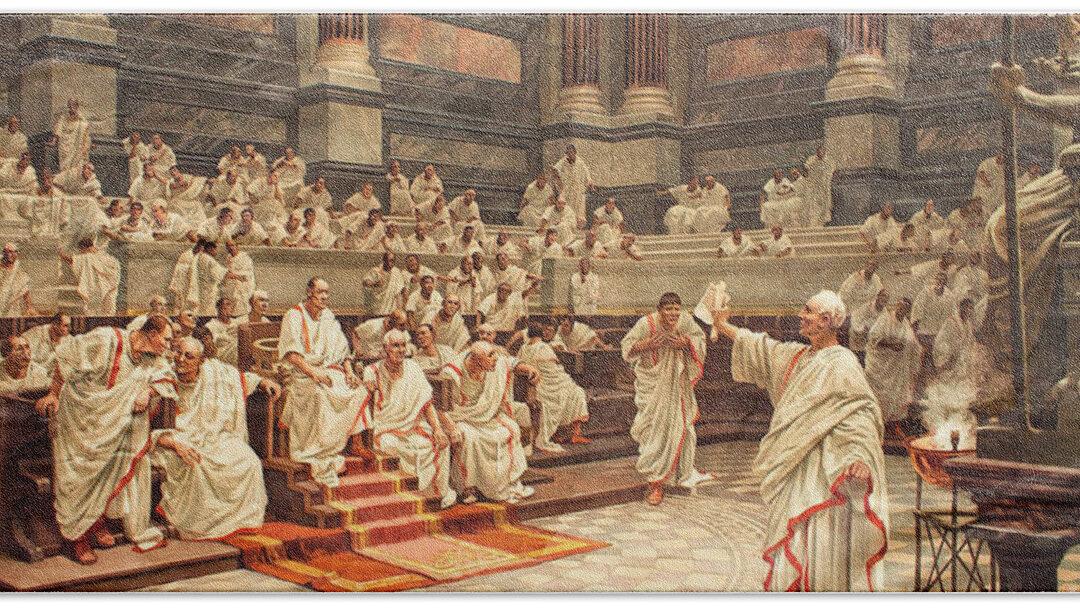
Today's Image: Cicero's Rede im Senat gegen Catilina
Artist: Hans Werner Schmidt
Chromolithograph 1912
Here is a text only version
[12] nunc iam aperte rem publicam universam petis, templa deorum immortalium, tecta urbis, vitam omnium civium, Italiam totam ad exitium et vastitatem vocas. qua re, quoniam id quod est primum, et quod huius imperi disciplinaeque maiorum proprium est, facere nondum audeo, faciam id quod est ad severitatem lenius, ad communem salutem utilius. nam si te interfici iussero, residebit in re publica reliqua coniuratorum manus; sin tu, quod te iam dudum hortor, exieris, exhaurietur ex urbe tuorum comitum magna et perniciosa sentina rei publicae. quid est, Catilina?
Chapter 6
[13] num dubitas id me imperante facere quod iam tua sponte faciebas? exire ex urbe iubet consul hostem. interrogas me, num in exsilium?
Need Help Understanding the Latin?
You might find it helpful to start with the Side-by-Side Version which allows you to see my own very literal translation of the text which is almost a word-for-word translation - in an attempt to make it easier to understand the Latin!
Finally come back to this page - Classical Text and you should be able to better understand and competently read the original Latin text.
Vocabulary Version
I have prepared a Vocabulary Version of the passage (link at bottom of the page) which highlights the 3057 Most Common Words in the texts of Vergil, Caesar and Cicero that we will explore on CentumVerba.com
If you are serious about building your vocabulary, the FLASHCARD set should help you learn them.
How To Read the Interactive Text
To Read the Interactive Text Below Without a Dictionary-
On a Computer: you hover over a word and get all the possible parts of speech; declensions; and conjugations of every word.
Need Help Understanding the Latin?
You might find it helpful to start with the Side-by-Side Version which allows you to see my own very literal translation of the text which is almost a word-for-word translation - in an attempt to make it easier to understand the Latin!
Finally come back to this page - Classical Text and you should be able to better understand and competently read the original Latin text.
Vocabulary Version
I have prepared a Vocabulary Version of the passage (link at bottom of the page) which highlights the 3057 Most Common Words in the texts of Vergil, Caesar and Cicero that we will explore on CentumVerba.com
If you are serious about building your vocabulary, the FLASHCARD set should help you learn them.
How To Read the Interactive Text
To Read the Interactive Text Below Without a Dictionary-
On a Phone or Tablet: don't 'hover' -'tap' the word. To remove the 'definition box' you 'tap' to the side of the text box.
INTERACTIVE DICTIONARY FREE TEXT
[12] nunc iam aperte rem publicam universam petis, templa deorum immortalium, tecta urbis, vitam omnium civium, Italiam totam ad exitium et vastitatem vocas.
You Need to be a Member to Access the Interactive Dictionary
qua re, quoniam id quod est primum, et quod huius imperi disciplinaeque maiorum proprium est, facere nondum audeo, faciam id quod est ad severitatem lenius, ad communem salutem utilius.
nam si te interfici iussero, residebit in re publica reliqua coniuratorum manus; sin tu, quod te iam dudum hortor, exieris, exhaurietur ex urbe tuorum comitum magna et perniciosa sentina rei publicae.
quid est, Catilina?
Chapter 6
[13] num dubitas id me imperante facere quod iam tua sponte faciebas? exire ex urbe iubet consul hostem. interrogas me, num in exsilium?
Recent Comments