
universus - turned into one
The Latin adjective universus is a fascinating word that conveys the idea of entirety, wholeness, and universality. It is derived from unus (meaning ‘one’) and versus (meaning ‘turned’), which together suggest something that is ‘turned into one’ or ‘taken as a whole’. This etymology reflects the word’s fundamental meaning: something that is complete, all-encompassing, or collectively considered.
Meaning and Usage
In classical Latin, universus was used to describe things that were whole or entire. It could refer to a group taken collectively rather than individually. For example, in political or social contexts, universus populus meant ‘the entire people’ or ‘the whole population.’ Similarly, universa civitas referred to ‘the entire state’ or ‘the whole community’. The word was often used to emphasize totality, distinguishing it from individual components.
Grammatical Forms
Universus follows the first and second declension patterns in Latin. It has masculine (universus), feminine (universa), and neuter (universum) forms, allowing it to modify nouns of different genders. The declension pattern ensures that it can be used flexibly in various grammatical constructions.
Philosophical and Scientific Influence
The concept of universus played a significant role in philosophical and scientific thought. The idea of the universe (universum) as a single, unified entity stems from this Latin root. Ancient Roman thinkers, influenced by Greek philosophy, used the term to describe the cosmos as an interconnected whole. This notion carried forward into medieval and modern philosophy, shaping discussions about existence, reality, and the nature of the world.
Legacy in Modern Languages
The Latin universus has left a lasting impact on many modern languages. Words like ‘universe’ in English, universo in Italian and Spanish, and universum in German all trace their origins back to this Latin adjective. These words continue to convey the idea of totality and completeness, demonstrating the enduring influence of Latin on contemporary vocabulary.
Thus, universus is more than just a word—it is a concept that has shaped how we understand wholeness, unity, and the vastness of existence.
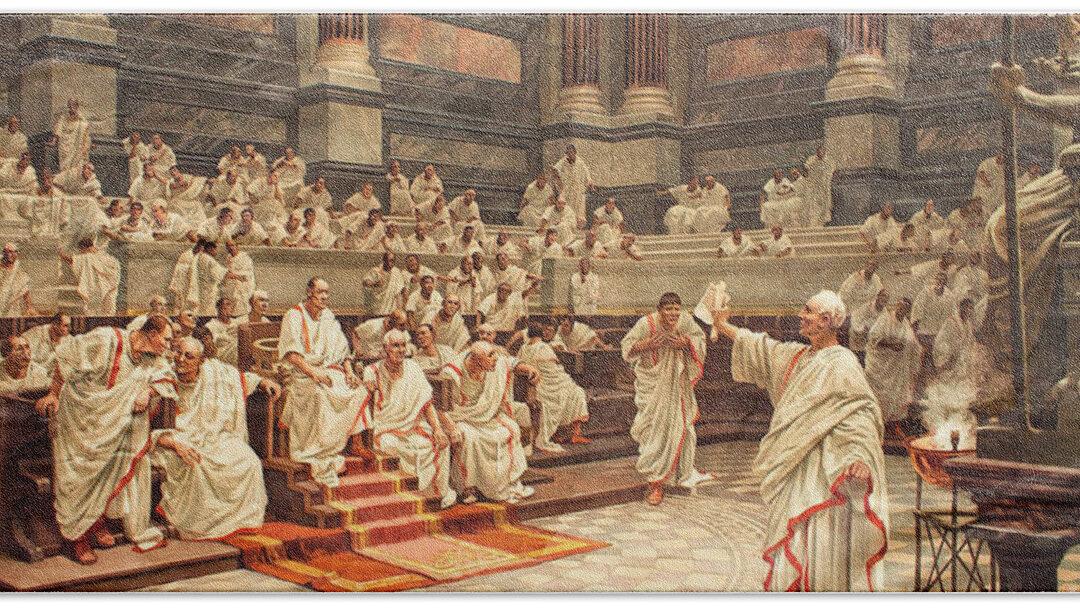
Today's Image: Cicero's Rede im Senat gegen Catilina
Artist: Hans Werner Schmidt
Chromolithograph 1912
Red and Green Vocab
The words in red and green are found among the 3057 Most Common Words in the Classical Latin texts that we will explore on CentumVerba.com and are essential to your understanding of the texts of Caesar, Vergil and Cicero. The green words appear frequently (at least five times) among Vergil's Aeneid (books I-VI), Caesar de bello Gallico (books I-V) and in Cicero's works - in Catilinam (books I-IV), de lege Manilia (also known as de Imperio Cn. Pompei), and pro Achia. These works constituted the curriculum for Latin over 4 years in American High Schools at the start of the 20th Century. The bulk of my information is taken from The Vocabulary of High School Latin by Gonzalez Lodge. I have added to these 2000 words from varioius other sources to compile my own list of The 3057 Most Common Latin Words.
The black words do not appear frequently in Classical Latin.
The red words are the first occurrences of these words in this author and this word will appear as green the next time you encounter it.
If you are serious about building your vocabulary then you should learn the red words as they occur and you should already know the green ones!
I have provided a FLASHCARD set to help - see below.
How To Read the Interactive Text
To Read the Interactive Text Below Without a Dictionary-
On a Computer: you hover over a word and get all the possible parts of speech; declensions; and conjugations of every word.
Red and Green Vocab
The words in red and green are found among the 3057 Most Common Words in the Classical Latin texts that we will explore on CentumVerba.com and are essential to your understanding of the texts of Caesar, Vergil and Cicero. The green words appear frequently (at least five times) among Vergil's Aeneid (books I-VI), Caesar de bello Gallico (books I-V) and in Cicero's works - in Catilinam (books I-IV), de lege Manilia (also known as de Imperio Cn. Pompei), and pro Achia. These works constituted the curriculum for Latin over 4 years in American High Schools at the start of the 20th Century. The bulk of my information is taken from The Vocabulary of High School Latin by Gonzalez Lodge. I have added to these 2000 words from varioius other sources to compile my own list of The 3057 Most Common Latin Words.
The black words do not appear frequently in Classical Latin.
The red words are the first occurrences of these words in this author and this word will appear as green the next time you encounter it.
If you are serious about building your vocabulary then you should learn the red words as they occur and you should already know the green ones!
I have provided a FLASHCARD set to help - see below.
How To Read the Interactive Text
To Read the Interactive Text Below Without a Dictionary-
On a Phone or Tablet: don't 'hover' -'tap' the word. To remove the 'definition box' you 'tap' to the side of the text box.
INTERACTIVE DICTIONARY FREE TEXT
[12] nunc iam aperte rem publicam universam petis, templa deorum immortalium, tecta urbis, vitam omnium civium, Italiam totam ad exitium et vastitatem vocas.
You Need to be a Member to Access the Interactive Dictionary
qua re, quoniam id quod est primum, et quod huius imperi disciplinaeque maiorum proprium est, facere nondum audeo, faciam id quod est ad severitatem lenius, ad communem salutem utilius.
nam si te interfici iussero, residebit in re publica reliqua coniuratorum manus; sin tu, quod te iam dudum hortor, exieris, exhaurietur ex urbe tuorum comitum magna et perniciosa sentina rei publicae.
quid est, Catilina?
CHAPTER 6
[13] num dubitas id me imperante facere quod iam tua sponte faciebas? exire ex urbe iubet consul hostem. interrogas me, num in exsilium?
I have prepared online Flashcards at CRAM.com to make learning the vocabulary much easier. I have no financial gain from you using the app as it is FREE to use.
I have created a stack of the 23 new words in this passage.
Here is the link to the FLASHCARDS
USING THE FLASHCARD APP:
To make the most of the online Flashcards use the "Click or use spacebar to begin" and the Latin word should appear. (The 'Shuffle' button will take the cards out of alphabetical order.) Type 'H' to get the conjugation / declension of the word if you want to see it. 'H' takes tyou back to the word. Click 'See Answer' or use the Spacebar to see the English.
If you were correct or close enough then select "I was right" or else "I was wrong". After you have completed the set it will start again but it will only display the ones you got wrong.
Continue through this process to learn all the words. I hope this is helpful!
Recent Comments