
appello - to call or not to call...
The Latin verbs appello, appellare and appello, appellere share a common root but diverge significantly in meaning and usage within Latin literature and discourse. Their differences stem from their grammatical conjugations—one belonging to the first conjugation (appellāre) and the other to the third (appellere)—and their semantic roles in classical Latin texts. Understanding these distinctions requires an examination of their functions in various contexts.
Appello, appellare (First Conjugation)
The verb appello, appellare primarily means ‘to call’ or ‘to name’ someone or something. It is a transitive verb frequently used in rhetorical, legal, and everyday contexts, often with an accusative object indicating what is being called or addressed.
Cicero, for example, employs appellare in legal discussions when referring to the act of addressing someone formally or making appeals in legal cases. Similarly, historians like Livy use appello to signify the act of designating a title or calling upon someone in a formal or political sense.
A notable extension of appello, appellare is its use in the naming conventions of Latin texts. Roman authors frequently use this verb when describing how people, places, or concepts are given their titles, aligning it closely with the English cognate ‘appellation.’ It is commonly used in expressions such as Hoc oppidum Roma appellatur (‘This town is called Rome’), where the emphasis is on assigning a name.
Appello, appellere (Third Conjugation)
By contrast, appello, appellere carries a completely different meaning related to movement. It generally translates to ‘drive to,’ ‘bring to,’ or ‘push toward’ and is commonly used in military, nautical, and geographical contexts.
Latin authors such as Caesar and Tacitus use appellere to describe the movement of armies or ships. For example, in military narratives, appellere often denotes the act of driving troops toward a location or forcing an enemy into a position. In naval contexts, the verb is frequently found in descriptions of ships landing at a shore (navem ad litus appellere – ‘to bring the ship to shore’).
Unlike appellāre, which involves verbal designation or communication, appellere is concerned with the physical act of directing or propelling something toward a destination. The verb often works with an accusative direct object (indicating what is being moved) and a prepositional phrase showing direction or arrival.
Conclusion
The contrast between appello, appellare and appello, appellere highlights an important distinction in Latin: verbal actions versus physical actions. While appellare deals with naming and addressing, appellere relates to movement and force. Despite their similar spelling, their meanings serve distinct roles in Latin writing. Understanding these nuances helps in parsing Latin texts accurately and recognizing the precision with which Roman authors conveyed both communication and motion.
In this passage it is the third conjugation verb that is used ‘cum Argonautae navem appulerunt.’ The Argonauts are not calling their ship but are pulling them onto the shore. To differentiate between the two conjugations when this situation arises in text you will find a number after the definition in the dictionary text e.g. ‘appello (3).’
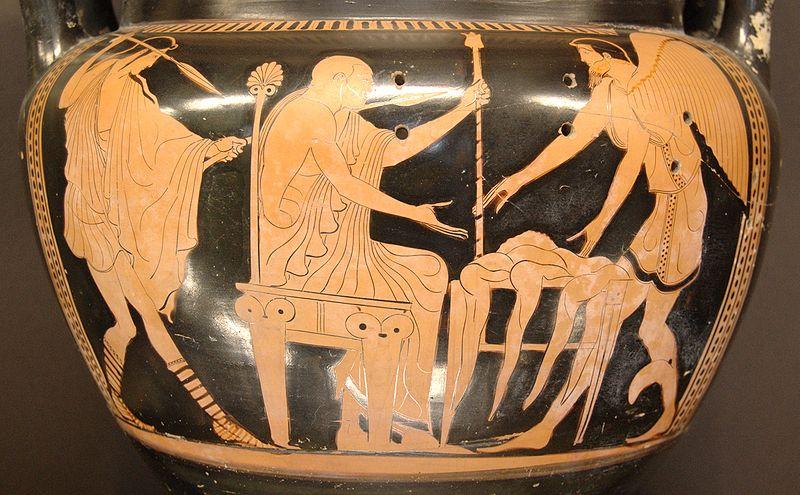
Today's Artwork: Phineus and the Harpies
Painted by: The Leningrad Painter, c. 460 BC
Depicts the Boread twins, Calais and Zetes, rescuing Phineus (seated) from the Harpies.Source: The Louvre
Here is a text only version. (See below for an interactive version)
9 Res igitur in hoc loco erant, cum Argonautae navem appulerunt. Phineus autem, simul atque audivit eos in suos finis egressos esse, magno opere gavisus est.
Sciebat enim quantam opinionem virtutis Argonautae haberent nec dubitabat quin sibi auxilium ferrent.
Nuntium igitur ad navem misit, qui Iasonem sociosque ad regiam vocaret.
Eo cum venissent, Phineus demonstravit quanto in periculo suae res essent et promisit se magna praemia daturum esse, si illi remedium repperissent.
Argonautae negotium libenter susceperunt et ubi hora venit cum rege accubuerunt; at simul ac cena apposita est, Harpyiae cenaculum intraverunt et cibum auferre conabantur.
Argonautae primum gladiis volucris petierunt; cum tamen viderent hoc nihil prodesse, Zetes et Calais, qui alis instructi sunt, in aera se sublevaverunt, ut desuper impetum facerent.
Quod cum sensissent Harpyiae, rei novitate perterritae, statim aufugerunt neque postea umquam redierunt.
Red and Green Vocab
The words in red and green are found among the 3057 Most Common Words in the Classical Latin texts that we will explore on CentumVerba.com and are essential to your understanding of the texts of Caesar, Vergil and Cicero. The green words appear frequently (at least five times) among Vergil's Aeneid (books I-VI), Caesar de bello Gallico (books I-V) and in Cicero's works - in Catilinam (books I-IV), de lege Manilia (also known as de Imperio Cn. Pompei), and pro Achia. These works constituted the curriculum for Latin over 4 years in American High Schools at the start of the 20th Century. The bulk of my information is taken from The Vocabulary of High School Latin by Gonzalez Lodge. I have added to these 2000 words from varioius other sources to compile my own list of The 3057 Most Common Latin Words.
The black words do not appear frequently in Classical Latin.
The red words are the first occurrences of these words in this author and this word will appear as green the next time you encounter it.
If you are serious about building your vocabulary then you should learn the red words as they occur and you should already know the green ones!
I have provided a FLASHCARD set to help - see below.
How To Read the Interactive Text
To Read the Interactive Text Below Without a Dictionary-
On a Computer: you hover over a word and get all the possible parts of speech; declensions; and conjugations of every word.
Red and Green Vocab
The words in red and green are found among the 3057 Most Common Words in the Classical Latin texts that we will explore on CentumVerba.com and are essential to your understanding of the texts of Caesar, Vergil and Cicero. The green words appear frequently (at least five times) among Vergil's Aeneid (books I-VI), Caesar de bello Gallico (books I-V) and in Cicero's works - in Catilinam (books I-IV), de lege Manilia (also known as de Imperio Cn. Pompei), and pro Achia. These works constituted the curriculum for Latin over 4 years in American High Schools at the start of the 20th Century. The bulk of my information is taken from The Vocabulary of High School Latin by Gonzalez Lodge. I have added to these 2000 words from varioius other sources to compile my own list of The 3057 Most Common Latin Words.
The black words do not appear frequently in Classical Latin.
The red words are the first occurrences of these words in this author and this word will appear as green the next time you encounter it.
If you are serious about building your vocabulary then you should learn the red words as they occur and you should already know the green ones!
I have provided a FLASHCARD set to help - see below.
How To Read the Interactive Text
To Read the Interactive Text Below Without a Dictionary-
On a Phone or Tablet: don't 'hover' -'tap' the word. To remove the 'definition box' you 'tap' to the side of the text box.
INTERACTIVE DICTIONARY FREE TEXT
9 Res igitur in hoc loco erant, cum Argonautae navem appulerunt. Phineus autem, simul atque audivit eos in suos finis egressos esse, magno opere gavisus est.
You Need to be a Member to Access the Interactive Dictionary
Sciebat enim quantam opinionem virtutis Argonautae haberent nec dubitabat quin sibi auxilium ferrent.
Nuntium igitur ad navem misit, qui Iasonem sociosque ad regiam vocaret.
Eo cum venissent, Phineus demonstravit quanto in periculo suae res essent et promisit se magna praemia daturum esse, si illi remedium repperissent.
Argonautae negotium libenter susceperunt et ubi hora venit cum rege accubuerunt; at simul ac cena apposita est, Harpyiae cenaculum intraverunt et cibum auferre conabantur.
Argonautae primum gladiis volucris petierunt; cum tamen viderent hoc nihil prodesse, Zetes et Calais, qui alis instructi sunt, in aera se sublevaverunt, ut desuper impetum facerent.
Quod cum sensissent Harpyiae, rei novitate perterritae, statim aufugerunt neque postea umquam redierunt.
I have prepared online Flashcards at CRAM.com to make learning the vocabulary much easier. I have no financial gain from you using the app as it is FREE to use.
I have created a stack of the 26 new words in this passage.
YOU NEED TO SIGN UP AS A TRIAL MEMBER TO ACCESS THE FLASHCARDS
Here is the link to the FLASHCARDS
USING THE FLASHCARD APP:
To make the most of the online Flashcards use the "Click or use spacebar to begin" and the Latin word should appear. (The 'Shuffle' button will take the cards out of alphabetical order.) Type 'H' to get the conjugation / declension of the word if you want to see it. 'H' takes tyou back to the word. Click 'See Answer' or use the Spacebar to see the English.
If you were correct or close enough then select "I was right" or else "I was wrong". After you have completed the set it will start again but it will only display the ones you got wrong.
Continue through this process to learn all the words. I hope this is helpful!
Recent Comments