
pro - not this time bono!
The Latin preposition pro is one of the most versatile and widely used words in classical literature, carrying meanings related to substitution, defense, advantage, and location. It governs the ablative case and frequently appears in expressions denoting support, exchange, or position.
One of the fundamental meanings of pro is ‘for’ or ‘on behalf of.’ It is commonly used in political and legal contexts, such as in pro populo (‘for the people’) or pro patria (‘for the fatherland’), emphasizing advocacy or dedication to a cause. Cicero, for example, uses pro extensively in his speeches, often to denote his defence of Roman values or individuals in legal cases (Pro Caelio, Pro Milone).
Additionally, pro can indicate substitution or exchange, similar to the English ‘in place of.’ In economic and rhetorical discussions, Roman authors use expressions like pro pecunia (‘in exchange for money’) or pro salute (‘in exchange for safety’), highlighting its transactional implications.
Pro also denotes position, meaning ‘in front of’ or ‘before.’ In military contexts, authors like Caesar use it to describe strategic placements—pro castris (‘in front of the camp’)—emphasizing tactical advantage and spatial awareness.
Beyond its literal meanings, pro often carries a rhetorical or philosophical dimension. Poets and philosophers employ it to convey moral superiority or justification, as seen in Seneca’s pro virtute (‘on behalf of virtue’). Its adaptability allows it to shape arguments and strengthen literary themes.
Ultimately, pro exemplifies the efficiency and expressiveness of Latin, playing a crucial role in legal, military, philosophical, and poetic discourse. Whether in defense, exchange, or spatial description, its nuanced applications reveal the precision and depth of Roman thought.
The Latin preposition pro appears in many famous works of classical literature, serving a variety of functions. Here are a few notable examples:
- Cicero – Pro Milone
Cicero frequently uses pro in legal contexts, as seen in his defence of Milo (Pro Milone), where he argues pro re publica (‘on behalf of the republic’). This usage emphasizes advocacy and defence, reinforcing Milo’s actions as beneficial to Rome. - Caesar – Commentarii de Bello Gallico
Julius Caesar employs pro in military descriptions, such as pro castris (‘in front of the camp’), to specify troop formations and strategic placements. This highlights the preposition’s importance in military discourse. - Virgil – Aeneid
In Virgil’s Aeneid, we find pro used in poetic and rhetorical contexts, such as pro vita (‘for life’), emphasizing sacrifice and duty. Virgil often employs pro to express devotion to a cause or higher purpose. - Seneca – Epistulae Morales ad Lucilium
In his philosophical writings, Seneca uses pro virtute (‘on behalf of virtue’) to discuss moral superiority and ethical duty. Pro in this context conveys a philosophical stance advocating virtue as a guiding principle.
Each of these examples showcases how pro functions in different domains—legal, military, poetic, and philosophical—illustrating its versatility in Latin literature. Would you like additional examples or further explanation on any of these texts?
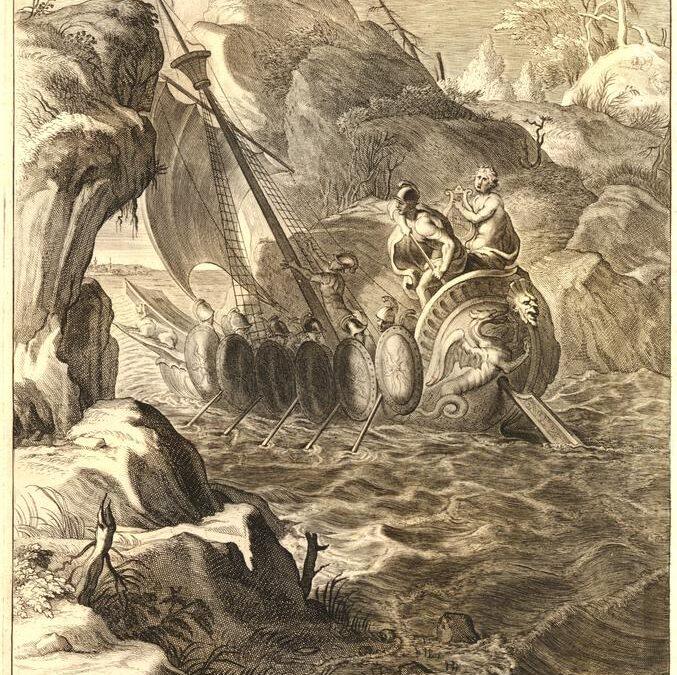
Today's Artwork: Phineus and the Harpies
Print made by: Cornelis Bloemaert & Theodor Matham (background only)
After: Abraham van DiepenbeeckSource: The British Museum
Here is a text only version. (See below for an interactive version)
9 Res igitur in hoc loco erant, cum Argonautae navem appulerunt. Phineus autem, simul atque audivit eos in suos finis egressos esse, magno opere gavisus est. Sciebat enim quantam opinionem virtutis Argonautae haberent nec dubitabat quin sibi auxilium ferrent. Nuntium igitur ad navem misit, qui Iasonem sociosque ad regiam vocaret. Eo cum venissent, Phineus demonstravit quanto in periculo suae res essent et promisit se magna praemia daturum esse, si illi remedium repperissent.
Argonautae negotium libenter susceperunt et ubi hora venit cum rege accubuerunt; at simul ac cena apposita est, Harpyiae cenaculum intraverunt et cibum auferre conabantur. Argonautae primum gladiis volucris petierunt; cum tamen viderent hoc nihil prodesse, Zetes et Calais, qui alis instructi sunt, in aera se sublevaverunt, ut desuper impetum facerent. Quod cum sensissent Harpyiae, rei novitate perterritae, statim aufugerunt neque postea umquam redierunt.
Red and Green Vocab
The words in red and green are found among the 3057 Most Common Words in the Classical Latin texts that we will explore on CentumVerba.com and are essential to your understanding of the texts of Caesar, Vergil and Cicero. The green words appear frequently (at least five times) among Vergil's Aeneid (books I-VI), Caesar de bello Gallico (books I-V) and in Cicero's works - in Catilinam (books I-IV), de lege Manilia (also known as de Imperio Cn. Pompei), and pro Achia. These works constituted the curriculum for Latin over 4 years in American High Schools at the start of the 20th Century. The bulk of my information is taken from The Vocabulary of High School Latin by Gonzalez Lodge. I have added to these 2000 words from varioius other sources to compile my own list of The 3057 Most Common Latin Words.
The black words do not appear frequently in Classical Latin.
The red words are the first occurrences of these words in this author and this word will appear as green the next time you encounter it.
If you are serious about building your vocabulary then you should learn the red words as they occur and you should already know the green ones!
I have provided a FLASHCARD set to help - see below.
How To Read the Interactive Text
To Read the Interactive Text Below Without a Dictionary-
On a Computer: you hover over a word and get all the possible parts of speech; declensions; and conjugations of every word.
Red and Green Vocab
The words in red and green are found among the 3057 Most Common Words in the Classical Latin texts that we will explore on CentumVerba.com and are essential to your understanding of the texts of Caesar, Vergil and Cicero. The green words appear frequently (at least five times) among Vergil's Aeneid (books I-VI), Caesar de bello Gallico (books I-V) and in Cicero's works - in Catilinam (books I-IV), de lege Manilia (also known as de Imperio Cn. Pompei), and pro Achia. These works constituted the curriculum for Latin over 4 years in American High Schools at the start of the 20th Century. The bulk of my information is taken from The Vocabulary of High School Latin by Gonzalez Lodge. I have added to these 2000 words from varioius other sources to compile my own list of The 3057 Most Common Latin Words.
The black words do not appear frequently in Classical Latin.
The red words are the first occurrences of these words in this author and this word will appear as green the next time you encounter it.
If you are serious about building your vocabulary then you should learn the red words as they occur and you should already know the green ones!
I have provided a FLASHCARD set to help - see below.
How To Read the Interactive Text
To Read the Interactive Text Below Without a Dictionary-
On a Phone or Tablet: don't 'hover' -'tap' the word. To remove the 'definition box' you 'tap' to the side of the text box.
INTERACTIVE DICTIONARY FREE TEXT
10 Hoc facto, Phineus, ut pro tanto beneficio meritas gratias referret, Iasoni demonstravit qua ratione Symplegades vitare posset.
You Need to be a Member to Access the Interactive Dictionary
Symplegades autem duae erant rupes ingenti magnitudine, quae a Iove positae erant eo consilio, ne quis ad Colchida perveniret.
Hae parvo intervallo in mari natabant et si quid in medium spatium venerat incredibili celeritate concurrebant.
Postquam igitur a Phineo doctus est quid faciendum esset, Iason sublatis ancoris navem solvit et leni vento provectus mox ad Symplegades appropinquavit; tum in prora stans columbam quam in manu tenebat emisit.
Illa recta via per medium spatium volavit et priusquam rupes conflixerunt incolumis evasit cauda tantum amissa.
Tum rupes utrimque discesserunt; antequam tamen rursus concurrerent, Argonautae, bene intellegentes omnem spem salutis in celeritate positam esse, summa vi remis contenderunt et navem incolumem perduxerunt.
Hoc facto, dis gratias libenter egerunt, quorum auxilio e tanto periculo erepti essent; bene enim sciebant non sine auxilio deorum rem ita feliciter evenisse.
I have prepared online Flashcards at CRAM.com to make learning the vocabulary much easier. I have no financial gain from you using the app as it is FREE to use.
I have created a stack of the 26 new words in this passage.
YOU NEED TO SIGN UP AS A TRIAL MEMBER TO ACCESS THE FLASHCARDS
Here is the link to the FLASHCARDS
USING THE FLASHCARD APP:
To make the most of the online Flashcards use the "Click or use spacebar to begin" and the Latin word should appear. (The 'Shuffle' button will take the cards out of alphabetical order.) Type 'H' to get the conjugation / declension of the word if you want to see it. 'H' takes tyou back to the word. Click 'See Answer' or use the Spacebar to see the English.
If you were correct or close enough then select "I was right" or else "I was wrong". After you have completed the set it will start again but it will only display the ones you got wrong.
Continue through this process to learn all the words. I hope this is helpful!
Recent Comments