
statim - immediately, at once
The Latin adverb statim means 'immediately' or 'at once,' conveying a sense of urgency or instant action. It was frequently used by classical authors to indicate swift transitions, immediate consequences, or sudden realizations.
In Roman literature, statim appears in historical, philosophical, and poetic texts. Historians like Livy and Tacitus employed it to describe rapid military movements or decisive actions taken by leaders. For example, Tacitus might use statim to emphasize the immediacy of a command or the swift execution of a strategy. In Caesar’s Commentarii de Bello Gallico, the word often underscores the urgency of battlefield decisions.
Philosophers such as Seneca and Cicero used statim in moral and rhetorical contexts, emphasizing the immediacy of wisdom or action. Cicero, in his speeches, might use statim to stress the necessity of immediate justice or response in political matters.
Poets like Virgil and Ovid incorporated statim to heighten dramatic tension. In epic poetry, the word could signal a sudden transformation or an immediate divine intervention. For instance, Ovid’s Metamorphoses often describes characters undergoing instant metamorphosis, where statim marks the precise moment of change.
The versatility of statim made it a powerful linguistic tool, shaping narratives and arguments with a sense of urgency. Whether in historical accounts, philosophical discourse, or poetic imagery, classical authors used statim to create immediacy and impact in their writing.
The images for these posts on Mark's gospel
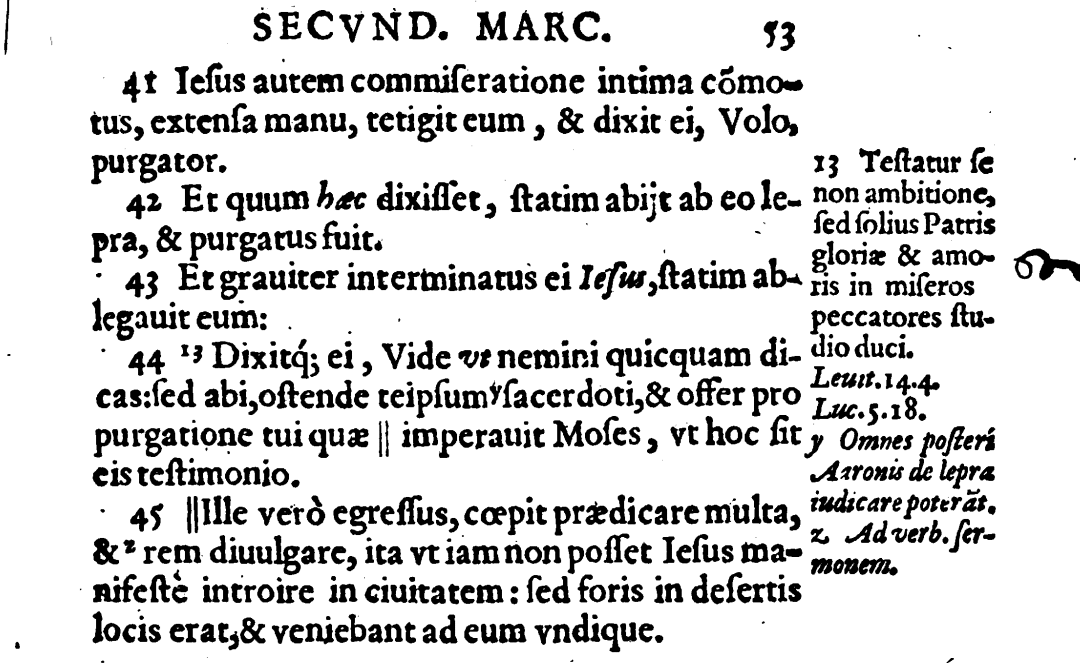
Screenshots taken from the Nouum Testamentum of Théodore de Bèze, (1519-1605) ( Londini : Thomas Vautrollerius, typographus, 1587 )
Accessed from the Post Reformation Digital Library
Red and Green Vocab
The words in red and green are found among the 3057 Most Common Words in the Classical Latin texts that we will explore on CentumVerba.com and are essential to your understanding of the texts of Caesar, Vergil and Cicero. The green words appear frequently (at least five times) among Vergil's Aeneid (books I-VI), Caesar de bello Gallico (books I-V) and in Cicero's works - in Catilinam (books I-IV), de lege Manilia (also known as de Imperio Cn. Pompei), and pro Achia. These works constituted the curriculum for Latin over 4 years in American High Schools at the start of the 20th Century. The bulk of my information is taken from The Vocabulary of High School Latin by Gonzalez Lodge. I have added to these 2000 words from varioius other sources to compile my own list of The 3057 Most Common Latin Words.
The black words do not appear frequently in Classical Latin.
The red words are the first occurrences of these words in this author and this word will appear as green the next time you encounter it.
If you are serious about building your vocabulary then you should learn the red words as they occur and you should already know the green ones!
I have provided a FLASHCARD set to help - see below.
How To Read the Interactive Text
To Read the Interactive Text Below Without a Dictionary-
On a Computer: you hover over a word and get all its possible parts of speech; declensions; and conjugations.
On a Tablet: 'Tap' the word to see the definition, and to remove the 'definition box' you simply 'Tap' anywhere to the side.
Red and Green Vocab
The words in red and green are found among the 3057 Most Common Words in the Classical Latin texts that we will explore on CentumVerba.com and are essential to your understanding of the texts of Caesar, Vergil and Cicero. The green words appear frequently (at least five times) among Vergil's Aeneid (books I-VI), Caesar de bello Gallico (books I-V) and in Cicero's works - in Catilinam (books I-IV), de lege Manilia (also known as de Imperio Cn. Pompei), and pro Achia. These works constituted the curriculum for Latin over 4 years in American High Schools at the start of the 20th Century. The bulk of my information is taken from The Vocabulary of High School Latin by Gonzalez Lodge. I have added to these 2000 words from varioius other sources to compile my own list of The 3057 Most Common Latin Words.
The black words do not appear frequently in Classical Latin.
The red words are the first occurrences of these words in this author and this word will appear as green the next time you encounter it.
If you are serious about building your vocabulary then you should learn the red words as they occur and you should already know the green ones!
I have provided a FLASHCARD set to help - see below.
How To Read the Interactive Text
To Read the Interactive Text Below Without a Dictionary-
On a Phone or Tablet: ''TAP' the word to see the definition, and to remove the 'definition box' you simply 'TAP' anywhere to the side.
INTERACTIVE DICTIONARY FREE TEXT
39 et erat prædicans in synagogis eorum et in omni Galilæa et dæmonia eiciens.
40 Et venit ad eum leprosus deprecans eum et genu flexo dixit ei si vis potes me mundare.
You Need to be at least a Trial Member to Access the Interactive Dictionary
41 Iesus autem misertus eius extendit manum suam et tangens eum ait illi volo: mundare
42 et cum dixisset statim discessit ab eo lepra et mundatus est
43 et comminatus ei statim eiecit illum
44 et dicit ei vide nemini dixeris sed vade ostende te principi sacerdotum et offer pro emundatione tua quæ præcepit Moses in testimonium illis.
45 At ille egressus cœpit prædicare et diffamare sermonem ita ut iam non posset manifeste introire in civitatem sed foris in desertis locis esset et conveniebant ad eum undique.
I have prepared online Flashcards at CRAM.com to make learning the vocabulary much easier. I have no financial gain as the app is FREE to use.
I have created a stack of the 21 new words in this passage.
YOU NEED TO SIGN UP AS A TRIAL MEMBER TO ACCESS THE FLASHCARDS
Here is the link to the FLASHCARDS
USING THE FLASHCARD APP:
To make the most of the online Flashcards use the "Click or use spacebar to begin" and the Latin word should appear. (The 'Shuffle' button will take the cards out of alphabetical order.) Type 'H' to get the conjugation / declension of the word if you want to see it. 'H' takes tyou back to the word. Click 'See Answer' or use the Spacebar to see the English.
If you were correct or close enough then select "I was right" or else "I was wrong". After you have completed the set it will start again but it will only display the ones you got wrong.
Continue through this process to learn all the words. I hope this is helpful!
Recent Comments