
autem - but on the other hand
The Latin conjunction autem is a postpositive word, meaning it always appears after the first word of a clause or phrase. It is typically translated as 'however', 'moreover', or 'on the other hand', and plays a crucial role in establishing contrast, emphasis, or logical progression in classical Latin texts.
Unlike sed or verum, which introduce direct contradictions, autem is often used to signal a mild contrast or a shift in thought, making it an essential tool for nuanced discourse. Cicero, the famed Roman orator, employs autem frequently in his speeches and philosophical writings to transition smoothly between arguments, highlighting subtle distinctions. Similarly, historians like Livy and Tacitus use autem to structure narratives, ensuring clarity when contrasting different events or perspectives.
Autem appears less often in poetry, as poets prefer more concise or emphatic conjunctions. However, in didactic and philosophical poetry—such as Lucretius' De Rerum Natura—it serves as a rhetorical aid to guide readers through complex arguments.
Grammatically, autem is a 'coordinating conjunction', meaning it does not subordinate clauses but rather connects them on equal footing. Its placement within a sentence underscores its function: it subtly shapes meaning without disrupting flow.
The versatility of autem made it a staple in rhetorical Latin, ensuring smooth transitions and logical coherence. Its careful use reflects the precision and elegance of Latin prose, reinforcing its enduring role in structured argumentation and historical narration.
The images for these posts on Mark's gospel
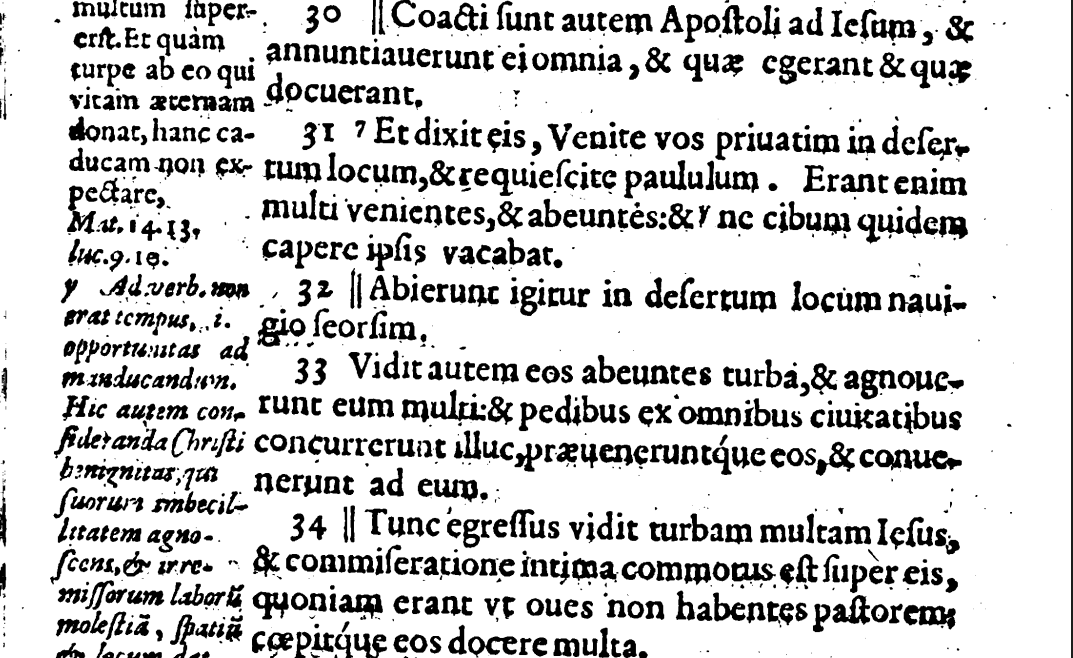
Screenshots taken from the Nouum Testamentum of Théodore de Bèze, (1519-1605) ( Londini : Thomas Vautrollerius, typographus, 1587 )
Accessed from the Post Reformation Digital Library
Red and Green Vocab
The words in red and green are found among the 3057 Most Common Words in the Classical Latin texts that we will explore on CentumVerba.com and are essential to your understanding of the texts of Caesar, Vergil and Cicero. The green words appear frequently (at least five times) among Vergil's Aeneid (books I-VI), Caesar de bello Gallico (books I-V) and in Cicero's works - in Catilinam (books I-IV), de lege Manilia (also known as de Imperio Cn. Pompei), and pro Achia. These works constituted the curriculum for Latin over 4 years in American High Schools at the start of the 20th Century. The bulk of my information is taken from The Vocabulary of High School Latin by Gonzalez Lodge. I have added to these 2000 words from varioius other sources to compile my own list of The 3057 Most Common Latin Words.
The black words do not appear frequently in Classical Latin.
The red words are the first occurrences of these words in this author and this word will appear as green the next time you encounter it.
If you are serious about building your vocabulary then you should learn the red words as they occur and you should already know the green ones!
I have provided a FLASHCARD set to help - see below.
How To Read the Interactive Text
To Read the Interactive Text Below Without a Dictionary-
On a Computer: you hover over a word and get all its possible parts of speech; declensions; and conjugations.
On a Tablet: 'Tap' the word to see the definition, and to remove the 'definition box' you simply 'Tap' anywhere to the side.
Red and Green Vocab
The words in red and green are found among the 3057 Most Common Words in the Classical Latin texts that we will explore on CentumVerba.com and are essential to your understanding of the texts of Caesar, Vergil and Cicero. The green words appear frequently (at least five times) among Vergil's Aeneid (books I-VI), Caesar de bello Gallico (books I-V) and in Cicero's works - in Catilinam (books I-IV), de lege Manilia (also known as de Imperio Cn. Pompei), and pro Achia. These works constituted the curriculum for Latin over 4 years in American High Schools at the start of the 20th Century. The bulk of my information is taken from The Vocabulary of High School Latin by Gonzalez Lodge. I have added to these 2000 words from varioius other sources to compile my own list of The 3057 Most Common Latin Words.
The black words do not appear frequently in Classical Latin.
The red words are the first occurrences of these words in this author and this word will appear as green the next time you encounter it.
If you are serious about building your vocabulary then you should learn the red words as they occur and you should already know the green ones!
I have provided a FLASHCARD set to help - see below.
How To Read the Interactive Text
To Read the Interactive Text Below Without a Dictionary-
On a Phone or Tablet: ''TAP' the word to see the definition, and to remove the 'definition box' you simply 'TAP' anywhere to the side.
INTERACTIVE DICTIONARY FREE TEXT
30 decumbebat autem socrus Simonis febricitans et statim dicunt ei de illa
31 et accedens elevavit eam, apprehensa manu eius et continuo dimisit eam febris et ministrabat eis
32 vespere autem facto cum occidisset sol afferebant ad eum omnes male habentes et dæmonia habentes
33 et erat omnis civitas congregata ad ianuam
34 et curavit multos qui vexabantur variis languoribus et dæmonia multa eiciebat. Et non sinebat ea loqui, quoniam sciebant eum.
35 Et diluculo valde surgens egressus abiit in desertum locum ibique orabat.
36 et prosecutus est eum Simon et qui cum illo erant
37 et cum invenissent eum dixerunt ei quia omnes quærunt te
38 et ait illis eamus in proximos vicos et civitates ut et ibi prædicem ad hoc enim veni
I have prepared online Flashcards at CRAM.com to make learning the vocabulary much easier. I have no financial gain as the app is FREE to use.
I have created a stack of the 23 new words in this passage.
YOU NEED TO SIGN UP AS A TRIAL MEMBER TO ACCESS THE FLASHCARDS
Here is the link to the FLASHCARDS
USING THE FLASHCARD APP:
To make the most of the online Flashcards use the "Click or use spacebar to begin" and the Latin word should appear. (The 'Shuffle' button will take the cards out of alphabetical order.) Type 'H' to get the conjugation / declension of the word if you want to see it. 'H' takes tyou back to the word. Click 'See Answer' or use the Spacebar to see the English.
If you were correct or close enough then select "I was right" or else "I was wrong". After you have completed the set it will start again but it will only display the ones you got wrong.
Continue through this process to learn all the words. I hope this is helpful!
Recent Comments