
mare - the sea in Latin literature
The Latin word mare (neuter noun, third declension) primarily translates to ‘sea’ and plays a significant role in both classical Latin literature and the Vulgate Bible. Its versatility made it a favored term among authors, expressing both the literal and metaphorical qualities of the sea.
In classical Latin, mare is frequently used by authors such as Virgil, Ovid, and Horace. For instance, in Virgil’s Aeneid, the word depicts the vast and perilous nature of the sea, often serving as a stage for heroism and divine intervention. Similarly, Ovid in his Metamorphoses employs mare to describe the physical seas as well as to symbolize transformation and fluidity. The sea's unpredictable nature became a metaphor for human emotions and the capriciousness of the gods.
In the Vulgate Bible, a Latin translation by St. Jerome, mare carries a theological resonance. It is used to describe real geographical seas, such as the Mediterranean or the Red Sea (Exodus 14:21, where the sea is parted for the Israelites). Beyond the literal, mare also appears in apocalyptic and symbolic contexts, such as in Revelation 21:1: “And there was no more sea” (et mare iam non erat), symbolizing the absence of chaos in the new creation. The word also reflects the Hebrew term yam, maintaining the biblical symbolism of the sea as a place of both danger and divine power.
The usage of mare across these contexts shows how the word not only denoted the natural world but also carried deep cultural and spiritual meaning.
The images for these posts on Mark's gospel
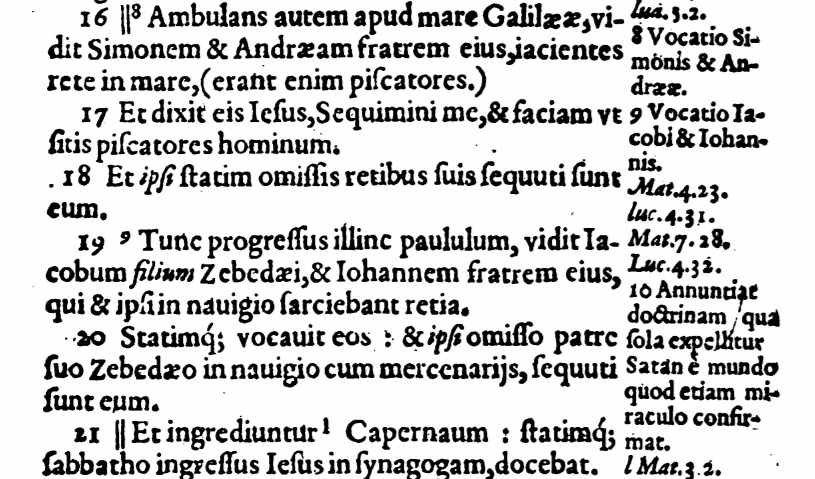
Screenshots taken from the Nouum Testamentum of Théodore de Bèze, (1519-1605) ( Londini : Thomas Vautrollerius, typographus, 1587 )
Accessed from the Post Reformation Digital Library
The words in red and green are found among the 3057 Most Common Words in the Classical Latin texts that we will explore on CentumVerba.com and are essential to your understanding of the texts of Caesar, Vergil and Cicero. The green words appear frequently (at least five times) among Vergil's Aeneid (books I-VI), Caesar de bello Gallico (books I-V) and in Cicero's works - in Catilinam (books I-IV), de lege Manilia (also known as de Imperio Cn. Pompei), and pro Achia. These works constituted the curriculum for Latin over 4 years in American High Schools at the start of the 20th Century. The bulk of my information is taken from The Vocabulary of High School Latin by Gonzalez Lodge. I have added to these 2000 words from varioius other sources to compile my own list of The 3057 Most Common Latin Words.
The black words do not appear frequently in Classical Latin.
The red words are the first occurrences of these words in this author and this word will appear as green the next time you encounter it.
If you are serious about building your vocabulary then you should learn the red words as they occur and you should already know the green ones!
I have provided a FLASHCARD set to help - see below.
To Read the Interactive Text Below Without a Dictionary-
On a Computer:
Hover over a word to get all its possible parts of speech, declensions, or conjugations.
On a Tablet:
'TAP' the word to see the definition, and to remove the 'definition box' you simply 'TAP' anywhere to the side.
mare - the sea in Latin literature
The Latin word mare (neuter noun, third declension) primarily translates to ‘sea’ and plays a significant role in both classical Latin literature and the Vulgate Bible. Its versatility made it a favored term among authors, expressing both the literal and metaphorical qualities of the sea.
In classical Latin, mare is frequently used by authors such as Virgil, Ovid, and Horace. For instance, in Virgil’s Aeneid, the word depicts the vast and perilous nature of the sea, often serving as a stage for heroism and divine intervention. Similarly, Ovid in his Metamorphoses employs mare to describe the physical seas as well as to symbolize transformation and fluidity. The sea's unpredictable nature became a metaphor for human emotions and the capriciousness of the gods.
In the Vulgate Bible, a Latin translation by St. Jerome, mare carries a theological resonance. It is used to describe real geographical seas, such as the Mediterranean or the Red Sea (Exodus 14:21, where the sea is parted for the Israelites). Beyond the literal, mare also appears in apocalyptic and symbolic contexts, such as in Revelation 21:1: “And there was no more sea” (et mare iam non erat), symbolizing the absence of chaos in the new creation. The word also reflects the Hebrew term yam, maintaining the biblical symbolism of the sea as a place of both danger and divine power.
The usage of mare across these contexts shows how the word not only denoted the natural world but also carried deep cultural and spiritual meaning.
The images for these posts on Mark's gospel
Screenshots taken from the Nouum Testamentum of Théodore de Bèze, (1519-1605) ( Londini : Thomas Vautrollerius, typographus, 1587 )
Accessed from the Post Reformation Digital Library
The words in red and green are found among the 3057 Most Common Words in the Classical Latin texts that we will explore on CentumVerba.com and are essential to your understanding of the texts of Caesar, Vergil and Cicero. The green words appear frequently (at least five times) among Vergil's Aeneid (books I-VI), Caesar de bello Gallico (books I-V) and in Cicero's works - in Catilinam (books I-IV), de lege Manilia (also known as de Imperio Cn. Pompei), and pro Achia. These works constituted the curriculum for Latin over 4 years in American High Schools at the start of the 20th Century. The bulk of my information is taken from The Vocabulary of High School Latin by Gonzalez Lodge. I have added to these 2000 words from varioius other sources to compile my own list of The 3057 Most Common Latin Words.
The black words do not appear frequently in Classical Latin.
The red words are the first occurrences of these words in this author and this word will appear as green the next time you encounter it.
If you are serious about building your vocabulary then you should learn the red words as they occur and you should already know the green ones!
I have provided a FLASHCARD set to help - see below.
To Read the Interactive Text Below Without a Dictionary-
On a Phone or Tablet: don't 'hover' -'tap' the word. To remove the 'definition box' you 'tap' to the side of the text box.
INTERACTIVE DICTIONARY FREE TEXT
16 et præteriens secus mare Galilææ vidit Simonem et Andream fratrem eius mittentes retia in mare erant enim piscatores
17 Et dixit eis Iesus venite post me et faciam vos fieri piscatores hominum.
18 et protinus relictis retibus secuti sunt eum.
19 Et progressus inde pusillum vidit Iacobum Zebedæi et Ioannem fratrem eius et ipsos in navi componentes retia
20 et statim vocavit illos et relicto patre suo Zebedæo in navi cum mercenariis secuti sunt eum.
21 Et ingrediuntur Capharnaum et statim sabbatis ingressus in synagogam docebat eos.
22 Et stupebant super doctrina eius erat enim docens eos quasi potestatem habens et non sicut scribæ.
I have prepared online Flashcards at CRAM.com to make learning the vocabulary much easier. I have no financial gain as the app is FREE to use.
I have created a stack of the 18 new words in this passage.
Here is the link to the FLASHCARDS
I have prepared online Flashcards at CRAM.com to make learning the vocabulary much easier. I have no financial gain as the app is FREE to use.
I have created a stack of the 18 new words in this passage.
Here is the link to the FLASHCARDS
USING THE FLASHCARD APP:
To make the most of the online Flashcards use the "Click or use spacebar to begin" and the Latin word should appear. (The 'Shuffle' button will take the cards out of alphabetical order.) Type 'H' to get the conjugation / declension of the word if you want to see it. 'H' takes tyou back to the word. Click 'See Answer' or use the Spacebar to see the English.
If you were correct or close enough then select "I was right" or else "I was wrong". After you have completed the set it will start again but it will only display the ones you got wrong.
Continue through this process to learn all the words. I hope this is helpful!
Recent Comments