
senatus - full of old men
The Latin noun senatus holds significant historical and cultural importance, as it refers to the Roman Senate, a crucial institution in ancient Rome's political system. The word senatus is a fourth-declension noun.
Historical Context:
The Roman Senate, or Senatus, played a pivotal role in the governance of Rome from its early days as a kingdom through the Republic and into the Empire. Initially, it was an advisory body to the kings, composed of Rome's leading patrician families. However, with the establishment of the Republic in 509 BCE, the Senate evolved into a more powerful institution, influencing legislation, foreign policy, and financial matters.
Composition and Functions:
The Senate was composed of senators, or senatores, who were primarily former magistrates. Entry into the Senate was often based on previous service in public office and was for life unless expelled for misconduct. The Senate's primary functions included:
- Advising Consuls: The Senate provided guidance to consuls, who were the chief executives of the Republic.
- Foreign Policy: It played a significant role in managing relations with foreign powers, including negotiating treaties and declaring war.
- Financial Oversight: The Senate controlled public finances and expenditures, ensuring the state’s economic stability.
- Legislation: While the Senate could not directly enact laws, it influenced legislative decisions through its decrees, known as senātūs consulta, which carried significant weight.
Influence and Legacy:
The influence of the Senate fluctuated over time, especially during the transition from Republic to Empire. Under the emperors, the Senate's authority was curtailed, but it remained a symbol of Roman tradition and governance. The term senatus itself is derived from senex, meaning old man, reflecting the original assembly of elders who advised the early kings.
Cultural Significance:
The concept of the Senate has left an enduring legacy, influencing modern legislative bodies. Many contemporary political systems, such as the United States and various European nations, have senates or similar institutions modeled after the Roman Senate. The idea of a deliberative assembly providing wisdom and continuity in governance remains a cornerstone of democratic principles.
Conclusion:
The Latin noun senatus encapsulates the rich history and enduring impact of the Roman Senate. As a vital institution in ancient Rome, the Senate shaped the political, social, and cultural landscape of one of history's most influential civilizations. Studying senatus offers valuable insights into Roman governance and the origins of modern political systems. If you have more questions or wish to explore other Latin terms, feel free to ask!
senatus appears relatively infrequently in our authors:
| AUTHOR | OCCURENCES |
| Caesar | 18 |
| Cicero | 14 |
| Vergil | 1 |
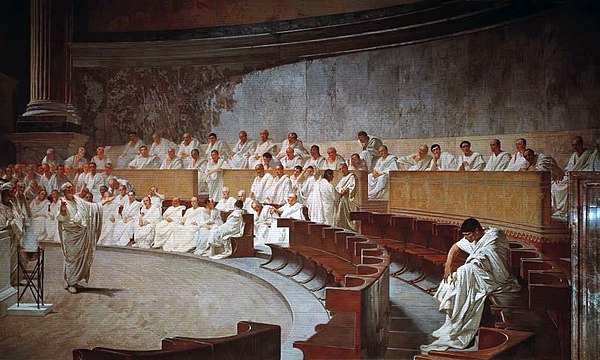
Today's Image: A fresco depicting Roman senator Cicero (106-43 BCE) denouncing Catiline's conspiracy to overthrow the Republic in the Roman senate. (Palazzo Madama, Rome)
Artist: Cesare Maccari (1840-1919)
Location: Palazzo Madama, Rome
To Read the Interactive Text Below Without a Dictionary-
On a Computer: you hover over a word and get all the possible parts of speech; declensions; and conjugations of every word.
The words in red and green are found among the 3057 Most Common Words in the Classical Latin texts that we will explore on CentumVerba.com and are essential to your understanding of the texts of Caesar, Vergil and Cicero. The green words appear frequently (at least five times) among Vergil's Aeneid (books I-VI), Caesar de bello Gallico (books I-V) and in Cicero's works - in Catilinam (books I-IV), de lege Manilia (also known as de Imperio Cn. Pompei), and pro Achia. These works constituted the curriculum for Latin over 4 years in American High Schools at the start of the 20th Century. The bulk of my information is taken from The Vocabulary of High School Latin by Gonzalez Lodge. I have added to these 2000 words from varioius other sources to compile my own list of The 3057 Most Common Latin Words.
The black words do not appear frequently in Classical Latin.
The red words are the first occurrences of these words in this author and this word will appear as green the next time you encounter it.
If you are serious about building your vocabulary then you should learn the red words as they occur and you should already know the green ones!
I have provided a FLASHCARD set to help - see below.
senatus - full of old men
The Latin noun senatus holds significant historical and cultural importance, as it refers to the Roman Senate, a crucial institution in ancient Rome's political system. The word senatus is a fourth-declension noun.
Historical Context:
The Roman Senate, or Senatus, played a pivotal role in the governance of Rome from its early days as a kingdom through the Republic and into the Empire. Initially, it was an advisory body to the kings, composed of Rome's leading patrician families. However, with the establishment of the Republic in 509 BCE, the Senate evolved into a more powerful institution, influencing legislation, foreign policy, and financial matters.
Composition and Functions:
The Senate was composed of senators, or senatores, who were primarily former magistrates. Entry into the Senate was often based on previous service in public office and was for life unless expelled for misconduct. The Senate's primary functions included:
- Advising Consuls: The Senate provided guidance to consuls, who were the chief executives of the Republic.
- Foreign Policy: It played a significant role in managing relations with foreign powers, including negotiating treaties and declaring war.
- Financial Oversight: The Senate controlled public finances and expenditures, ensuring the state’s economic stability.
- Legislation: While the Senate could not directly enact laws, it influenced legislative decisions through its decrees, known as senātūs consulta, which carried significant weight.
Influence and Legacy:
The influence of the Senate fluctuated over time, especially during the transition from Republic to Empire. Under the emperors, the Senate's authority was curtailed, but it remained a symbol of Roman tradition and governance. The term senatus itself is derived from senex, meaning old man, reflecting the original assembly of elders who advised the early kings.
Cultural Significance:
The concept of the Senate has left an enduring legacy, influencing modern legislative bodies. Many contemporary political systems, such as the United States and various European nations, have senates or similar institutions modeled after the Roman Senate. The idea of a deliberative assembly providing wisdom and continuity in governance remains a cornerstone of democratic principles.
Conclusion:
The Latin noun senatus encapsulates the rich history and enduring impact of the Roman Senate. As a vital institution in ancient Rome, the Senate shaped the political, social, and cultural landscape of one of history's most influential civilizations. Studying senatus offers valuable insights into Roman governance and the origins of modern political systems. If you have more questions or wish to explore other Latin terms, feel free to ask!
senatus appears relatively infrequently in our authors:
| AUTHOR | OCCURENCES |
| Caesar | 18 |
| Cicero | 14 |
| Vergil | 1 |
Today's Image: A fresco depicting Roman senator Cicero (106-43 BCE) denouncing Catiline's conspiracy to overthrow the Republic in the Roman senate. (Palazzo Madama, Rome)
Artist: Cesare Maccari (1840-1919)
Location: Palazzo Madama, Rome
The words in red and green are found among the 3057 Most Common Words in the Classical Latin texts that we will explore on CentumVerba.com and are essential to your understanding of the texts of Caesar, Vergil and Cicero. The green words appear frequently (at least five times) among Vergil's Aeneid (books I-VI), Caesar de bello Gallico (books I-V) and in Cicero's works - in Catilinam (books I-IV), de lege Manilia (also known as de Imperio Cn. Pompei), and pro Achia. These works constituted the curriculum for Latin over 4 years in American High Schools at the start of the 20th Century. The bulk of my information is taken from The Vocabulary of High School Latin by Gonzalez Lodge. I have added to these 2000 words from varioius other sources to compile my own list of The 3057 Most Common Latin Words.
The black words do not appear frequently in Classical Latin.
The red words are the first occurrences of these words in this author and this word will appear as green the next time you encounter it.
If you are serious about building your vocabulary then you should learn the red words as they occur and you should already know the green ones!
I have provided a FLASHCARD set to help - see below.
To Read the Interactive Text Below Without a Dictionary-
On a Phone or Tablet: don't 'hover' -'tap' the word. To remove the 'definition box' you 'tap' to the side of the text box.
INTERACTIVE DICTIONARY FREE TEXT
0 habemus senatus consultum in te, Catilina, vehemens et grave, non deest rei publicae consilium neque auctoritas huius ordinis:
You Need to Sign Up as a Trial Member to Access the Interactive Dictionary
nos, nos, dico aperte, consules desumus.
[4] decrevit quondam senatus uti L. Opimius consul videret ne quid res publica detrimenti caperet: nox nulla intercessit:
interfectus est propter quasdam seditionum suspiciones C. Gracchus, clarissimo patre, avo, maioribus, occisus est cum liberis M. Fulvius consularis.
simili senatus consulto C. Mario et L. Valerio consulibus est permissa res publica: num unum diem postea L. Saturninum tribunum plebis et C. Servilium praetorem mors ac rei publicae poena remorata est?
at vero nos vicesimum iam diem patimur hebescere aciem horum auctoritatis.
I have prepared online Flashcards at CRAM.com to make learning the vocabulary much easier. I have no financial gain from you using the app as it is FREE to use.
I have created a stack of the 32 new words in this passage.
Here is the link to the FLASHCARDS
USING THE FLASHCARD APP:
To make the most of the online Flashcards use the "Click or use spacebar to begin" and the Latin word should appear. (The 'Shuffle' button will take the cards out of alphabetical order.) Type 'H' to get the conjugation / declension of the word if you want to see it. 'H' takes you back to the word. Click 'See Answer' or use the Spacebar to see the English.
If you were correct or close enough then select "I was right" or else "I was wrong". After you have completed the set it will start again but it will only display the ones you got wrong.
Continue through this process to learn all the words. I hope this is helpful!
Recent Comments