
The Versatility of 'proprius': Embracing Individuality
proprius (feminine propria, neuter proprium); first/second-declension adjective
Sent by Copilot:
In the rich lexicon of Latin, the adjective proprius (feminine propria, neuter proprium) stands out for its multifaceted meanings. This first/second-declension adjective primarily conveys the idea of own, individual, or characteristic, but its applications extend far beyond these basic definitions.
At its core, proprius signifies something that is appropriate to oneself—that which is inherently yours and cannot be separated from your identity. This notion of ownership is not merely physical; it encompasses personal attributes, beliefs, and values that define who we are. For instance, when we speak of our own style or taste, we refer to those unique characteristics that set us apart from others.
Moreover, proprius can denote belongings or properties that are distinctly ours. This aspect emphasizes the importance of personal space and possessions, highlighting the idea that certain things are meant to be exclusively ours. In a world where sharing is common, recognizing what is personal to us can foster a sense of individuality and self-worth.
The term also captures the essence of being characteristic or distinctive. Whether referring to a particular group, individual, or case, proprius conveys the uniqueness that defines us. It celebrates the eccentricities and idiosyncrasies that make each person or thing special, reminding us that our differences are what enrich our experiences.
In the context of activities, proprius maintains a sense of belonging to a specific set of individuals or things, reinforcing the idea that certain traits or behaviors are inherent to particular groups. When used in language, it signifies the proper or literal meaning of words, grounding our communication in clarity and precision.
In essence, proprius invites us to embrace our individuality, celebrate our unique characteristics, and recognize the importance of what is truly ours. It serves as a reminder that our identities are shaped by both our possessions and our personal traits, making us who we are in a diverse world.
proprius appears:
| AUTHOR | OCCURENCES |
| Caesar | 2 |
| Cicero | 3 |
| Vergil | 6 |
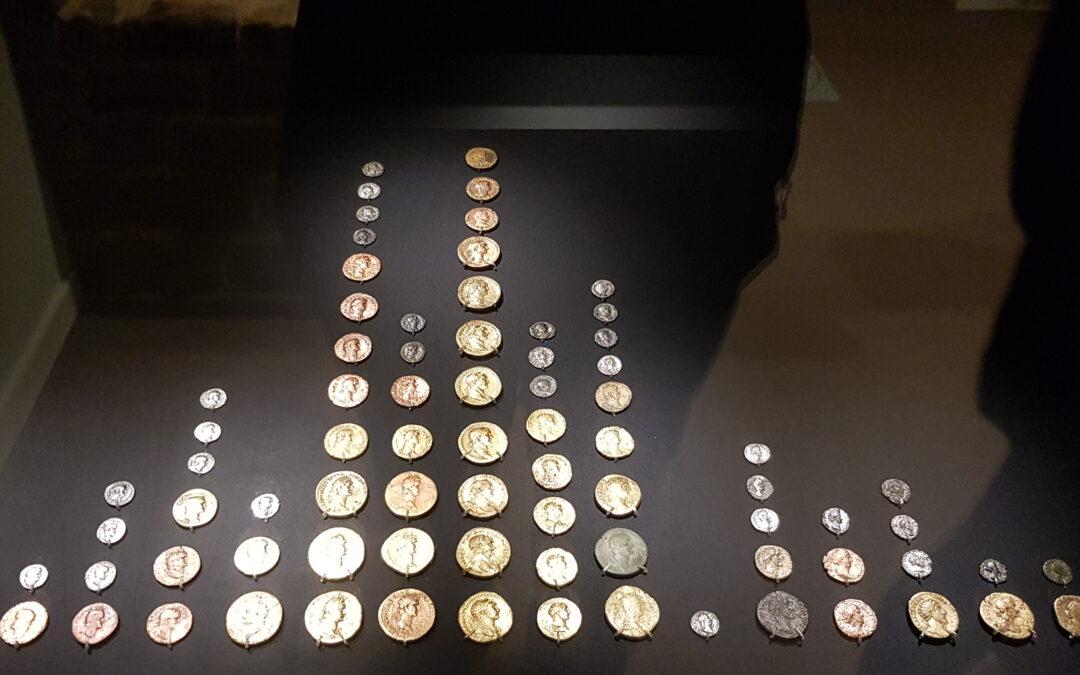
Today's Image: A collection of Roman Coins
Photo Credit: Author's own
Location: Vindolanda Museum
Red and Green Vocab
The words in red and green are found among the 3057 Most Common Words in the Classical Latin texts that we will explore on CentumVerba.com and are essential to your understanding of the texts of Caesar, Vergil and Cicero. The green words appear frequently (at least five times) among Vergil's Aeneid (books I-VI), Caesar de bello Gallico (books I-V) and in Cicero's works - in Catilinam (books I-IV), de lege Manilia (also known as de Imperio Cn. Pompei), and pro Achia. These works constituted the curriculum for Latin over 4 years in American High Schools at the start of the 20th Century. The bulk of my information is taken from The Vocabulary of High School Latin by Gonzalez Lodge. I have added to these 2000 words from varioius other sources to compile my own list of The 3057 Most Common Latin Words.
The black words do not appear frequently in Classical Latin.
The red words are the first occurrences of these words in this author and this word will appear as green the next time you encounter it.
If you are serious about building your vocabulary then you should learn the red words as they occur and you should already know the green ones!
I have provided a FLASHCARD set to help - see below.
How To Read the Interactive Text
To Read the Interactive Text Below Without a Dictionary-
On a Computer: you hover over a word and get all the possible parts of speech; declensions; and conjugations of every word.
Red and Green Vocab
The words in red and green are found among the 3057 Most Common Words in the Classical Latin texts that we will explore on CentumVerba.com and are essential to your understanding of the texts of Caesar, Vergil and Cicero. The green words appear frequently (at least five times) among Vergil's Aeneid (books I-VI), Caesar de bello Gallico (books I-V) and in Cicero's works - in Catilinam (books I-IV), de lege Manilia (also known as de Imperio Cn. Pompei), and pro Achia. These works constituted the curriculum for Latin over 4 years in American High Schools at the start of the 20th Century. The bulk of my information is taken from The Vocabulary of High School Latin by Gonzalez Lodge. I have added to these 2000 words from varioius other sources to compile my own list of The 3057 Most Common Latin Words.
The black words do not appear frequently in Classical Latin.
The red words are the first occurrences of these words in this author and this word will appear as green the next time you encounter it.
If you are serious about building your vocabulary then you should learn the red words as they occur and you should already know the green ones!
I have provided a FLASHCARD set to help - see below.
How To Read the Interactive Text
To Read the Interactive Text Below Without a Dictionary-
On a Phone or Tablet: don't 'hover' -'tap' the word. To remove the 'definition box' you 'tap' to the side of the text box.
INTERACTIVE DICTIONARY FREE TEXT
"...Sunt mihi bis septem praestanti corpore Nymphae,
quarum quae forma pulcherrima Deiopea,
conubio iungam stabili propriamque dicabo,
You Need to Sign Up as a Trial Member to Access the Interactive Dictionary
omnis ut tecum meritis pro talibus annos
exigat, et pulchra faciat te prole parentem.”
Aeolus haec contra: “Tuus, O regina, quid optes
explorare labor; mihi iussa capessere fas est.
Tu mihi, quodcumque hoc regni, tu sceptra Iovemque
concilias, tu das epulis accumbere divom,
nimborumque facis tempestatumque potentem.”
Haec ubi dicta, cavum conversa cuspide montem
impulit in latus: ac venti, velut agmine facto,
qua data porta, ruunt et terras turbine perflant.
Incubuere mari, totumque a sedibus imis
una Eurusque Notusque ruunt creberque procellis
Africus, et vastos volvunt ad litora fluctus.
I have prepared online Flashcards at CRAM.com to make learning the vocabulary much easier. I have no financial gain from you using the app as it is FREE to use.
I have created a stack of the 27 new words in this passage.
Here is the link to the FLASHCARDS
Members Only- Become a Member
USING THE FLASHCARD APP:
To make the most of the online Flashcards use the "Click or use spacebar to begin" and the Latin word should appear. (The 'Shuffle' button will take the cards out of alphabetical order.) Type 'H' to get the conjugation / declension of the word if you want to see it. 'H' takes tyou back to the word. Click 'See Answer' or use the Spacebar to see the English.
If you were correct or close enough then select "I was right" or else "I was wrong". After you have completed the set it will start again but it will only display the ones you got wrong.
Continue through this process to learn all the words. I hope this is helpful!
Recent Comments