
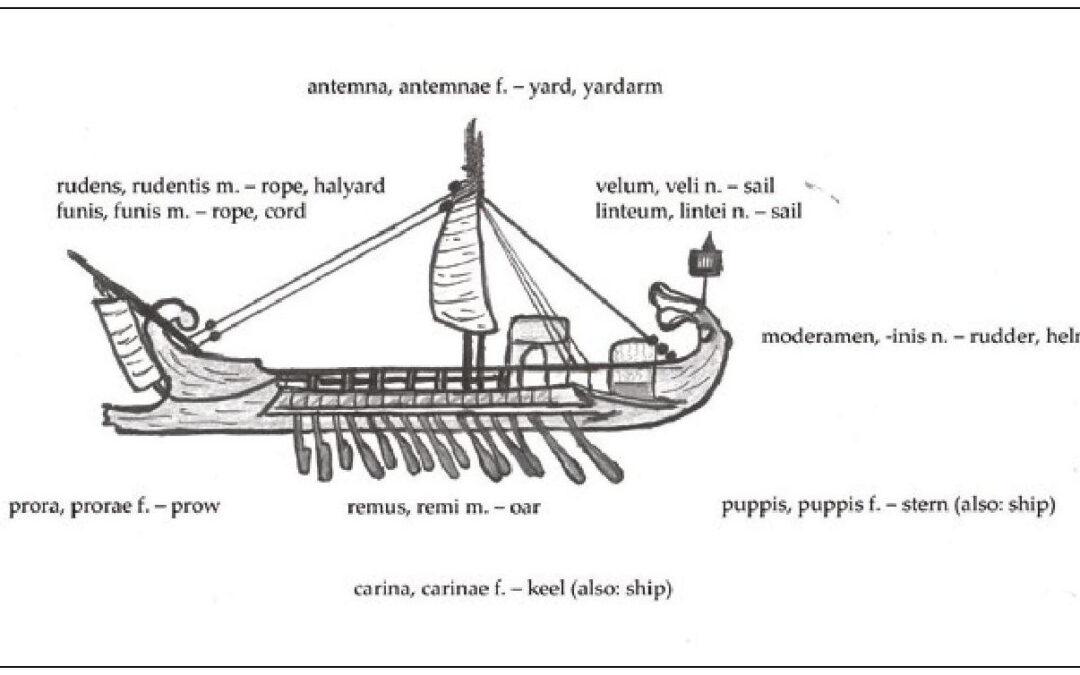
Understanding puppis: The Synecdoche of Ship Anatomy
Sent by Copilot:
The Latin word puppis refers specifically to the back of a ship, but it can also serve as a noun for the entire vessel. This usage exemplifies a figure of speech known as synecdoche, where a part is used to represent the whole or vice versa. Such linguistic techniques enrich our language, allowing for more vivid and expressive communication.
In medieval maritime terminology, the puppis or hind part of a ship evolved into what we now call the poop deck. This term originates from the French word poupe, which also means stern, and traces its roots back to the Latin puppis. The poop deck was typically located at the rear of the ship and often served as a raised platform, providing a commanding view of the sea and the crew’s activities.
The significance of the poop deck extended beyond its physical structure; it was often a place of authority and navigation. Captains and officers would use this elevated position to oversee operations, making it a crucial part of maritime life. Understanding terms like puppis not only enhances our grasp of nautical language but also connects us to the rich history of seafaring and shipbuilding.
Other parts of the Roman ship that appear in the image above and also in the 3057 Most Common Words are:
carina f (genitive carinae); a keel; boat, ship
remus m (genitive remi); an oar
velum n (genitive veli); the sail of a ship; a cloth, curtain, veil, awning
These words appear frequently in Vergil but much less in Caesar and not at all in Cicero:
| AUTHOR |
puppis |
carina |
remus |
velum |
| Caesar | 2 | 1 | 4 | 3 |
| Cicero | 0 | 0 | 0 | 1 |
| Vergil | 28 | 13 | 27 | 26 |
To Read the Interactive Text Below Without a Dictionary-
On a Computer: you hover over a word and get all the possible parts of speech; declensions; and conjugations of every word.
The words in red and green are found among the 3057 Most Common Words in the Classical Latin texts that we will explore on CentumVerba.com and are essential to your understanding of the texts of Caesar, Vergil and Cicero.
The red and green words appear frequently (at least five times) among Vergil's Aeneid (books I-VI), Caesar de bello Gallico (books I-V) and in Cicero's works - in Catilinam (books I-IV), de lege Manilia (also known as de Imperio Cn. Pompei), and pro Achia. These works constituted the Latin curriculum in American High Schools at the start of the 20th Century. The bulk of my information is taken from The Vocabulary of High School Latin by Gonzalez Lodge. I have added to these 2000 words from various other sources to compile my own list of The 3057 Most Common Latin Words. #Latin3057
The red words are the first occurrences of these words in this author, and this word will appear as green the next time you encounter it. The black words do not appear as frequently in Classical Latin.
If you are serious about building your vocabulary, then you should learn the red words as they occur, and you should already know the green ones!
I have provided a FLASHCARD set to help-see below.
Understanding puppis: The Synecdoche of Ship Anatomy
Sent by Copilot:
The Latin word puppis refers specifically to the back of a ship, but it can also serve as a noun for the entire vessel. This usage exemplifies a figure of speech known as synecdoche, where a part is used to represent the whole or vice versa. Such linguistic techniques enrich our language, allowing for more vivid and expressive communication.
In medieval maritime terminology, the puppis or hind part of a ship evolved into what we now call the poop deck. This term originates from the French word poupe, which also means stern, and traces its roots back to the Latin puppis. The poop deck was typically located at the rear of the ship and often served as a raised platform, providing a commanding view of the sea and the crew’s activities.
The significance of the poop deck extended beyond its physical structure; it was often a place of authority and navigation. Captains and officers would use this elevated position to oversee operations, making it a crucial part of maritime life. Understanding terms like puppis not only enhances our grasp of nautical language but also connects us to the rich history of seafaring and shipbuilding.
Other parts of the Roman ship that appear in the image above and also in the 3057 Most Common Words are:
carina f (genitive carinae); a keel; boat, ship
remus m (genitive remi); an oar
velum n (genitive veli); the sail of a ship; a cloth, curtain, veil, awning
These words appear frequently in Vergil but much less in Caesar and not at all in Cicero:
| AUTHOR |
puppis |
carina |
remus |
velum |
| Caesar | 2 | 1 | 4 | 3 |
| Cicero | 0 | 0 | 0 | 1 |
| Vergil | 28 | 13 | 27 | 26 |
The words in red and green are found among the 3057 Most Common Words in the Classical Latin texts that we will explore on CentumVerba.com and are essential to your understanding of the texts of Caesar, Vergil and Cicero.
The red and green words appear frequently (at least five times) among Vergil's Aeneid (books I-VI), Caesar de bello Gallico (books I-V) and in Cicero's works - in Catilinam (books I-IV), de lege Manilia (also known as de Imperio Cn. Pompei), and pro Achia. These works constituted the Latin curriculum in American High Schools at the start of the 20th Century. The bulk of my information is taken from The Vocabulary of High School Latin by Gonzalez Lodge. I have added to these 2000 words from various other sources to compile my own list of The 3057 Most Common Latin Words. #Latin3057
The red words are the first occurrences of these words in this author, and this word will appear as green the next time you encounter it. The black words do not appear as frequently in Classical Latin.
If you are serious about building your vocabulary, then you should learn the red words as they occur, and you should already know the green ones!
I have provided a FLASHCARD set to help-see below.
To Read the Interactive Text Below Without a Dictionary-
On a Phone or Tablet: don't 'hover' -'tap' the word. To remove the 'definition box' you 'tap' to the side of the text box.
INTERACTIVE DICTIONARY FREE TEXT
Illi indignantes magno cum murmure montis
circum claustra fremunt; celsa sedet Aeolus arce
sceptra tenens, mollitque animos et temperat iras.
You Need to Sign Up as a Trial Member to Access the Interactive Dictionary
Ni faciat, maria ac terras caelumque profundum
quippe ferant rapidi secum verrantque per auras.
Sed pater omnipotens speluncis abdidit atris,
hoc metuens, molemque et montis insuper altos
imposuit, regemque dedit, qui foedere certo
et premere et laxas sciret dare iussus habenas.
Ad quem tum Iuno supplex his vocibus usa est:
“Aeole, namque tibi divom pater atque hominum rex
et mulcere dedit fluctus et tollere vento,
gens inimica mihi Tyrrhenum navigat aequor,
Ilium in Italiam portans victosque Penates:
incute vim ventis submersasque obrue puppes,
aut age diversos et disiice corpora ponto...
I have prepared online Flashcards at CRAM.com to make learning the vocabulary much easier. I have no financial gain from you using the app as it is FREE to use.
I have created a stack of the 34 new words in this passage.
Here is the link to the FLASHCARDS
USING THE FLASHCARD APP:
To make the most of the online Flashcards use the "Click or use spacebar to begin" and the Latin word should appear. (The 'Shuffle' button will take the cards out of alphabetical order.) Type 'H' to get the conjugation / declension of the word if you want to see it. 'H' takes tyou back to the word. Click 'See Answer' or use the Spacebar to see the English.
If you were correct or close enough then select "I was right" or else "I was wrong". After you have completed the set it will start again but it will only display the ones you got wrong.
Continue through this process to learn all the words. I hope this is helpful!
Recent Comments