
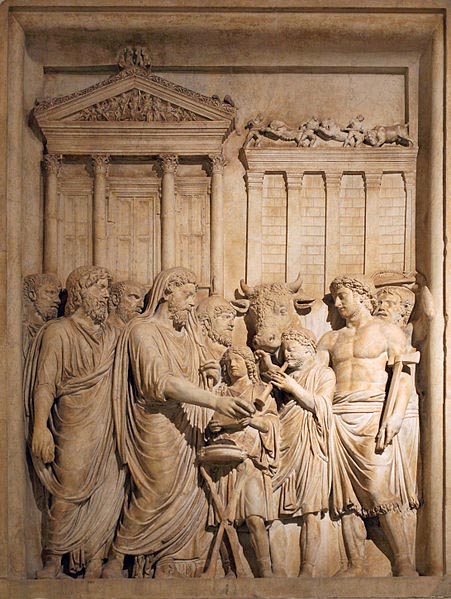
Prodigies were aberrations in nature, such as a talking chicken or the birth of a hermaphrodite, or destructive natural phenomena, such as a lightning strike or deadly plague. Almost always bad signs, they communicated the gods’ anger toward Rome. During the Republic they had been reported annually and expiated in public and high-profile ceremonies, typically conducted by the consuls before they left for their provinces, and often involving elaborate ritual responses (such as the introduction of new deities) and broad community participation. (Satterfield)
Livy continues in this passage with his list of aberrations of nature which the Romans regarded as prodigies from their various gods. Livy gathers all of these, from apparently different periods of time, and uses these to discredit the consulship of Flaminius. Why Livy goes to the great effort to collate all these prodigies together in his history will become apparent in a few chapters. It is well worth noting, however, the great importance that the Romans placed in prodigies as omens for success and failure.
If you are a beginner or at the beyond-beginner stage then you might find it helpful to start with the Hamiltonian Version of Livy Book 22 which lays out the Latin in nearly English word order which makes it easier to see how it all fits together. Once you understand the vocabulary then progress to the Side-by-Side Version which allows you to see the English translation of B. O. Foster. This translation is not always literal, so you will not find it a word for word translation - there will be some translator's licence!
Finally come back to this page - Classical Text and you should be able to fully understand and competently read the original Latin text.
Thank you for joining me in this journey through the classical texts of Rome...
Here is a text only version. (See below for an interactive version)
Chapter 1 (contd)
[9] et milites quosdam ictos fulminibus, et solis orbem minui visum et Praeneste ardentes lapides caelo; cecidisse et Arpis parmas in caelo visas pugnantem cum luna; solemque
[10] et Capenae duas interdiu; lunas ortas et aquas Caeretes sanguine, mixtas fluxisse fontem ipsumque Herculis cruentis manasse respersum maculis; et Antii metentibus cruentas in corbem; spicas cecidisse
[11] et Faleriis caelum findi velut magno hiatu, visum quaque patuerit, ingens lumen effulsisse; et sortes adtenuatas; unamque sua sponte excidisse ita inscriptam 'Mavors telum:' suum concutit
[12] et per idem tempus Romae signum Martis Appia via ac simulacra luporum sudasse, et Capuae speciem "caeli " ardentis fuisse lunaeque inter imbrem. cadentis.
[13] inde minoribus etiam dictu prodigiis fides habita: capras lanatas quibusdam factas, et gallinam in marem, gallum in feminam sese vertisse.
To read the interactive text without a dictionary-
On a Computer: you simply hover over a word and you will get all the possible parts of speech; declensions; conjugations of every word.
On a Phone or Tablet: you simply 'tap' the word and you will get the relevant parts of speech, declensions and conjugations. To remove the 'definition box' you 'tap' to the side of the text box.
[9] et milites quosdam ictos fulminibus, et solis orbem minui visum et Praeneste ardentes lapides caelo; cecidisse et Arpis parmas in caelo visas pugnantem cum luna; solemque
[10] et Capenae duas interdiu; lunas ortas et aquas Caeretes sanguine, mixtas fluxisse fontem ipsumque Herculis cruentis manasse respersum maculis; et Antii metentibus cruentas in corbem; spicas cecidisse
[11] et Faleriis caelum findi velut magno hiatu, visum quaque patuerit, ingens lumen effulsisse; et sortes adtenuatas; unamque sua sponte excidisse ita inscriptam 'Mavors telum:' suum concutit
[12] et per idem tempus Romae signum Martis Appia via ac simulacra luporum sudasse, et Capuae speciem "caeli " ardentis fuisse lunaeque inter imbrem. cadentis.
[13] inde minoribus etiam dictu prodigiis fides habita: capras lanatas quibusdam factas, et gallinam in marem, gallum in feminam sese vertisse.
Recent Comments