
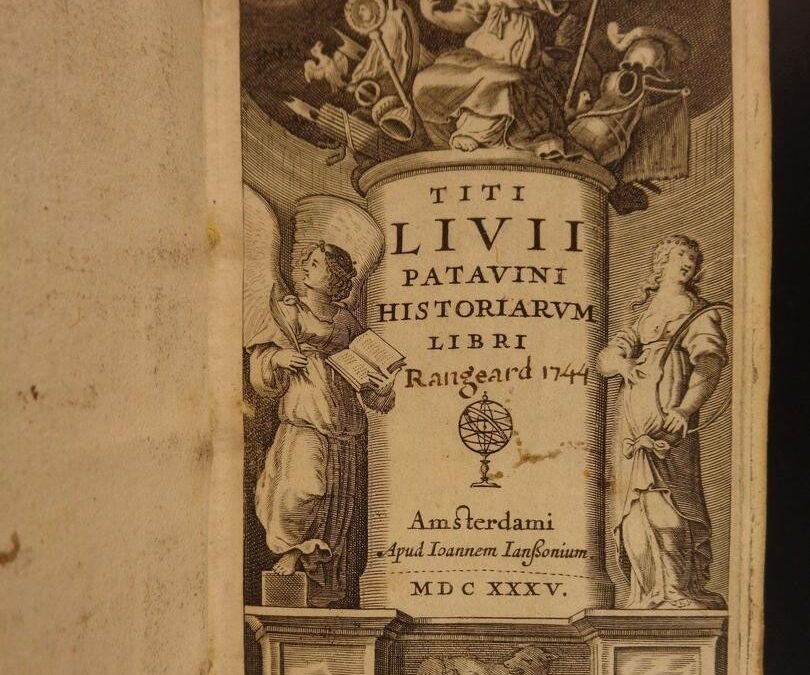
Gaius Flaminius has just been elected consul along with Gnaeus Servillius. The year is 217 B.C. and it's the Ides of March which corresponds to the 15th March in our calendar. This day was marked by several religious observances and was notable for the Romans as a deadline for settling debts.
The two newly elected consuls Gnaeus Servilius Geminus and Gaius Flaminius were in charge of the legions . There was a struggle between Flaminius and Servilius for control.
Livy stresses the religious aspects of leadership and sanctions that were expected to be followed. Flaminius is accused of breaching these and going against everyone including the gods. Livy aggregates a series of omens form different times and brings them all together to strengthen his argument.
Could it be that Livy wants to portray Gaius Flaminius as reckless, self-willed and obstinate in preparation for the coming events?
If you are a beginner or at the beyond-beginner stage then you might find it helpful to start with the Hamiltonian Version of Livy Book 22 which lays out the Latin in nearly English word order which makes it easier to see how it all fits together. Once you understand the vocabulary then progress to the Side-by-Side Version which allows you to see the English translation of B. O. Foster. This translation is not always literal, so you will not find it a word for word translation - there will be some translator's licence!
Finally come back to this page - Classical Text and you should be able to fully understand and competently read the original Latin text.
Thank you for joining me in this journey through the classical texts of Rome...
Here is a text only version. (See below for an interactive version)
[5] ibi cum de re publica rettulisset, redintegrata in C. Flaminium invidia est: duos se consules creasse, unum habere; quod enim illi iustum imperium, quod auspicium esse?
[6] magistratus id a domo, publicis privatisque penatibus, Latinis feriis actis, sacrificio in monte perfecto, votis rite in Capitolio nuncupatis secum ferre;
[7] nec privatum auspicia sequi, nec sine auspiciis profectum in externo ea solo nova atque integra concipere posse.
[8] augebant metum prodigia ex pluribus simul locis nuntiata: in Sicilia militibus aliquot spicula, in Sardinia autem in muro circumeunti vigilias equiti scipionem, quem mann tenuerit, arsisse, et litora crebris ignibus fulsisse, et scuta duo sanguine sudasse,
To read the interactive text without a dictionary-
On a Computer: you simply hover over a word and you will get all the possible parts of speech; declensions; conjugations of every word.
On a Phone or Tablet: you simply 'tap' the word and you will get the relevant parts of speech, declensions and conjugations. To remove the 'definition box' you 'tap' to the side of the text box.
Chapter 1 (contd)
[5] ibi cum de re publica rettulisset, redintegrata in C. Flaminium invidia est: duos se consules creasse, unum habere; quod enim illi iustum imperium, quod auspicium esse?
[6] magistratus id a domo, publicis privatisque penatibus, Latinis feriis actis, sacrificio in monte perfecto, votis rite in Capitolio nuncupatis secum ferre;
[7] nec privatum auspicia sequi, nec sine auspiciis profectum in externo ea solo nova atque integra concipere posse.
[8] augebant metum prodigia ex pluribus simul locis nuntiata: in Sicilia militibus aliquot spicula, in Sardinia autem in muro circumeunti vigilias equiti scipionem, quem mann tenuerit, arsisse, et litora crebris ignibus fulsisse, et scuta duo sanguine sudasse,
Recent Comments