
video - I can see clearly now
The Latin verb video, meaning ‘I see’, is one of the most frequently used and conceptually rich verbs in classical Latin literature. It expresses not only physical sight but also perception, understanding, and mental insight. Its range of meanings allows authors to explore themes of knowledge, revelation, and illusion across genres.
In epic poetry, video often marks moments of recognition or divine intervention. Virgil uses it in the Aeneid to describe both literal vision and prophetic insight. When Aeneas videt omens or apparitions, the verb signals a shift in narrative awareness, linking the hero’s journey to fate and divine will. The act of seeing becomes a gateway to understanding destiny.
In elegiac poetry, video is frequently used in expressions of longing or memory. Ovid, in Amores and Tristia, uses video to evoke the image of a beloved, whether present or imagined. The verb often blurs the line between physical sight and emotional perception, suggesting that to videre is also to feel and remember. This layered use adds depth to the poet’s emotional landscape.
In prose, video serves both practical and philosophical functions. Cicero uses it extensively in his speeches and treatises, where video can mean ‘I perceive’ or ‘I understand’. It becomes a rhetorical tool, asserting clarity of thought or moral insight. In philosophical contexts, especially in Stoic and Platonic traditions, video may denote intellectual vision—the grasp of truth beyond appearances.
Historians such as Livy and Tacitus use video to describe eyewitness accounts or to frame narrative perspective. The verb lends authority to the historian’s voice, suggesting direct observation or reliable testimony.
Seneca, in his moral letters, often contrasts video with specto, distinguishing between passive looking and active seeing. For him, video implies discernment and wisdom.
Thus, video in classical Latin literature is a dynamic and expressive verb, central to how authors articulate perception, knowledge, and emotional experience.
The images for these posts on Mark's gospel
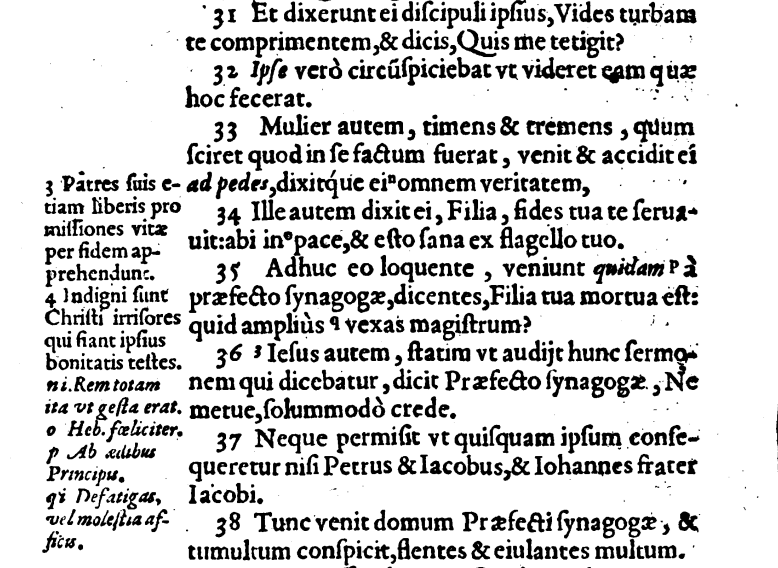
Screenshots taken from the Nouum Testamentum of Théodore de Bèze, (1519-1605) ( Londini : Thomas Vautrollerius, typographus, 1587 )
Accessed from the Post Reformation Digital Library
JUMP To Dictionary Free Interactive Text
Here is a text only version.
EVANGELIUM MARCUM
CAPUT V
32 Et circumspiciebat videre eam, quae hoc fecerat.
33 Mulier autem timens et tremens, sciens quod factum esset in se, venit et procidit ante eum et dixit ei omnem veritatem.
34 Ille autem dixit ei Filia, fides tua te salvam fecit. Vade in pace et esto sana a plaga tua.
35 Adhuc eo loquente, veniunt ab archisynagogo dicentes Filia tua mortua est quid ultra vexas magistrum?
36 Iesus autem, verbo, quod dicebatur, audito, ait archisynagogo Noli timere tantummodo crede!
37 Et non admisit quemquam sequi se nisi Petrum et Iacobum et Ioannem fratrem Iacobi.
38 Et veniunt ad domum archisynagogi et videt tumultum et flentes et eiulantes multum,
How To Read the Interactive Text Without a Dictionary
On a Computer:
Hover over a word to get all its possible parts of speech, declensions, or conjugations.
On a Tablet:
'TAP' the word to see the definition, and to remove the 'definition box' you simply 'TAP' anywhere to the side.
How To Read the Interactive Text
'Tap' the word to see the definition and to remove the 'definition box' you simply 'tap' antwhere to the side.
EVANGELIUM MARCUM
CAPUT V
32 Et circumspiciebat videre eam, quae hoc fecerat.
You Need to be at least a Trial Member to Access the Interactive Dictionary
33 Mulier autem timens et tremens, sciens quod factum esset in se, venit et procidit ante eum et dixit ei omnem veritatem.
34 Ille autem dixit ei Filia, fides tua te salvam fecit. Vade in pace et esto sana a plaga tua.
35 Adhuc eo loquente, veniunt ab archisynagogo dicentes Filia tua mortua est quid ultra vexas magistrum?
36 Iesus autem, verbo, quod dicebatur, audito, ait archisynagogo Noli timere tantummodo crede!
37 Et non admisit quemquam sequi se nisi Petrum et Iacobum et Ioannem fratrem Iacobi.
38 Et veniunt ad domum archisynagogi et videt tumultum et flentes et eiulantes multum,
Recent Comments