
ne - no - with purpose
The Latin particle ne is primarily used to introduce negative purpose clauses, indirect questions, and expressions of fear or prohibition. It is a syntactic marker rather than a lexical item with a standalone meaning. Yet its role in classical Latin literature is both subtle and essential, shaping the tone and intent of countless passages.
In purpose clauses, ne functions to express what should not happen. For example, in Virgil’s Aeneid, characters often act ne quid detrimenti capiant, to prevent harm or misfortune. The presence of ne signals a forward-looking concern, often tied to fate, divine will, or human caution. It allows poets to articulate the tension between desire and restraint, especially in moments of decision or danger.
In expressions of fear, ne introduces what the subject fears might occur. Cicero frequently uses this construction in his speeches, as in vereor ne quid accidat, to convey apprehension about political or legal outcomes. This use of ne adds a layer of psychological depth, allowing the speaker to frame uncertainty and risk in terms of personal or collective anxiety. It is particularly effective in rhetorical contexts, where the speaker seeks to align the audience’s emotions with his own.
In indirect questions, ne may appear after verbs of asking or knowing, such as rogo or scio, to introduce a yes-or-no query. Though less common than num or utrum, ne is used when the question is neutral or when the speaker does not imply a preferred answer. This usage is frequent in both prose and drama, where dialogue requires concise and flexible structures.
Poets like Ovid and Horace use ne to shape the mood of their verse, especially in prayers or invocations, where the speaker pleads ne me relinquas or ne noceat. The particle’s brevity and precision make it ideal for lyric and elegiac contexts, where emotional nuance is paramount.
Thus, ne in classical Latin is a grammatical tool of restraint, fear, and inquiry—quiet but powerful in its ability to guide meaning and emotion.
The images for these posts on Mark's gospel
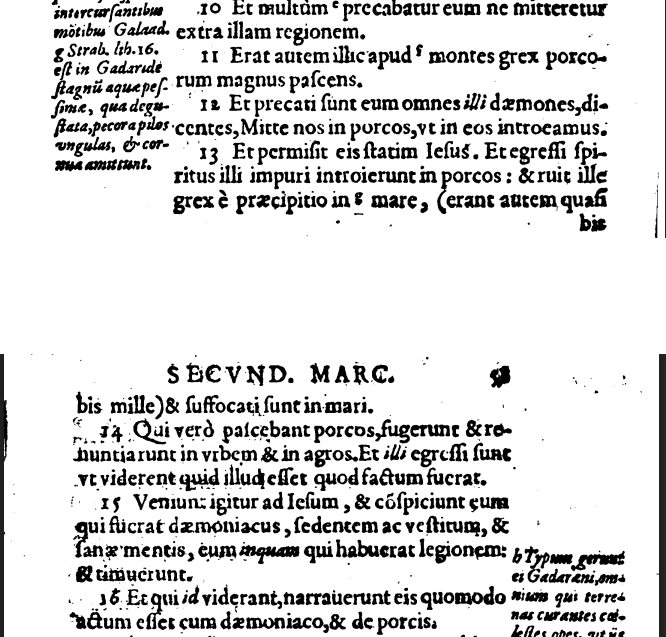
Screenshots taken from the Nouum Testamentum of Théodore de Bèze, (1519-1605) ( Londini : Thomas Vautrollerius, typographus, 1587 )
Accessed from the Post Reformation Digital Library
Red and Green Vocab
The words in red and green are found among the 3057 Most Common Words in the Classical Latin texts that we will explore on CentumVerba.com and are essential to your understanding of the texts of Caesar, Vergil and Cicero. The green words appear frequently (at least five times) among Vergil's Aeneid (books I-VI), Caesar de bello Gallico (books I-V) and in Cicero's works - in Catilinam (books I-IV), de lege Manilia (also known as de Imperio Cn. Pompei), and pro Achia. These works constituted the curriculum for Latin over 4 years in American High Schools at the start of the 20th Century. The bulk of my information is taken from The Vocabulary of High School Latin by Gonzalez Lodge. I have added to these 2000 words from varioius other sources to compile my own list of The 3057 Most Common Latin Words.
The black words do not appear frequently in Classical Latin.
The red words are the first occurrences of these words in this author and this word will appear as green the next time you encounter it.
If you are serious about building your vocabulary then you should learn the red words as they occur and you should already know the green ones!
I have provided a FLASHCARD set to help - see below.
How To Read the Interactive Text
To Read the Interactive Text Below Without a Dictionary-
On a Computer: you hover over a word and get all its possible parts of speech; declensions; and conjugations.
On a Tablet: 'Tap' the word to see the definition, and to remove the 'definition box' you simply 'Tap' anywhere to the side.
Red and Green Vocab
The words in red and green are found among the 3057 Most Common Words in the Classical Latin texts that we will explore on CentumVerba.com and are essential to your understanding of the texts of Caesar, Vergil and Cicero. The green words appear frequently (at least five times) among Vergil's Aeneid (books I-VI), Caesar de bello Gallico (books I-V) and in Cicero's works - in Catilinam (books I-IV), de lege Manilia (also known as de Imperio Cn. Pompei), and pro Achia. These works constituted the curriculum for Latin over 4 years in American High Schools at the start of the 20th Century. The bulk of my information is taken from The Vocabulary of High School Latin by Gonzalez Lodge. I have added to these 2000 words from varioius other sources to compile my own list of The 3057 Most Common Latin Words.
The black words do not appear frequently in Classical Latin.
The red words are the first occurrences of these words in this author and this word will appear as green the next time you encounter it.
If you are serious about building your vocabulary then you should learn the red words as they occur and you should already know the green ones!
I have provided a FLASHCARD set to help - see below.
How To Read the Interactive Text
To Read the Interactive Text Below Without a Dictionary-
On a Phone or Tablet: ''TAP' the word to see the definition, and to remove the 'definition box' you simply 'TAP' anywhere to the side.
INTERACTIVE DICTIONARY FREE TEXT
Caput V
10 Et deprecabatur eum multum, ne se expelleret extra regionem.
You Need to be at least a Trial Member to Access the Interactive Dictionary
11 Erat autem ibi circa montem grex porcorum magnus pascens
12 et deprecati sunt eum dicentes Mitte nos in porcos, ut in eos introeamus.
13 Et concessit eis. Et exeuntes spiritus immundi introierunt in porcos. Et magno impetu grex ruit per praecipitium in mare, ad duo milia, et suffocabantur in mari.
14 Qui autem pascebant eos, fugerunt et nuntiaverunt in civitatem et in agros et egressi sunt videre quid esset facti.
15 Et veniunt ad Iesum et vident illum, qui a daemonio vexabatur, sedentem, vestitum et sanae mentis, eum qui legionem habuerat, et timuerunt.
16 Et qui viderant, narraverunt illis qualiter factum esset ei, qui daemonium habuerat, et de porcis.
I have prepared online Flashcards at CRAM.com to make learning the vocabulary much easier. I have no financial gain as the app is FREE to use.
I have created a stack of the 14 new words in this passage.
YOU NEED TO SIGN UP AS A TRIAL MEMBER TO ACCESS THE FLASHCARDS
Here is the link to the FLASHCARDS
USING THE FLASHCARD APP:
To make the most of the online Flashcards use the "Click or use spacebar to begin" and the Latin word should appear. (The 'Shuffle' button will take the cards out of alphabetical order.) Type 'H' to get the conjugation / declension of the word if you want to see it. 'H' takes tyou back to the word. Click 'See Answer' or use the Spacebar to see the English.
If you were correct or close enough then select "I was right" or else "I was wrong". After you have completed the set it will start again but it will only display the ones you got wrong.
Continue through this process to learn all the words. I hope this is helpful!
Recent Comments