
odium - I hate to tell you...
The Latin noun odium (neuter, second declension) means ‘hatred’, ‘disgust’, or ‘aversion’, and is used in classical Latin literature to express both personal animosity and broader social or political hostility. It can refer to internal emotions, public sentiment, or divine displeasure, depending on context and genre.
In Virgil’s Aeneid, odium appears in scenes of conflict and divine wrath. The gods, particularly Juno, are described as acting out of odium toward the Trojans, especially Aeneas. This divine odium is not irrational but rooted in mythological grievance, such as the judgment of Paris or the fall of Troy. The word helps characterise Juno’s persistent opposition as emotionally charged and ideologically motivated. Odium also surfaces in descriptions of interpersonal hostility, such as the enmity between Aeneas and Turnus, where it marks the escalation from rivalry to lethal hatred.
In Cicero’s speeches, odium is a strategic term used to describe public opinion or political danger. He often warns against incurring odium from the people or the Senate, especially when defending controversial actions. The word is closely tied to invidia, and both are treated as forces that can undermine authority or provoke unrest. Cicero’s use of odium reflects his sensitivity to reputation and the volatility of Roman politics.
Ovid employs odium in his elegiac poetry to describe emotional rejection and romantic conflict. In the Amores, lovers may feel odium after betrayal or disappointment, and the term captures the intensity of shifting affections. In the Metamorphoses, odium can be divine or mortal, often leading to transformation or punishment. The word helps dramatise the consequences of unchecked emotion.
Seneca uses odium philosophically, often to critique irrational passions. In his Stoic writings, odium is presented as a destructive force that must be mastered through reason. It is linked to anger and vengeance, and its presence signals moral failure or weakness.
In historical prose, odium may describe the public’s reaction to leaders or policies. Tacitus, for example, uses it to explain political downfall or rebellion, showing how odium can accumulate and erupt into violence.
Thus, odium in classical Latin literature is a potent term that conveys emotional, political, and moral tension across a wide range of contexts.
Today's Artwork:
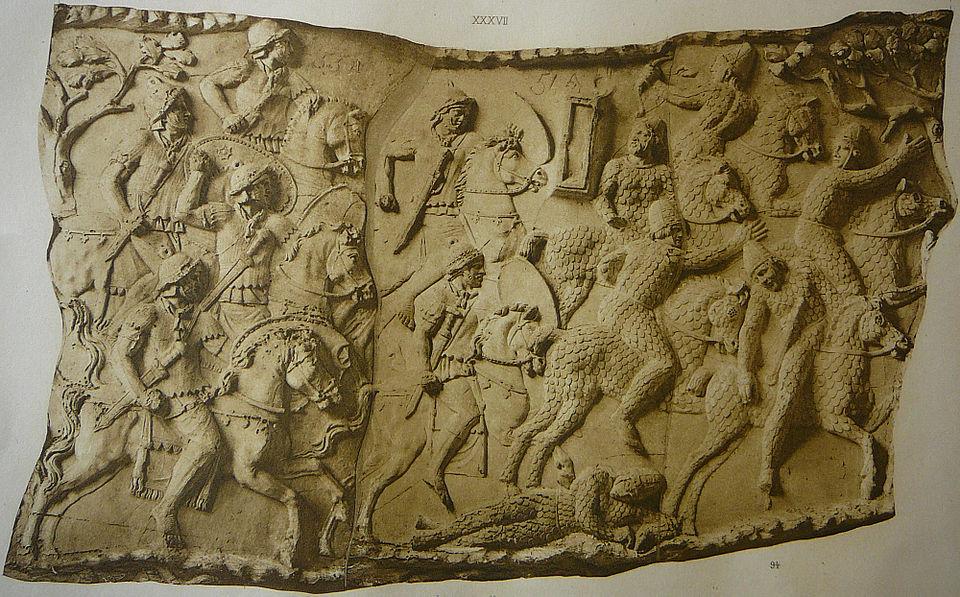
Image: Panel from Trajan's Column, Rome
Routed Sarmatian cataphracts (right), allied to the Dacian king Decebalus, flee from charging Roman alares (auxiliary cavalrymen), during the Dacian Wars (AD 101–6).
Source: https://commons.wikimedia.org/
Red and Green Vocab
The words in red and green are found among the 3057 Most Common Words in the Classical Latin texts that we will explore on CentumVerba.com and are essential to your understanding of the texts of Caesar, Vergil and Cicero. The green words appear frequently (at least five times) among Vergil's Aeneid (books I-VI), Caesar de bello Gallico (books I-V) and in Cicero's works - in Catilinam (books I-IV), de lege Manilia (also known as de Imperio Cn. Pompei), and pro Achia. These works constituted the curriculum for Latin over 4 years in American High Schools at the start of the 20th Century. The bulk of my information is taken from The Vocabulary of High School Latin by Gonzalez Lodge. I have added to these 2000 words from varioius other sources to compile my own list of The 3057 Most Common Latin Words.
The black words do not appear frequently in Classical Latin.
The red words are the first occurrences of these words in this author and this word will appear as green the next time you encounter it.
If you are serious about building your vocabulary then you should learn the red words as they occur and you should already know the green ones!
I have provided a FLASHCARD set to help - see below.
How To Read the Interactive Text
To Read the Interactive Text Below Without a Dictionary-
On a Computer: you hover over a word and get all the possible parts of speech; declensions; and conjugations of every word.
Red and Green Vocab
The words in red and green are found among the 3057 Most Common Words in the Classical Latin texts that we will explore on CentumVerba.com and are essential to your understanding of the texts of Caesar, Vergil and Cicero. The green words appear frequently (at least five times) among Vergil's Aeneid (books I-VI), Caesar de bello Gallico (books I-V) and in Cicero's works - in Catilinam (books I-IV), de lege Manilia (also known as de Imperio Cn. Pompei), and pro Achia. These works constituted the curriculum for Latin over 4 years in American High Schools at the start of the 20th Century. The bulk of my information is taken from The Vocabulary of High School Latin by Gonzalez Lodge. I have added to these 2000 words from varioius other sources to compile my own list of The 3057 Most Common Latin Words.
The black words do not appear frequently in Classical Latin.
The red words are the first occurrences of these words in this author and this word will appear as green the next time you encounter it.
If you are serious about building your vocabulary then you should learn the red words as they occur and you should already know the green ones!
I have provided a FLASHCARD set to help - see below.
How To Read the Interactive Text
To Read the Interactive Text Below Without a Dictionary-
On a Phone or Tablet: don't 'hover' -'tap' the word. To remove the 'definition box' you 'tap' to the side of the text box.
INTERACTIVE DICTIONARY FREE TEXT
His commota fugam Dido sociosque parabat: conveniunt, quibus aut odium crudele tyranni aut metus acer erat;
You Need to be a Member to Access the Interactive Dictionary
navis, quae forte paratae, corripiunt, onerantque auro: portantur avari Pygmalionis opes pelago;
dux femina facti. Devenere locos, ubi nunc ingentia cernis moenia surgentemque novae Karthaginis arcem, mercatique solum, facti de nomine Byrsam, taurino quantum possent circumdare tergo.
Sed vos qui tandem, quibus aut venistis ab oris, quove tenetis iter? “Quaerenti talibus ille suspirans, imoque trahens a pectore vocem:
“O dea, si prima repetens ab origine pergam, et vacet annalis nostrorum audire laborum, ante diem clauso componat Vesper Olympo.
Nos Troia antiqua, si vestras forte per auris Troiae nomen iit, diversa per aequora vectos forte sua Libycis tempestas adpulit oris.
I have prepared online Flashcards at CRAM.com to make learning the vocabulary much easier. I have no financial gain from you using the app as it is FREE to use.
I have created a stack of the 15 new words in this passage.
Here is the link to the FLASHCARDS
USING THE FLASHCARD APP:
To make the most of the online Flashcards use the "Click or use spacebar to begin" and the Latin word should appear. (The 'Shuffle' button will take the cards out of alphabetical order.) Type 'H' to get the conjugation / declension of the word if you want to see it. 'H' takes tyou back to the word. Click 'See Answer' or use the Spacebar to see the English.
If you were correct or close enough then select "I was right" or else "I was wrong". After you have completed the set it will start again but it will only display the ones you got wrong.
Continue through this process to learn all the words. I hope this is helpful!
Recent Comments