
cupiditas - desire
The Latin noun cupiditas, feminine and of the third declension, denotes desire, longing, or ambition, and features prominently in moral, philosophical, and political discourse throughout classical Latin literature. It is often used to express not only general yearning but also specific forms of immoderate or misguided desire, such as greed, lust, or the pursuit of power.
Cicero employs cupiditas extensively in his philosophical works, particularly in De Officiis and Tusculanae Disputationes, where it represents a threat to ethical conduct and civic responsibility. He frequently contrasts cupiditas with virtus, suggesting that unchecked desire undermines justice and rational governance. In his speeches, cupiditas imperii and cupiditas pecuniae are rhetorical tools used to discredit political opponents by portraying them as driven by selfish ambition rather than public service.
Caesar’s use of cupiditas is more restrained but strategically pointed. In Commentarii de Bello Gallico 1.2, he attributes regni cupiditate to Orgetorix, framing the Helvetian leader’s actions as driven by a dangerous lust for kingship. This usage serves to justify Roman intervention by casting local unrest as the product of excessive personal ambition.
Sallust, in Bellum Catilinae, uses cupiditas to diagnose the moral decline of Rome. He describes cupiditas dominandi and cupiditas pecuniae as corrosive forces that have replaced traditional Roman virtues. For Sallust, cupiditas is not merely a personal failing but a societal pathology, emblematic of the Republic’s decay.
Lucretius, in De Rerum Natura, treats cupiditas as a source of existential disturbance. He argues that liberation from cupiditas is essential for achieving tranquillitas animi, aligning with Epicurean ideals. Ovid, by contrast, often uses cupiditas in the context of erotic desire, though sometimes with ironic or playful undertones.
The term’s semantic range—from philosophical vice to poetic longing—reflects its adaptability across genres. Whether as a moral warning, a political accusation, or a poetic motif, cupiditas serves as a lens through which Roman authors interrogate the nature and consequences of human desire.
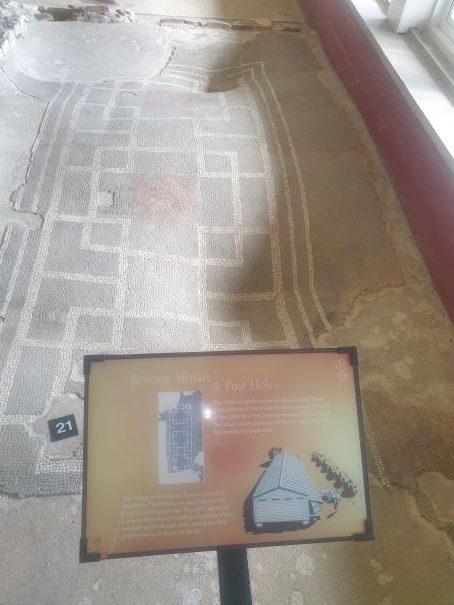
Today's Image: Roman mosaic flooring, with an unusual black on white pattern.
Source: My own Photo
Site: Fishbourne Roman Palace
Here is a text only version. (See below for an interactive version)
21 His rebus cognitis Medea rem aegre tulit et regni cupiditate adducta constituit mortem regi per dolum inferre. Hoc constituto, ad filias regis venit atque ita locuta est. “Videtis patrem vestrum aetate iam esse confectum neque ad laborem regnandi perferendum satis valere. Voltisne eum rursus iuvenem fieri?” Tum filiae regis his auditis ita responderunt. “Num hoc fieri potest? Quis enim umquam e sene iuvenis factus est?”
At Medea respondit, “Scitis me medicinae summam habere scientiam. Nunc igitur vobis demonstrabo quo modo haec res fieri possit.” His dictis, cum arietem aetate iam confectum interfecisset, membra eius in vas aeneum posuit et igni supposito aquae herbas quasdam infudit. Tum, dum aqua effervesceret, carmen magicum cantabat. Post breve tempus aries e vase exsiluit et viribus refectis per agros currebat.
How To Read the Interactive Text
To Read the Interactive Text Below Without a Dictionary-
On a Computer: you hover over a word and get all the possible parts of speech; declensions; and conjugations of every word.
How To Read the Interactive Text
To Read the Interactive Text Below Without a Dictionary-
On a Phone or Tablet: don't 'hover' -'tap' the word. To remove the 'definition box' you 'tap' to the side of the text box.
INTERACTIVE DICTIONARY FREE TEXT
21 His rebus cognitis Medea rem aegre tulit et regni cupiditate adducta constituit mortem regi per dolum inferre.
You Need to be a Member to Access the Interactive Dictionary
Hoc constituto, ad filias regis venit atque ita locuta est.
“Videtis patrem vestrum aetate iam esse confectum neque ad laborem regnandi perferendum satis valere.
Voltisne eum rursus iuvenem fieri?”
Tum filiae regis his auditis ita responderunt. “Num hoc fieri potest? Quis enim umquam e sene iuvenis factus est?”
At Medea respondit, “Scitis me medicinae summam habere scientiam. Nunc igitur vobis demonstrabo quo modo haec res fieri possit.”
His dictis, cum arietem aetate iam confectum interfecisset, membra eius in vas aeneum posuit et igni supposito aquae herbas quasdam infudit.
Tum, dum aqua effervesceret, carmen magicum cantabat. Post breve tempus aries e vase exsiluit et viribus refectis per agros currebat.
20 Tandem post multa pericula Iason in eundem locum pervenit unde olim profectus erat.
You Need to be a Member to Access the Interactive Dictionary
Tum e navi egressus ad regem Peliam, qui regnum adhuc obtinebat, statim se contulit et vellere aureo monstrato ab eo postulavit ut regnum sibi traderetur;
Pelias enim pollicitus erat, si Iason vellus rettulisset, se regnum ei traditurum.
Postquam Iason ostendit quid fieri vellet Pelias primum nihil respondit, sed diu in eadem tristitia tacitus permansit; tandem ita locutus est. “Vides me aetate iam esse confectum neque dubium est quin dies supremus mihi adsit.
Liceat igitur mihi dum vivam hoc regnum obtinere; tum, postquam ego e vita discesserd, tu in meum locum venies.”
Hac oratione adductus Iason respondit se id facturum quod ille rogasset.
Recent Comments