
et - and, and
The Latin word et, meaning 'and', is among the most frequently encountered particles in classical Latin literature. Far from being a mere connective, et operates with remarkable flexibility, serving not only to link words and clauses but also to shape rhythm, emphasis, and nuance within a sentence. Its simplicity belies its syntactic and stylistic versatility.
In prose, et often appears in pairs or sequences to build cumulative force. Cicero, for instance, uses et to amplify arguments, layering ideas for rhetorical effect: et hoc, et illud, et tertium. This polysyndetic usage can heighten urgency or underscore the breadth of a claim. Conversely, its absence—asyndeton—can create a clipped, emphatic tone, making the presence or omission of et a deliberate stylistic choice.
Poets exploit et not only for its connective function but also for metrical convenience and expressive subtlety. In Virgil’s Aeneid, et frequently initiates lines or clauses, lending a sense of continuity or transition. Its placement can guide the reader’s emotional response, as in et dulcis nati exspectans, where et gently ushers in a poignant image. Ovid, too, manipulates et to control pace and tone, sometimes using it to juxtapose contrasting ideas or to weave together a complex emotional tapestry.
Beyond coordination, et can convey emphasis. In expressions like et ipse, the particle adds weight, suggesting not just inclusion but significance. This emphatic use is especially potent in philosophical or moral contexts, where et may signal a shift in perspective or an unexpected addition.
Grammatically, et coordinates elements of equal syntactic rank, but its semantic impact depends on context. It can imply simultaneity, consequence, or mere addition. In narrative, et often propels action forward, linking events in a chain of causality or temporal sequence.
Thus, while et is structurally simple, its literary function is anything but. Classical authors wield it with precision, using its modest form to achieve clarity, rhythm, and rhetorical force. Its ubiquity is not a sign of banality but of its indispensable role in shaping Latin expression.
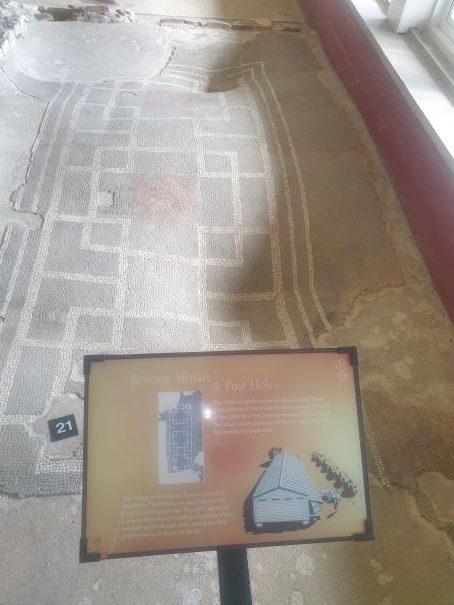
Today's Image: Roman mosaic flooring, with an unusual black on white pattern.
Source: My own Photo
Site: Fishbourne Roman Palace
Here is a text only version. (See below for an interactive version)
21 His rebus cognitis Medea rem aegre tulit et regni cupiditate adducta constituit mortem regi per dolum inferre. Hoc constituto, ad filias regis venit atque ita locuta est. “Videtis patrem vestrum aetate iam esse confectum neque ad laborem regnandi perferendum satis valere. Voltisne eum rursus iuvenem fieri?” Tum filiae regis his auditis ita responderunt. “Num hoc fieri potest? Quis enim umquam e sene iuvenis factus est?”
At Medea respondit, “Scitis me medicinae summam habere scientiam. Nunc igitur vobis demonstrabo quo modo haec res fieri possit.” His dictis, cum arietem aetate iam confectum interfecisset, membra eius in vas aeneum posuit et igni supposito aquae herbas quasdam infudit. Tum, dum aqua effervesceret, carmen magicum cantabat. Post breve tempus aries e vase exsiluit et viribus refectis per agros currebat.
Red and Green Vocab
The words in red and green are found among the 3057 Most Common Words in the Classical Latin texts that we will explore on CentumVerba.com and are essential to your understanding of the texts of Caesar, Vergil and Cicero. The green words appear frequently (at least five times) among Vergil's Aeneid (books I-VI), Caesar de bello Gallico (books I-V) and in Cicero's works - in Catilinam (books I-IV), de lege Manilia (also known as de Imperio Cn. Pompei), and pro Achia. These works constituted the curriculum for Latin over 4 years in American High Schools at the start of the 20th Century. The bulk of my information is taken from The Vocabulary of High School Latin by Gonzalez Lodge. I have added to these 2000 words from varioius other sources to compile my own list of The 3057 Most Common Latin Words.
The black words do not appear frequently in Classical Latin.
The red words are the first occurrences of these words in this author and this word will appear as green the next time you encounter it.
If you are serious about building your vocabulary then you should learn the red words as they occur and you should already know the green ones!
I have provided a FLASHCARD set to help - see below.
How To Read the Interactive Text
To Read the Interactive Text Below Without a Dictionary-
On a Computer: you hover over a word and get all the possible parts of speech; declensions; and conjugations of every word.
Red and Green Vocab
The words in red and green are found among the 3057 Most Common Words in the Classical Latin texts that we will explore on CentumVerba.com and are essential to your understanding of the texts of Caesar, Vergil and Cicero. The green words appear frequently (at least five times) among Vergil's Aeneid (books I-VI), Caesar de bello Gallico (books I-V) and in Cicero's works - in Catilinam (books I-IV), de lege Manilia (also known as de Imperio Cn. Pompei), and pro Achia. These works constituted the curriculum for Latin over 4 years in American High Schools at the start of the 20th Century. The bulk of my information is taken from The Vocabulary of High School Latin by Gonzalez Lodge. I have added to these 2000 words from varioius other sources to compile my own list of The 3057 Most Common Latin Words.
The black words do not appear frequently in Classical Latin.
The red words are the first occurrences of these words in this author and this word will appear as green the next time you encounter it.
If you are serious about building your vocabulary then you should learn the red words as they occur and you should already know the green ones!
I have provided a FLASHCARD set to help - see below.
How To Read the Interactive Text
To Read the Interactive Text Below Without a Dictionary-
On a Phone or Tablet: don't 'hover' -'tap' the word. To remove the 'definition box' you 'tap' to the side of the text box.
INTERACTIVE DICTIONARY FREE TEXT
21 His rebus cdgnitis Medea rem aegre tulit et regni cupiditate adducta constituit mortem regi per dolum inferre. You Need to be a Member to Access the Interactive Dictionary
Hoc constituto, ad filias regis venit atque ita locuta est.
“Videtis patrem vestrum aetate iam esse confectum neque ad laborem regnandi perferendum satis valere. Voltisne eum rursus iuvenem fieri?”
Tum filiae regis his auditis ita responderunt. “Num hoc fieri potest?
Quis enim umquam e sene iuvenis factus est?”
At Medea respondit, “Scitis me medicinae summam habere scientiam. Nunc igitur vobis demonstrabo quo modo haec res fieri possit.”
His dictis, cum arietem aetate iam confectum interfecisset, membra eius in vas aeneum posuit et igni supposito aquae herbas quasdam infudit.
Tum, dum aqua effervesceret, carmen magicum cantabat. Post breve tempus aries e vase exsiluit et viribus refectis per agros currebat.
I have prepared online Flashcards at CRAM.com to make learning the vocabulary much easier. I have no financial gain from you using the app as it is FREE to use.
I have created a stack of the 14 new words in this passage.
YOU NEED TO SIGN UP AS A TRIAL MEMBER TO ACCESS THE FLASHCARDS
Here is the link to the FLASHCARDS
USING THE FLASHCARD APP:
To make the most of the online Flashcards use the "Click or use spacebar to begin" and the Latin word should appear. (The 'Shuffle' button will take the cards out of alphabetical order.) Type 'H' to get the conjugation / declension of the word if you want to see it. 'H' takes tyou back to the word. Click 'See Answer' or use the Spacebar to see the English.
If you were correct or close enough then select "I was right" or else "I was wrong". After you have completed the set it will start again but it will only display the ones you got wrong.
Continue through this process to learn all the words. I hope this is helpful!
Recent Comments