
de - semantically rich
The Latin preposition de is one of the most frequently used and semantically rich elements in classical Latin literature. Governing the ablative case, de primarily expresses notions of origin, separation, topic, and cause. Its versatility allows authors to convey both concrete and abstract relationships with precision and economy.
In its most literal sense, de indicates motion or derivation from a higher place or source. In Caesar’s Commentarii de Bello Gallico, de monte or de colle situates troops descending from elevated terrain, a detail crucial to military strategy and spatial orientation. This spatial usage is common in historical prose, where clarity of movement and geography is essential.
Beyond physical descent, de frequently denotes origin or source in more abstract terms. Cicero, in his philosophical and rhetorical works, uses de to introduce topics of discussion: de officiis, de re publica, de amicitia. Here, de signals intellectual engagement with a subject, framing the discourse as an exploration or exposition. This usage became so standard that many Latin treatises are titled with de followed by the theme, establishing a convention that persisted into medieval and Renaissance Latin.
De also functions to express cause or reason. In Livy’s historical narrative, one might find de metu or de ira, indicating that an action was motivated by fear or anger. This causal usage allows authors to articulate psychological or emotional drivers behind decisions, enriching character portrayal and moral analysis.
In poetic literature, de is often used metaphorically or symbolically. Virgil might describe tears falling de vultu or light emerging de caelo, blending physical imagery with emotional or divine resonance. Ovid, in Metamorphoses, uses de to trace transformations, as in de puella in arborem, marking the shift from one state of being to another.
Stylistically, de contributes to Latin’s conciseness. Its ability to express complex relationships with a single syllable makes it indispensable in both prose and verse. Whether indicating descent, origin, topic, or cause, de serves as a syntactic and semantic bridge, linking ideas with clarity and subtlety.
Across classical Latin literature, de is not merely a preposition—it is a tool of thought, enabling authors to navigate space, reason, and abstraction with elegance and precision.
Today's Image
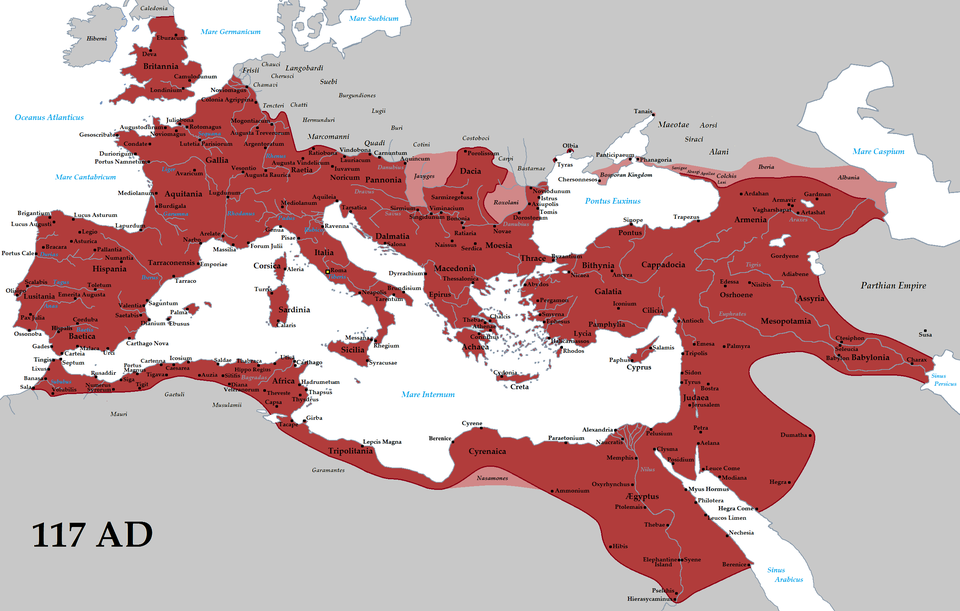
Roman Empire in AD 117 at its greatest territorial extent, at the time of Trajan's death
Red and Green Vocab
The words in red and green are found among the 3057 Most Common Words in the Classical Latin texts that we will explore on CentumVerba.com and are essential to your understanding of the texts of Caesar, Vergil and Cicero. The green words appear frequently (at least five times) among Vergil's Aeneid (books I-VI), Caesar de bello Gallico (books I-V) and in Cicero's works - in Catilinam (books I-IV), de lege Manilia (also known as de Imperio Cn. Pompei), and pro Achia. These works constituted the curriculum for Latin over 4 years in American High Schools at the start of the 20th Century. The bulk of my information is taken from The Vocabulary of High School Latin by Gonzalez Lodge. I have added to these 2000 words from varioius other sources to compile my own list of The 3057 Most Common Latin Words.
The black words do not appear frequently in Classical Latin.
The red words are the first occurrences of these words in this author and this word will appear as green the next time you encounter it.
If you are serious about building your vocabulary then you should learn the red words as they occur and you should already know the green ones!
I have provided a FLASHCARD set to help - see below.
How To Read the Interactive Text
To Read the Interactive Text Below Without a Dictionary-
On a Computer: you hover over a word and get all the possible parts of speech; declensions; and conjugations of every word.
Red and Green Vocab
The words in red and green are found among the 3057 Most Common Words in the Classical Latin texts that we will explore on CentumVerba.com and are essential to your understanding of the texts of Caesar, Vergil and Cicero. The green words appear frequently (at least five times) among Vergil's Aeneid (books I-VI), Caesar de bello Gallico (books I-V) and in Cicero's works - in Catilinam (books I-IV), de lege Manilia (also known as de Imperio Cn. Pompei), and pro Achia. These works constituted the curriculum for Latin over 4 years in American High Schools at the start of the 20th Century. The bulk of my information is taken from The Vocabulary of High School Latin by Gonzalez Lodge. I have added to these 2000 words from varioius other sources to compile my own list of The 3057 Most Common Latin Words.
The black words do not appear frequently in Classical Latin.
The red words are the first occurrences of these words in this author and this word will appear as green the next time you encounter it.
If you are serious about building your vocabulary then you should learn the red words as they occur and you should already know the green ones!
I have provided a FLASHCARD set to help - see below.
How To Read the Interactive Text
To Read the Interactive Text Below Without a Dictionary-
On a Phone or Tablet: don't 'hover' -'tap' the word. To remove the 'definition box' you 'tap' to the side of the text box.
INTERACTIVE DICTIONARY FREE TEXT
imperio populi Romani non modo de regno, sed etiam de ea quam habeat gratia desperare.
You Need to be a Member to Access the Interactive Dictionary
Reperiebat etiam in quaerendo Caesar, quod proelium equestre adversum paucis ante diebus esset factum, initium eius fugae factum a Dumnorige atque eius equitibus
(nam equitatui, quem auxilio Caesari Haedui miserant, Dumnorix praeerat): eorum fuga reliquum esse equitatum perterritum.
CAPUT XIX
Quibus rebus cognitis, cum ad has suspiciones certissimae res accederent, quod per fines Sequanorum Helvetios traduxisset, quod obsides inter eos dandos curasset,
quod ea omnia non modo iniussu suo et civitatis sed etiam inscientibus ipsis fecisset, quod a magistratu Haeduorum accusaretur,
satis esse causae arbitrabatur quare in eum aut ipse animadverteret aut civitatem animadvertere iuberet.
You Need to be a Member to Access the Interactive Dictionary
I have prepared online Flashcards at CRAM.com to make learning the vocabulary much easier. I have no financial gain from you using the app as it is FREE to use.
I have created a stack of the 7 new words in this passage.
Here is the link to the FLASHCARDS
USING THE FLASHCARD APP:
To make the most of the online Flashcards use the "Click or use spacebar to begin" and the Latin word should appear. (The 'Shuffle' button will take the cards out of alphabetical order.) Type 'H' to get the conjugation / declension of the word if you want to see it. 'H' takes tyou back to the word. Click 'See Answer' or use the Spacebar to see the English.
If you were correct or close enough then select "I was right" or else "I was wrong". After you have completed the set it will start again but it will only display the ones you got wrong.
Continue through this process to learn all the words. I hope this is helpful!
Recent Comments