
transeo - cross to the other side
The Latin verb transeo—meaning ‘to go across,’ ‘to pass over,’ ‘to go beyond,’ or ‘to cross’—appears in the Vulgate with layered usage that navigates physical movement, moral transformation, and eschatological vision. As a compound of eo with the preposition trans, it carries inherent motion and transition, which Jerome deploys to great effect in both narrative flow and theological depth.
In historical recounting and geographic descriptions, transeo often illustrates movement across land, water, or boundaries. The Israelites transeunt mare Rubrum, signifying the miraculous crossing of the Red Sea—a pivotal moment not just in journey but in divine deliverance. Here, transeo acts as more than description; it encapsulates rupture from bondage and entrance into providence.
Beyond spatial transitions, transeo acquires metaphorical force in ethical and spiritual domains. In exhortative passages, believers are called to transire de morte ad vitam, capturing conversion not as conceptual change but as a decisive passage into renewed life. This usage constructs a spiritual geography where transeo maps redemptive movement.
The verb also supports judicial imagery. Transgression may be framed as having transitum praeceptum, suggesting not only disobedience but a boundary willingly crossed. In this way, transeo expresses agency with consequence, reinforcing the moral seriousness of divine law.
In prophetic or apocalyptic texts, transeo often suggests transience. The world transit, echoing themes of impermanence and pointing toward what endures. When Christ says caelum et terra transibunt, the verb offers not destruction but transformation—an idea deeply embedded in eschatological hope.
Even liturgically, transeo supports the rhythm of journey and return. Psalms may speak of pilgrims who transierunt per vallem plorationis, hinting at endurance through sorrow toward joy. In these contexts, transeo holds emotional resonance as well as theological freight.
In the Vulgate, transeo becomes a narrative engine and spiritual lexicon. Jerome’s usage allows the verb to move across domains—bodily, cosmic, moral—with nuance and precision, always pointing toward passage, transition, and purpose.
The images for these posts on Mark's gospel
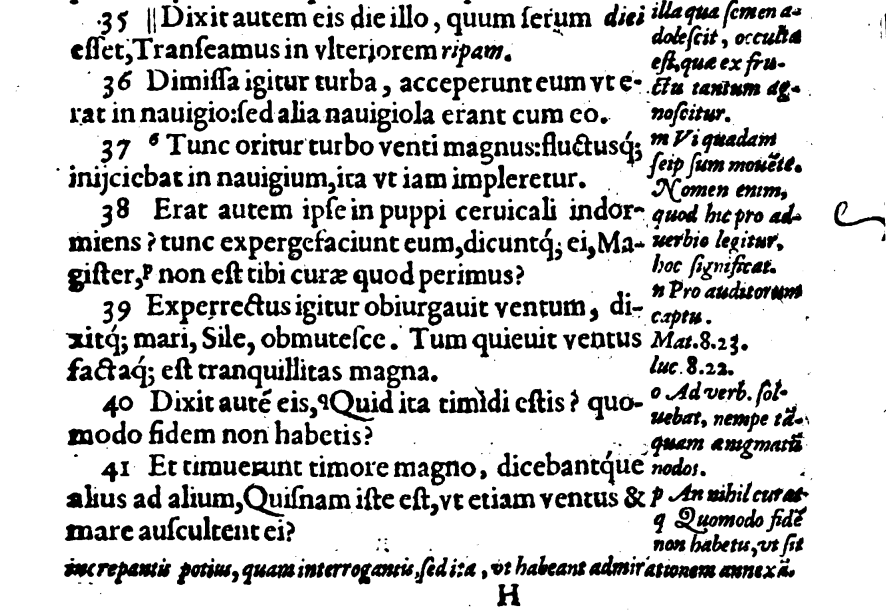
Screenshots taken from the Nouum Testamentum of Théodore de Bèze, (1519-1605) ( Londini : Thomas Vautrollerius, typographus, 1587 )
Accessed from the Post Reformation Digital Library
JUMP To Dictionary Free Interactive Text
Here is a text only version.
EVANGELIUM MARCUM
CAPUT IV
35 et ait illis illa die cum sero esset factum transeamus contra
36 et dimittentes turbam adsumunt eum ita ut erat in navi et aliae naves erant cum illo
37 et facta est procella magna venti et fluctus mittebat in navem ita ut impleretur navis
38 et erat ipse in puppi supra cervical dormiens et excitant eum et dicunt ei magister non ad te pertinet quia perimus
39 et exsurgens comminatus est vento et dixit mari tace obmutesce et cessavit ventus et facta est tranquillitas magna
40 et ait illis quid timidi estis necdum habetis fidem
41 et timuerunt magno timore et dicebant ad alterutrum quis putas est iste quia et ventus et mare oboediunt ei
How To Read the Interactive Text Without a Dictionary
On a Computer:
Hover over a word to get all its possible parts of speech, declensions, or conjugations.
On a Tablet:
'TAP' the word to see the definition, and to remove the 'definition box' you simply 'TAP' anywhere to the side.
How To Read the Interactive Text
'Tap' the word to see the definition and to remove the 'definition box' you simply 'tap' antwhere to the side.
EVANGELIUM MARCUM
CAPUT IV
35 Et ait illis illa die, cum sero esset factum Transeamus contra.
You Need to be at least a Trial Member to Access the Interactive Dictionary
36 Et dimittentes turbam, assumunt eum, ut erat in navi et aliae naves erant cum illo.
37 Et exoritur procella magna venti, et fluctus se mittebant in navem, ita ut iam impleretur navis.
38 Et erat ipse in puppi supra cervical dormiens et excitant eum et dicunt ei Magister, non ad te pertinet quia perimus?
39 Et exsurgens comminatus est vento et dixit mari Tace, obmutesce! Et cessavit ventus, et facta est tranquillitas magna.
40 Et ait illis Quid timidi estis? Necdum habetis fidem?
41 Et timuerunt magno timore et dicebant ad alterutrum Quis putas est iste, quia et ventus et mare oboediunt ei?
Recent Comments