
terra - land not cotta
The Latin noun terra—meaning ‘earth,’ ‘land,’ or ‘ground’—functions in the Vulgate as both a geographic and theological canvas. Jerome’s rendering infuses terra with layers of meaning that move between mundane soil and sacred significance, capturing the tensions and harmonies of divine interaction with creation.
In its most basic use, terra designates the physical world. It appears in terra et mare to encompass the totality of the inhabited globe, often in contrast to the heavens (caelum), establishing a cosmological framework. In creation narratives, terra emerges from void as an ordered domain—terra arida transformed by divine command into fertile ground. The word carries the idea of habitation, provision, and stewardship.
Terra also becomes the locus of divine activity. It is where covenants unfold, prophets speak, and salvation history plays out. When God commands his people to inherit terram promissionis, the land becomes more than territory—it becomes promise, fulfilment, and identity. The spiritual value of terra elevates it from geography to sacred space.
Conversely, terra can symbolize mortality and sin. Humanity is formed de terra and returns to it, marking the boundary between life and death. In judgment scenes, terra may quake or open, as in aperuit terra os suum, swallowing transgressors—portraying the land itself as responsive to divine justice. This dual nature of terra—giver of life and grave of the condemned—deepens its symbolic resonance.
Liturgically, terra participates in praise. Psalms call terra to sing and rejoice, joining creation in responding to its maker. This anthropomorphic use suggests terra is not inert but animated in divine worship.
Throughout the Vulgate, terra operates as more than topography. It is a medium of covenant, revelation, judgment, and renewal. Jerome’s Latin lets terra speak with voice, memory, and mystery—mirroring humanity’s journey upon it and the divine will imprinted across its surface.
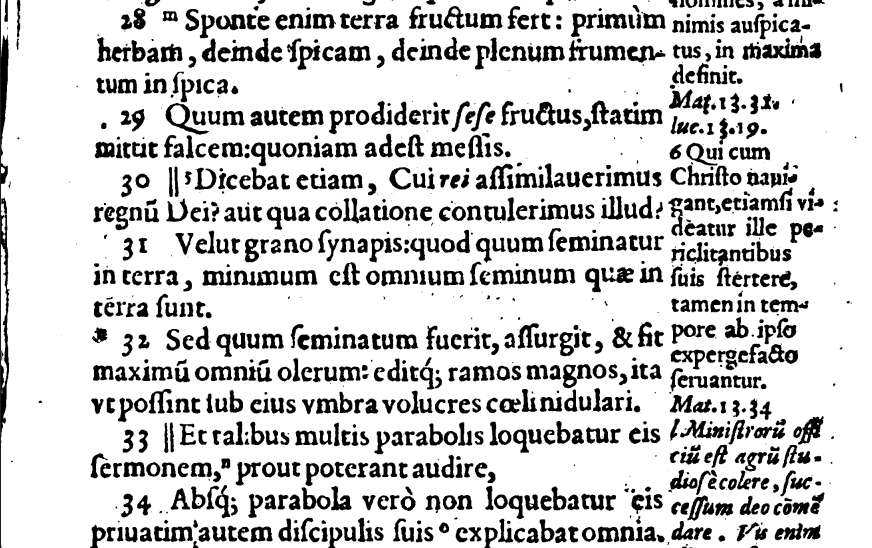
The images for these posts on Mark's gospel
Screenshots taken from the Nouum Testamentum of Théodore de Bèze, (1519-1605) ( Londini : Thomas Vautrollerius, typographus, 1587 )
Accessed from the Post Reformation Digital Library
JUMP To Dictionary Free Interactive Text
Here is a text only version.
EVANGELIUM MARCUM
CAPUT IV
28 ultro enim terra fructificat primum herbam deinde spicam deinde plenum frumentum in spica
29et cum se produxerit fructus statim mittit falcem quoniam adest messis
30 et dicebat cui adsimilabimus regnum Dei aut cui parabolae conparabimus illud
31 sicut granum sinapis quod cum seminatum fuerit in terra minus est omnibus seminibus quae sunt in terra
32 et cum seminatum fuerit ascendit et fit maius omnibus holeribus et facit ramos magnos ita ut possint sub umbra eius aves caeli habitare
33 et talibus multis parabolis loquebatur eis verbum prout poterant audire
34 sine parabola autem non loquebatur eis seorsum autem discipulis suis disserebat omnia
How To Read the Interactive Text Without a Dictionary
On a Computer:
Hover over a word to get all its possible parts of speech, declensions, or conjugations.
On a Tablet:
'TAP' the word to see the definition, and to remove the 'definition box' you simply 'TAP' anywhere to the side.
How To Read the Interactive Text
'Tap' the word to see the definition and to remove the 'definition box' you simply 'tap' antwhere to the side.
EVANGELIUM MARCUM
CAPUT IV
28 Ultro terra fructificat primum herbam, deinde spicam, deinde plenum frumentum in spica.
You Need to be at least a Trial Member to Access the Interactive Dictionary
29 Et cum se produxerit fructus, statim mittit falcem, quoniam adest messis.
30 Et dicebat Quomodo assimilabimus regnum Dei aut in qua parabola ponemus illud?
31 Sicut granum sinapis, quod cum seminatum fuerit in terra, minus est omnibus seminibus, quae sunt in terra
32 et cum seminatum fuerit, ascendit et fit maius omnibus holeribus et facit ramos magnos, ita ut possint sub umbra eius aves caeli habitare.
33 Et talibus multis parabolis loquebatur eis verbum, prout poterant audire
34 sine parabola autem non loquebatur eis. Seorsum autem discipulis suis disserebat omnia.
Recent Comments