
frumentum - an allowance
The Latin word frumentum denotes grain, especially wheat, and by extension refers to a vital resource: food supply for both civilian and military populations. In Caesar’s writings—most notably Commentarii de Bello Gallico—frumentum appears frequently, not as a neutral term, but as a strategic and political instrument.
Caesar uses frumentum to illuminate the logistical concerns of warfare. Armies depended on regular access to grain, and controlling frumentum meant controlling movement, morale, and negotiation. Before engaging in battles, Caesar often describes efforts to frumentum comparare, securing provisions either through local allies or by requisitioning from subject tribes. The recurring emphasis on frumentum reflects the practical reality of campaigning: victory depended as much on supply lines as on combat.
Caesar’s use of frumentum in his commentaries was shaped by several key historical and logistical pressures during the Gallic Wars:
-
The Helvetii Migration: Early in the Commentarii de Bello Gallico, Caesar describes the Helvetii’s mass movement across Gaul. Their migration disrupted local agriculture and strained Roman supply lines. Caesar’s army had to secure frumentum from allies like the Aedui, who repeatedly delayed delivery, prompting Caesar to confront them politically.
-
Climate and Geography of Gaul: Gaul’s colder climate meant that grain (frumenta) was often unripe during campaign season. Caesar notes that frumentum was scarce due to frigora, and even fodder for animals was limited. This forced him to rely on grain transported via rivers like the Arar (Saône), which became inaccessible when the Helvetii changed their route.
-
Military Strategy and Siege Warfare: Grain was central to sustaining sieges and troop morale. Caesar’s campaigns often involved prolonged engagements where access to frumentum determined whether a city could hold out or a legion could continue marching. He frequently used grain shortages to pressure tribes into submission or justify tactical decisions.
-
Diplomatic Leverage: Offering or withholding frumentum became a tool of diplomacy. Tribes that supplied grain were seen as cooperative; those that withheld it risked Roman retaliation. Caesar’s emphasis on frumentum in these contexts reflects its role as both sustenance and symbol of allegiance.
-
Roman Military Logistics: The broader Roman emphasis on supply chains meant that frumentum was tracked meticulously. Caesar’s attention to grain reflects his understanding that logistics were as decisive as battlefield tactics. His success in Gaul was partly due to his ability to secure and manage grain supplies efficiently.
In short, frumentum wasn’t just food—it was a strategic asset shaped by geography, diplomacy, and the realities of ancient warfare. Caesar’s repeated focus on it reveals how deeply intertwined grain was with power and survival.
Today's Image
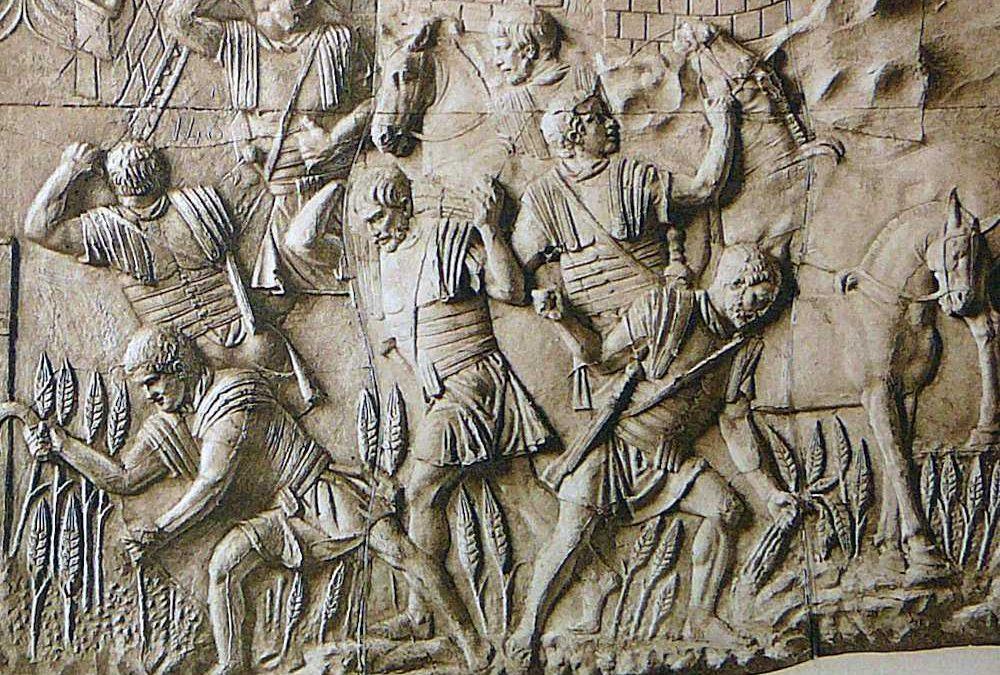
A reconstructed relief panel from the original on the Column of Trajan, Rome. The scene, showing the frumentarii at work gathering wheat.
Source: thehistorianshut.com
frumentum - an allowance
The Latin word frumentum denotes grain, especially wheat, and by extension refers to a vital resource: food supply for both civilian and military populations. In Caesar’s writings—most notably Commentarii de Bello Gallico—frumentum appears frequently, not as a neutral term, but as a strategic and political instrument.
Caesar uses frumentum to illuminate the logistical concerns of warfare. Armies depended on regular access to grain, and controlling frumentum meant controlling movement, morale, and negotiation. Before engaging in battles, Caesar often describes efforts to frumentum comparare, securing provisions either through local allies or by requisitioning from subject tribes. The recurring emphasis on frumentum reflects the practical reality of campaigning: victory depended as much on supply lines as on combat.
Caesar’s use of frumentum in his commentaries was shaped by several key historical and logistical pressures during the Gallic Wars:
- The Helvetii Migration: Early in the Commentarii de Bello Gallico, Caesar describes the Helvetii’s mass movement across Gaul. Their migration disrupted local agriculture and strained Roman supply lines. Caesar’s army had to secure frumentum from allies like the Aedui, who repeatedly delayed delivery, prompting Caesar to confront them politically.
- Climate and Geography of Gaul: Gaul’s colder climate meant that grain (frumenta) was often unripe during campaign season. Caesar notes that frumentum was scarce due to frigora, and even fodder for animals was limited. This forced him to rely on grain transported via rivers like the Arar (Saône), which became inaccessible when the Helvetii changed their route.
- Military Strategy and Siege Warfare: Grain was central to sustaining sieges and troop morale. Caesar’s campaigns often involved prolonged engagements where access to frumentum determined whether a city could hold out or a legion could continue marching. He frequently used grain shortages to pressure tribes into submission or justify tactical decisions.
- Diplomatic Leverage: Offering or withholding frumentum became a tool of diplomacy. Tribes that supplied grain were seen as cooperative; those that withheld it risked Roman retaliation. Caesar’s emphasis on frumentum in these contexts reflects its role as both sustenance and symbol of allegiance.
- Roman Military Logistics: The broader Roman emphasis on supply chains meant that frumentum was tracked meticulously. Caesar’s attention to grain reflects his understanding that logistics were as decisive as battlefield tactics. His success in Gaul was partly due to his ability to secure and manage grain supplies efficiently.
In short, frumentum wasn’t just food—it was a strategic asset shaped by geography, diplomacy, and the realities of ancient warfare. Caesar’s repeated focus on it reveals how deeply intertwined grain was with power and survival.
Today's Image
A reconstructed relief panel from the original on the Column of Trajan, Rome. The scene, showing the frumentarii at work gathering wheat.
Source: thehistorianshut.com
Here is a text only version. (See below for an interactive version)
Chapter 16
Interim cotidie Caesar Haeduos frumentum, quod essent publice polliciti, flagitare. Nam propter frigora [quod Gallia sub septentrionibus, ut ante dictum est, posita est,] non modo frumenta in agris matura non erant, sed ne pabuli quidem satis magna copia suppetebat; eo autem frumento quod flumine Arari navibus subvexerat propterea uti minus poterat quod iter ab Arari Helvetii averterant, a quibus discedere nolebat.
Diem ex die ducere Haedui: conferri, comportari, adesse dicere. Ubi se diutius duci intellexit et diem instare quo die frumentum militibus metiri oporteret, convocatis eorum principibus, quorum magnam copiam in castris habebat, in his Diviciaco et Lisco, qui summo magistratui praeerat, quem vergobretum appellant Haedui, qui creatur annuus et vitae necisque in suos habet potestatem, graviter eos accusat,
Need Help Understanding the Latin?
You might find it helpful to start with the Side-by-Side Version which allows you to see my own very literal translation of the text which is almost a word-for-word translation - in an attempt to make it easier to understand the Latin!
Finally come back to this page - Classical Text and you should be able to better understand and competently read the original Latin text.
Vocabulary Version
I have prepared a Vocabulary Version of the passage (link at bottom of the page) which highlights the 3057 Most Common Words in the texts of Vergil, Caesar and Cicero that we will explore on CentumVerba.com
If you are serious about building your vocabulary, the FLASHCARD set should help you learn them.
How To Read the Interactive Text
To Read the Interactive Text Below Without a Dictionary-
On a Computer: you hover over a word and get all the possible parts of speech; declensions; and conjugations of every word.
Need Help Understanding the Latin?
You might find it helpful to start with the Side-by-Side Version which allows you to see my own very literal translation of the text which is almost a word-for-word translation - in an attempt to make it easier to understand the Latin!
Finally come back to this page - Classical Text and you should be able to better understand and competently read the original Latin text.
Vocabulary Version
I have prepared a Vocabulary Version of the passage (link at bottom of the page) which highlights the 3057 Most Common Words in the texts of Vergil, Caesar and Cicero that we will explore on CentumVerba.com
If you are serious about building your vocabulary, the FLASHCARD set should help you learn them.
How To Read the Interactive Text
To Read the Interactive Text Below Without a Dictionary-
On a Phone or Tablet: don't 'hover' -'tap' the word. To remove the 'definition box' you 'tap' to the side of the text box.
Dictionary-Free Interactive Text
16 Interim cotidie Caesar Haeduos frumentum, quod essent publice polliciti, flagitare.
You Need to be a Member to Access the Interactive Dictionary
Nam propter frigora [quod Gallia sub septentrionibus, ut ante dictum est, posita est,] non modo frumenta in agris matura non erant, sed ne pabuli quidem satis magna copia suppetebat;
eo autem frumento quod flumine Arari navibus subvexerat propterea uti minus poterat quod iter ab Arari Helvetii averterant, a quibus discedere nolebat.
Diem ex die ducere Haedui: conferri, comportari, adesse dicere.
Ubi se diutius duci intellexit et diem instare quo die frumentum militibus metiri oporteret, convocatis eorum principibus, quorum magnam copiam in castris habebat,
in his Diviciaco et Lisco, qui summo magistratui praeerat, quem vergobretum appellant Haedui, qui creatur annuus et vitae necisque in suos habet potestatem, graviter eos accusat,
INTERACTIVE DICTIONARY-FREE TEXT
16 Interim cotidie Caesar Haeduos frumentum, quod essent publice polliciti, flagitare.
You Need to be a Member to Access the Interactive Dictionary
Nam propter frigora [quod Gallia sub septentrionibus, ut ante dictum est, posita est,] non modo frumenta in agris matura non erant, sed ne pabuli quidem satis magna copia suppetebat;
eo autem frumento quod flumine Arari navibus subvexerat propterea uti minus poterat quod iter ab Arari Helvetii averterant, a quibus discedere nolebat.
Diem ex die ducere Haedui: conferri, comportari, adesse dicere.
Ubi se diutius duci intellexit et diem instare quo die frumentum militibus metiri oporteret, convocatis eorum principibus, quorum magnam copiam in castris habebat,
in his Diviciaco et Lisco, qui summo magistratui praeerat, quem vergobretum appellant Haedui, qui creatur annuus et vitae necisque in suos habet potestatem, graviter eos accusat,
Recent Comments