
mora - delays are a hindrance
In Latin, mora is a feminine noun of the first declension meaning 'delay', 'pause', or 'hindrance'. Its forms include mora, morae, morae, moram, morā in the singular and morae, morarum, moris, moras, moris in the plural. The word derives from the verb morari, meaning 'to delay' or 'to linger', and is closely tied to concepts of time, hesitation, and interruption in classical literature.
In Roman prose, mora frequently appears in military and political contexts. Caesar uses it in Commentarii de Bello Gallico to describe tactical delays or strategic pauses, as in sine mora—'without delay'—to emphasize swift action. Cicero employs mora in legal and rhetorical settings to highlight procedural postponements or moral hesitation. In Pro Milone, he refers to mora temporis to underscore the urgency of justice and the dangers of delay.
Poets use mora to evoke emotional or dramatic tension. In Virgil’s Aeneid, mora can signal divine obstruction or human indecision, such as when fate delays Aeneas’s journey. Ovid uses mora to heighten romantic suspense or to mark the passage of time in transformation narratives. The phrase morae amoris—'delays of love'—captures the bittersweet nature of longing and anticipation.
Philosophically, mora represents the tension between action and contemplation. Seneca, in his Stoic writings, warns against the mora vitae—the delay of life—urging readers to seize the present and avoid procrastination. The word thus becomes a symbol of wasted potential and the fleeting nature of time.
In idiomatic expressions, sine mora ('without delay') and cum mora ('with delay') are common in both formal and colloquial Latin. These phrases appear in inscriptions, letters, and legal documents to indicate urgency or procedural timing.
Modern languages preserve mora in legal and poetic contexts. In Scots law, mora refers to delay in bringing a claim. In linguistics, it denotes a unit of syllable weight. English derivatives like 'moratorium' and 'demur' reflect its semantic field of postponement and hesitation.
Ultimately, mora in Latin literature is more than a temporal marker—it is a narrative device, a philosophical warning, and a poetic tool for expressing suspense, reflection, and urgency.
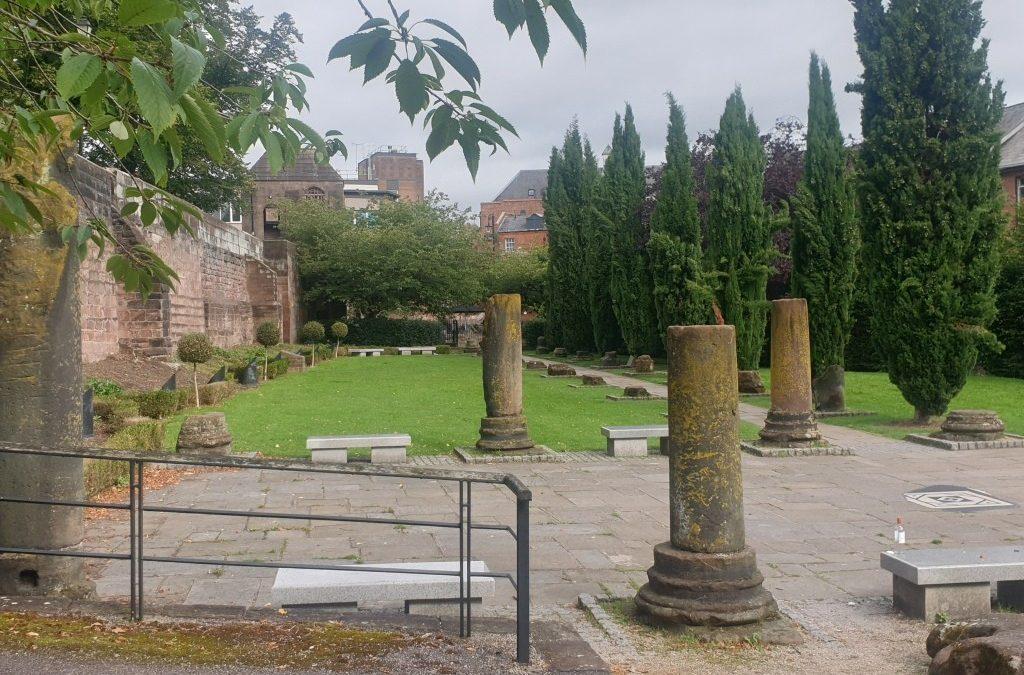
Today's Image: Gardens in Chester with Roman artefacts
Source: My own Photo
Here is a text only version. (See below for an interactive version)
18 His rebus gestis, omnes sine mora navem rursus conscenderunt et sublatis ancoris prima vigilia solverunt; neque enim satis tutum esse arbitrati sunt in eo loco manere. At rex Aeetes, qui iam ante inimico in eos fuerat animo, ubi cognovit filiam suam non modo ad Argonautas se recepisse sed etiam ad vellus auferendum auxilium tulisse, hoc dolore gravius exarsit. Navem longam quam celerrime deduci iussit et militibus impositis fugientis insecutus est.
Argonautae, qui bene sciebant rem in discrimine esse, summis viribus remis contendebant. Cum tamen navis qua vehebantur ingenti esset magnitudine, non eadem celeritate qua Colchi progredi poterant. Quae cum ita essent, minimum afuit quin a Colchis sequentibus caperentur neque enim longius intererat quam quo telum adici posset. At Medea, cum vidisset quo in loco res essent, paene omni spe deposita, infandum hoc consilium cepit.
How To Read the Interactive Text
To Read the Interactive Text Below Without a Dictionary-
On a Computer: you hover over a word and get all the possible parts of speech; declensions; and conjugations of every word.
How To Read the Interactive Text
To Read the Interactive Text Below Without a Dictionary-
On a Phone or Tablet: don't 'hover' -'tap' the word. To remove the 'definition box' you 'tap' to the side of the text box.
INTERACTIVE DICTIONARY FREE TEXT
18 His rebus gestis, omnes sine mora navem rursus conscenderunt et sublatis ancoris prima vigilia solverunt;
You Need to be a Member to Access the Interactive Dictionary
neque enim satis tutum esse arbitrati sunt in eo loco manere.
At rex Aeetes, qui iam ante inimico in eos fuerat animo, ubi cognovit filiam suam non modo ad Argonautas se recepisse sed etiam ad vellus auferendum auxilium tulisse, hoc dolore gravius exarsit.
Navem longam quam celerrime deduci iussit et militibus impositis fugientis insecutus est.
Argonautae, qui bene sciebant rem in discrimine esse, summis viribus remis contendebant.
Cum tamen navis qua vehebantur ingenti esset magnitudine, non eadem celeritate qua Colchi progredi poterant
Quae cum ita essent, minimum afuit quin a Colchis sequentibus caperentur neque enim longius intererat quam quo telum adici posset.
At Medea, cum vidisset quo in loco res essent, paene omni spe deposita, infandum hoc consilium cepit.
Recent Comments