
exsilium
The Roman concept of exsilium referred to exile or banishment, a form of punishment that removed individuals from their homeland, often as an alternative to harsher penalties like execution. However, exsilium was voluntary on the part of an accused citizen, and was allowed by law ; thus citizens often withdrew to escape fines, but when the charge was a grave one, e.g. scandalous misgovernment (as Verres), or the putting to death of Roman citizens illegally (as Cicero), the accused always retired to a foreign country.
The continued absence of the exile could be made compulsory afterwards by inter dictio aqua et ignis = prohibition from water and fire, necessaries of life, i.e. no citizen or Latin might harbor the exile. exsilium implied a loss of the property left behind, and loss of political privileges but the exile remained a civis (citizen) unless he attached himself to a foreign ruler. On return to Rome, his property might be restored by special grant. An exile could be recalled (revocari), and resume his station as a full citizen, e.g. Cicero in B.C. 57.
Roman exsilium came in different forms: relegatio was a milder version, where the individual was banished but retained their citizenship and property. This was often used for political figures or writers, such as the poet Ovid, who was exiled to Tomis by Emperor Augustus. Whereas deportatio, a harsher form, involved permanent exile, loss of citizenship, and confiscation of property. This was reserved for more serious offences.
exsilium was not just a legal punishment but also a tool for political control. Emperors used it to remove rivals or dissenters, ensuring stability within the empire. Some exiles found refuge in distant provinces, while others suffered greatly due to isolation and loss of status. Despite its punitive nature, exsilium sometimes allowed individuals to continue their intellectual or political work from afar. The concept influenced later legal traditions, shaping exile practices in medieval and modern societies.
Here are some notable examples:
Ovid (8 CE) – The poet was exiled by Emperor Augustus to Tomis (modern-day Romania) for reasons that remain unclear. He referred to his exile as a great personal tragedy and wrote Tristia and Epistulae ex Ponto while in exile. However, he died in exile.
Cicero (58 BCE) – Cicero himself was exiled by the tribune Clodius Pulcher after Cicero ordered the execution of conspirators without trial during the Catilinarian Conspiracy that we are reading here. He spent time in Greece before being recalled to Rome.
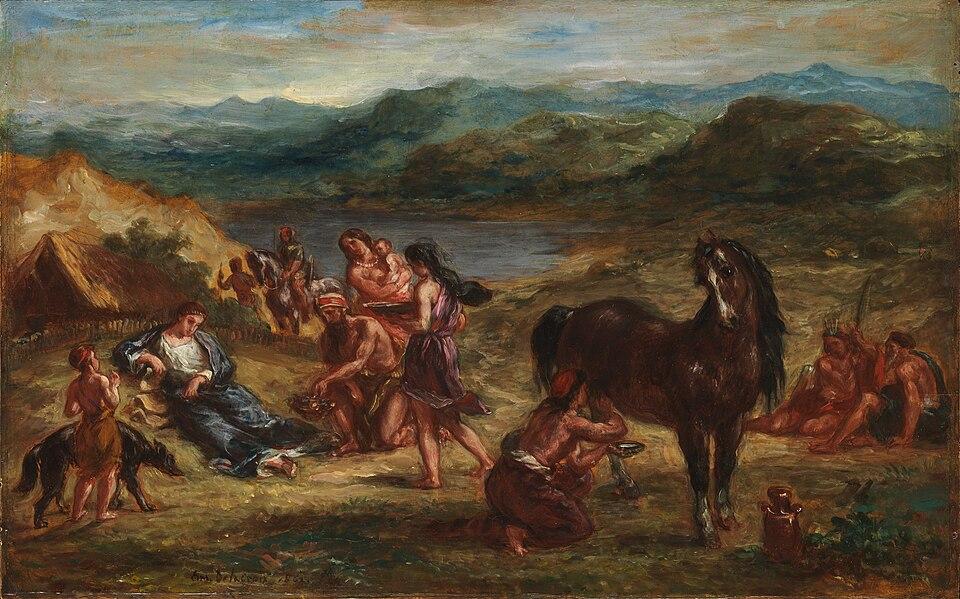
Today's Image: Ovide chez les Scythes
Artist: Eugène Delacroix (1862)
Here is a text only version
non iubeo, sed, si me consulis, suadeo. quid est enim, Catilina, quod te iam in hac urbe delectare possit? in qua nemo est extra istam coniurationem perditorum hominum qui te non metuat, nemo qui non oderit. quae nota domesticae turpitudinis non inusta vitae tuae est? quod privatarum rerum dedecus non haeret in fama? quae libido ab oculis, quod facinus a manibus umquam tuis, quod flagitium a toto corpore afuit? cui tu adulescentulo quem corruptelarum inlecebris inretisses non aut ad audaciam ferrum aut ad libidinem facem praetulisti?
[14] quid vero? nuper cum morte superioris uxoris novis nuptiis locum vacuefecisses, nonne etiam alio incredibili scelere hoc scelus cumulavisti?
Need Help Understanding the Latin?
You might find it helpful to start with the Side-by-Side Version which allows you to see my own very literal translation of the text which is almost a word-for-word translation - in an attempt to make it easier to understand the Latin!
Finally come back to this page - Classical Text and you should be able to better understand and competently read the original Latin text.
Vocabulary Version
I have prepared a Vocabulary Version of the passage (link at bottom of the page) which highlights the 3057 Most Common Words in the texts of Vergil, Caesar and Cicero that we will explore on CentumVerba.com
If you are serious about building your vocabulary, the FLASHCARD set should help you learn them.
How To Read the Interactive Text
To Read the Interactive Text Below Without a Dictionary-
On a Computer: you hover over a word and get all the possible parts of speech; declensions; and conjugations of every word.
Need Help Understanding the Latin?
You might find it helpful to start with the Side-by-Side Version which allows you to see my own very literal translation of the text which is almost a word-for-word translation - in an attempt to make it easier to understand the Latin!
Finally come back to this page - Classical Text and you should be able to better understand and competently read the original Latin text.
Vocabulary Version
I have prepared a Vocabulary Version of the passage (link at bottom of the page) which highlights the 3057 Most Common Words in the texts of Vergil, Caesar and Cicero that we will explore on CentumVerba.com
If you are serious about building your vocabulary, the FLASHCARD set should help you learn them.
How To Read the Interactive Text
To Read the Interactive Text Below Without a Dictionary-
On a Phone or Tablet: don't 'hover' -'tap' the word. To remove the 'definition box' you 'tap' to the side of the text box.
INTERACTIVE DICTIONARY FREE TEXT
non iubeo, sed, si me consulis, suadeo. quid est enim, Catilina, quod te iam in hac urbe delectare possit?
You Need to be a Member to Access the Interactive Dictionary
in qua nemo est extra istam coniurationem perditorum hominum qui te non metuat, nemo qui non oderit. quae nota domesticae turpitudinis non inusta vitae tuae est? quod privatarum rerum dedecus non haeret in fama?
quae libido ab oculis, quod facinus a manibus umquam tuis, quod flagitium a toto corpore afuit? cui tu adulescentulo quem corruptelarum inlecebris inretisses non aut ad audaciam ferrum aut ad libidinem facem praetulisti?
[14] quid vero? nuper cum morte superioris uxoris novis nuptiis locum vacuefecisses, nonne etiam alio incredibili scelere hoc scelus cumulavisti?
Recent Comments