
talis - of such a kind is this
The Latin adjective talis, meaning ‘such’ or ‘of such a kind’, is a demonstrative term used to indicate quality, type, or nature, often in relation to something previously mentioned or implied. Its function is both grammatical and rhetorical, allowing authors to draw comparisons, establish equivalence, or emphasise particular characteristics.
In epic poetry, talis frequently appears in similes and narrative transitions. Virgil uses it in the Aeneid to introduce comparisons between divine and mortal actions, or to highlight the grandeur of a scene. For example, when describing a hero’s fury or a god’s intervention, talis helps to elevate the moment by linking it to a known or imagined archetype. The word thus serves to bridge the specific and the universal, anchoring the narrative in shared cultural reference.
In elegiac poetry, talis often appears in expressions of emotion or moral reflection. Ovid uses it to describe the nature of love, fate, or poetic inspiration. In Amores and Tristia, talis can signal the uniqueness of a lover’s beauty or the bitterness of exile. The term allows for subtle shifts in tone, from admiration to lament, depending on context.
In prose, talis is common in philosophical and rhetorical writing. Cicero employs it to define abstract qualities or to frame examples in argumentation. In his speeches and treatises, talis helps to clarify the nature of justice, virtue, or civic duty, often in contrast to their opposites. Seneca uses talis to describe moral types or states of mind, reinforcing his Stoic emphasis on internal consistency and ethical clarity.
Historians such as Livy and Tacitus use talis to characterise events or individuals, especially when drawing moral conclusions. It often appears in evaluative passages, where the historian reflects on the significance of an action or the character of a leader.
Overall, talis in classical Latin literature is a versatile term that enables authors to define, compare, and elevate. Its use reflects a concern with typology, judgement, and the shaping of meaning through relational language.
Today's Artwork:
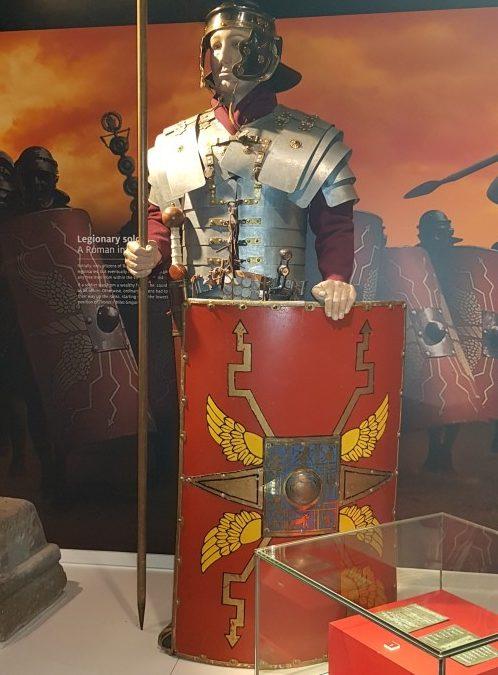
Image: A Legionary Soldier at Vindolanda Roman Army Museum
Source: My own photo
Here is a text only version. (See below for an interactive version)
Talibus incusat, gressumque ad moenia tendit:
at Venus obscuro gradientes aere saepsit,
et multo nebulae circum dea fudit amictu,
cernere ne quis eos, neu quis contingere posset,
molirive moram, aut veniendi poscere causas.
Ipsa Paphum sublimis abit, sedesque revisit
laeta suas, ubi templum illi, centumque Sabaeo
ture calent arae, sertisque recentibus halant.
Corripuere viam interea, qua semita monstrat.
Iamque ascendebant collem, qui plurimus urbi
imminet, adversasque adspectat desuper arces.
Miratur molem Aeneas, magalia quondam,
miratur portas strepitumque et strata viarum.
Instant ardentes Tyrii pars ducere muros,
molirique arcem et manibus subvolvere saxa,
pars optare locum tecto et concludere sulco.
Iura magistratusque legunt sanctumque senatum;
hic portus alii effodiunt; hic alta theatris
fundamenta locant alii, immanisque columnas
rupibus excidunt, scaenis decora alta futuris.
Need Help Understanding the Latin?
You might find it helpful to start with the Side-by-Side Version which allows you to see my own very literal translation of the text which is almost a word-for-word translation - in an attempt to make it easier to understand the Latin!
Finally come back to this page - Classical Text and you should be able to better understand and competently read the original Latin text.
Vocabulary Version
I have prepared a Vocabulary Version of the passage (link at bottom of the page) which highlights the 3057 Most Common Words in the texts of Vergil, Caesar and Cicero that we will explore on CentumVerba.com
If you are serious about building your vocabulary, the FLASHCARD set should help you learn them.
How To Read the Interactive Text
To Read the Interactive Text Below Without a Dictionary-
On a Computer: you hover over a word and get all the possible parts of speech; declensions; and conjugations of every word.
Need Help Understanding the Latin?
You might find it helpful to start with the Side-by-Side Version which allows you to see my own very literal translation of the text which is almost a word-for-word translation - in an attempt to make it easier to understand the Latin!
Finally come back to this page - Classical Text and you should be able to better understand and competently read the original Latin text.
Vocabulary Version
I have prepared a Vocabulary Version of the passage (link at bottom of the page) which highlights the 3057 Most Common Words in the texts of Vergil, Caesar and Cicero that we will explore on CentumVerba.com
If you are serious about building your vocabulary, the FLASHCARD set should help you learn them.
How To Read the Interactive Text
To Read the Interactive Text Below Without a Dictionary-
On a Phone or Tablet: don't 'hover' -'tap' the word. To remove the 'definition box' you 'tap' to the side of the text box.
INTERACTIVE DICTIONARY FREE TEXT
Talibus incusat, gressumque ad moenia tendit:
You Need to be a Member to Access the Interactive Dictionary
at Venus obscuro gradientes aere saepsit, et multo nebulae circum dea fudit amictu, cernere ne quis eos, neu quis contingere posset, molirive moram, aut veniendi poscere causas.
Ipsa Paphum sublimis abit, sedesque revisit laeta suas, ubi templum illi, centumque Sabaeo ture calent arae, sertisque recentibus halant.
Corripuere viam interea, qua semita monstrat. Iamque ascendebant collem, qui plurimus urbi imminet, adversasque adspectat desuper arces.
Miratur molem Aeneas, magalia quondam, miratur portas strepitumque et strata viarum. Instant ardentes Tyrii pars ducere muros, molirique arcem et manibus subvolvere saxa, pars optare locum tecto et concludere sulco.
Iura magistratusque legunt sanctumque senatum; hic portus alii effodiunt; hic alta theatris fundamenta locant alii, immanisque columnas rupibus excidunt, scaenis decora alta futuris.
Recent Comments