
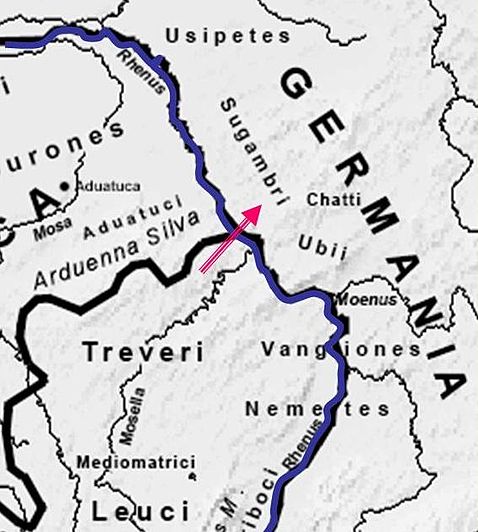
With a length of 1326 kilometer, the Rhenus, the Rhine, is one of the longest rivers in Europe. Its sources are in the Swiss Alps. In the area described in this passage the Rhenus was streaming through a Celtic-speaking country - in fact, the word "Rhine" or Rên is Celtic and means "stream".
Frontier
On the west bank, people spoke Celtic languages, and on the east bank, Germanic, because the Rhenus in the first century was the frontier between what was to become the Roman empire and "free" Germania. At regular intervals, there were forts for the auxiliary troops, and on some places the legions had their fortresses. Their commander resided in Cologne (Colonia Claudia Ara Agrippinensium).
JUMP To Dictionary Free Interactive Text
Thank you for joining me in this journey through the classical texts of Rome...
Here is a text only version. (See below for an interactive version)
Chapter 4 (contd)
[3] Cum civitas ob eam rem incitata armis ius suum exequi conaretur multitudinemque hominum ex agris magistratus cogerent, Orgetorix mortuus est; [4] neque abest suspicio, ut Helvetii arbitrantur, quin ipse sibi mortem consciverit.
Chapter 5.
Post eius mortem nihilo minus Helvetii id quod constituerant facere conantur, ut e finibus suis exeant. [2] Ubi iam se ad eam rem paratos esse arbitrati sunt, oppida sua omnia, numero ad duodecim, vicos ad quadringentos, reliqua privata aedificia incendunt;
[3] frumentum omne, praeter quod secum portaturi erant, comburunt, ut domum reditionis spe sublata paratiores ad omnia pericula subeunda essent; trium mensum molita cibaria sibi quemque domo efferre iubent.
Persuadent Rauracis et Tulingis et Latobrigis finitimis, uti eodem usi consilio oppidis suis vicisque exustis una cum iis proficiscantur, Boiosque, qui trans Rhenum incoluerant et in agrum Noricum transierant Noreiamque oppugnabant, receptos ad se socios sibi adsciscunt.
If you are a beginner or at the beyond-beginner stage then you might find it helpful to start with the Hamiltonian Version which lays out the Latin in nearly English word order which makes it easier to see how it all fits together. Once you understand the vocabulary then progress to the Side-by-Side Version which allows you to see Aeneid Translation of J.W. Mackail. This translation is not literal, so you will not find it a word for word translation - there will be some poetic licence!
Finally come back to this page - Classical Text and you should be able to fully understand and competently read the original Latin text.
To read the interactive text without a dictionary-
On a Computer: you simply hover over a word and you will get all the possible parts of speech; declensions; conjugations of every word.
On a Phone or Tablet: you simply 'tap' the word and you will get the relevant parts of speech, declensions and conjugations. To remove the 'definition box' you 'tap' to the side of the text box.
INTERACTIVE DICTIONARY FREE TEXT
[3] Cum civitas ob eam rem incitata armis ius suum exequi conaretur multitudinemque hominum ex agris magistratus cogerent, Orgetorix mortuus est;
[4] neque abest suspicio, ut Helvetii arbitrantur, quin ipse sibi mortem consciverit.
Chapter 5
Post eius mortem nihilo minus Helvetii id quod constituerant facere conantur, ut e finibus suis exeant.
[2] Ubi iam se ad eam rem paratos esse arbitrati sunt, oppida sua omnia, numero ad duodecim, vicos ad quadringentos, reliqua privata aedificia incendunt;
[3] frumentum omne, praeter quod secum portaturi erant, comburunt, ut domum reditionis spe sublata paratiores ad omnia pericula subeunda essent; trium mensum molita cibaria sibi quemque domo efferre iubent.
Persuadent Rauracis et Tulingis et Latobrigis finitimis, uti eodem usi consilio oppidis suis vicisque exustis una cum iis proficiscantur, Boiosque, qui trans Rhenum incoluerant et in agrum Noricum transierant Noreiamque oppugnabant, receptos ad se socios sibi adsciscunt.
Recent Comments