
sum - the most frequently used Latin verb
The Latin verb sum translates to "I am" and stands as one of the most fundamental verbs in the Latin language, representing the essence of existence and being. As an irregular verb, sum plays a crucial role in forming compound tenses with other verbs, making it indispensable in both classical and ecclesiastical Latin.
The conjugation of sum is distinct and unique, lacking the regular endings typically found in other verb conjugations. Here are some key forms:
- Present: sum (I am), es (you are), est (he/she/it is), sumus (we are), estis (you all are), sunt (they are)
- Imperfect: eram (I was), eras (you were), erat (he/she/it was), eramus (we were), eratis (you all were), erant (they were)
- Future: ero (I will be), eris (you will be), erit (he/she/it will be), erimus (we will be), eritis (you all will be), erunt (they will be)
sum also appears in various idiomatic expressions and philosophical contexts, such as Cogito, ergo sum (I think, therefore I am), popularized by René Descartes. Understanding sum is essential for grasping the structure and flow of Latin, as it frequently appears in literature, legal texts, and historical documents.
sum appears frequently in each author:
| AUTHOR | OCCURENCES |
| Caesar | 685 |
| Cicero | 840 |
| Vergil | 263 |
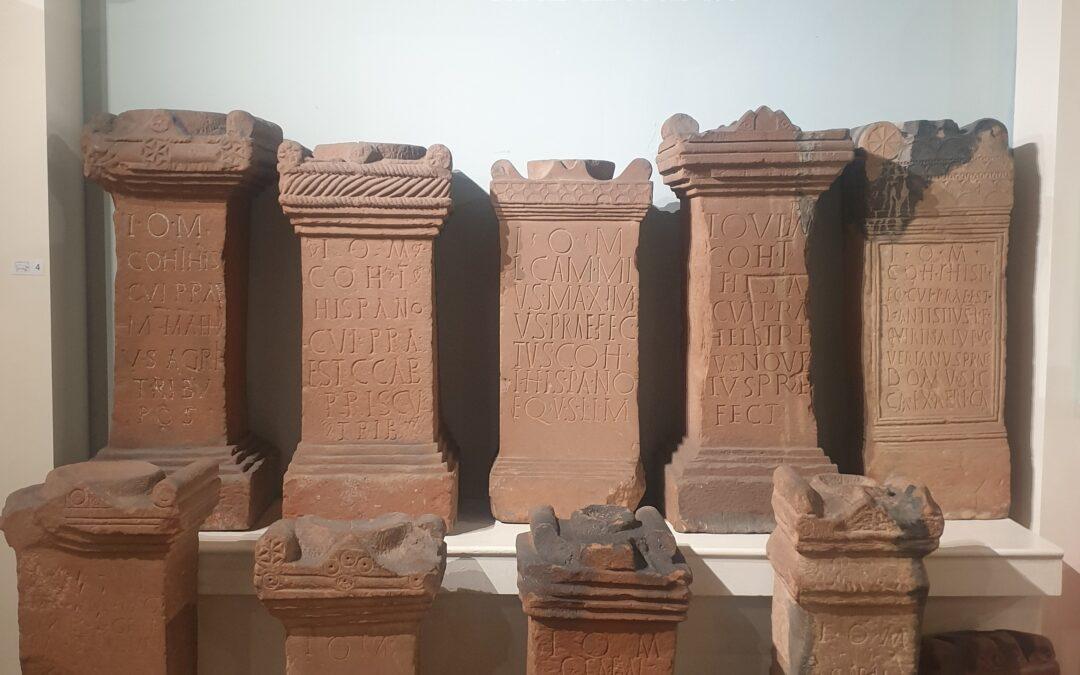
Today's Image: Altars of the First Cohort of Spaniards at Maryport 122-138 AD
Location: Senhouse Roman Museum
To Read the Interactive Text Below Without a Dictionary-
On a Computer: you hover over a word and get all the possible parts of speech; declensions; and conjugations of every word.
The words in red and green are found among the 3057 Most Common Words in the Classical Latin texts that we will explore on CentumVerba.com and are essential to your understanding of the texts of Caesar, Vergil and Cicero. The green words appear frequently (at least five times) among Vergil's Aeneid (books I-VI), Caesar de bello Gallico (books I-V) and in Cicero's works - in Catilinam (books I-IV), de lege Manilia (also known as de Imperio Cn. Pompei), and pro Achia. These works constituted the curriculum for Latin over 4 years in American High Schools at the start of the 20th Century. The bulk of my information is taken from The Vocabulary of High School Latin by Gonzalez Lodge. I have added to these 2000 words from varioius other sources to compile my own list of The 3057 Most Common Latin Words.
The black words do not appear frequently in Classical Latin.
The red words are the first occurrences of these words in this author and this word will appear as green the next time you encounter it.
If you are serious about building your vocabulary then you should learn the red words as they occur and you should already know the green ones!
I have provided a FLASHCARD set to help - see below.
sum - the most frequently used Latin verb
The Latin verb sum translates to "I am" and stands as one of the most fundamental verbs in the Latin language, representing the essence of existence and being. As an irregular verb, sum plays a crucial role in forming compound tenses with other verbs, making it indispensable in both classical and ecclesiastical Latin.
The conjugation of sum is distinct and unique, lacking the regular endings typically found in other verb conjugations. Here are some key forms:
- Present: sum (I am), es (you are), est (he/she/it is), sumus (we are), estis (you all are), sunt (they are)
- Imperfect: eram (I was), eras (you were), erat (he/she/it was), eramus (we were), eratis (you all were), erant (they were)
- Future: ero (I will be), eris (you will be), erit (he/she/it will be), erimus (we will be), eritis (you all will be), erunt (they will be)
sum also appears in various idiomatic expressions and philosophical contexts, such as Cogito, ergo sum (I think, therefore I am), popularized by René Descartes. Understanding sum is essential for grasping the structure and flow of Latin, as it frequently appears in literature, legal texts, and historical documents.
sum appears frequently in each author:
| AUTHOR | OCCURENCES |
| Caesar | 685 |
| Cicero | 840 |
| Vergil | 263 |
Today's Image: Altars of the First Cohort of Spaniards at Maryport 122-138 AD
Location: Senhouse Roman Museum
The words in red and green are found among the 3057 Most Common Words in the Classical Latin texts that we will explore on CentumVerba.com and are essential to your understanding of the texts of Caesar, Vergil and Cicero. The green words appear frequently (at least five times) among Vergil's Aeneid (books I-VI), Caesar de bello Gallico (books I-V) and in Cicero's works - in Catilinam (books I-IV), de lege Manilia (also known as de Imperio Cn. Pompei), and pro Achia. These works constituted the curriculum for Latin over 4 years in American High Schools at the start of the 20th Century. The bulk of my information is taken from The Vocabulary of High School Latin by Gonzalez Lodge. I have added to these 2000 words from varioius other sources to compile my own list of The 3057 Most Common Latin Words.
The black words do not appear frequently in Classical Latin.
The red words are the first occurrences of these words in this author and this word will appear as green the next time you encounter it.
If you are serious about building your vocabulary then you should learn the red words as they occur and you should already know the green ones!
I have provided a FLASHCARD set to help - see below.
To Read the Interactive Text Below Without a Dictionary-
On a Phone or Tablet: don't 'hover' -'tap' the word. To remove the 'definition box' you 'tap' to the side of the text box.
INTERACTIVE DICTIONARY FREE TEXT
Gallia est omnis divisa in partes tres, quarum unam incolunt Belgae, aliam Aquitani, tertiam qui ipsorum lingua Celtae, nostra Galli appellantur.
Hi omnes lingua, institutis, legibus inter se differunt. Gallos ab Aquitanis Garumna flumen, a Belgis Matrona et Sequana dividit.
Horum omnium fortissimi sunt Belgae, propterea quod a cultu atque humanitate provinciae longissime absunt, minime que ad eos mercatores saepe commeant atque ea quae ad effeminandos animos pertinent important, proximi que sunt Germanis, qui trans Rhenum incolunt, quibuscum continenter bellum gerunt.
Qua de causa Helvetii quoque reliquos Gallos virtute praecedunt, quod fere cotidianis proeliis cum Germanis contendunt, cum aut suis finibus eos prohibent aut ipsi in eorum finibus bellum gerunt.
I have prepared online Flashcards at CRAM.com to make learning the vocabulary much easier. I have no financial gain from you using the app as it is FREE to use.
I have created a stack of the 55 new words in this passage.
Here is the link to the FLASHCARDS
If that is too many at once I have split the list into 3 x 18
1-18
19-36
37-55
USING THE FLASHCARD APP:
To make the most of the online Flashcards use the "Click or use spacebar to begin" and the Latin word should appear. (The 'Shuffle' button will take the cards out of alphabetical order.) Type 'H' to get the conjugation / declension of the word if you want to see it. 'H' takes you back to the word. Click 'See Answer' or use the Spacebar to see the English.
If you were correct or close enough then select "I was right" or else "I was wrong". After you have completed the set it will start again but it will only display the ones you got wrong.
Continue through this process to learn all the words. I hope this is helpful!
Recent Comments