
facile - easy does it!
The Latin adverb facile translates to 'easily' in English and stems from the adjective facilis, meaning 'easy.' It is used to describe the manner in which an action is performed, emphasizing the ease or simplicity of the task. As an adverb, facile is versatile and appears frequently in classical Latin texts, providing nuance and detail to descriptions of actions and events.
The root adjective "facilis" also gives rise to several related words, including facilitas (ease, facility) and facilitare (to make easy). These derivatives highlight the importance of the concept of ease in Latin language and culture.
In terms of usage, facile can modify a variety of verbs to indicate that the action is performed without difficulty. For example, in the sentence vincere facile, it means 'to win easily.' Similarly, facile can be used to describe mental or physical tasks, such as intellegere facile (to understand easily) or currere facile (to run easily).
facile is also found in comparative and superlative forms, facilius (more easily) and facillime (most easily), respectively. These forms allow for a more precise expression of the degree of ease associated with an action.
Understanding facile and its related forms is useful for grasping the nuances of Latin adverbs and their role in sentence structure. Its frequent appearance in classical literature and inscriptions underscores its importance in conveying the effortless nature of certain actions.
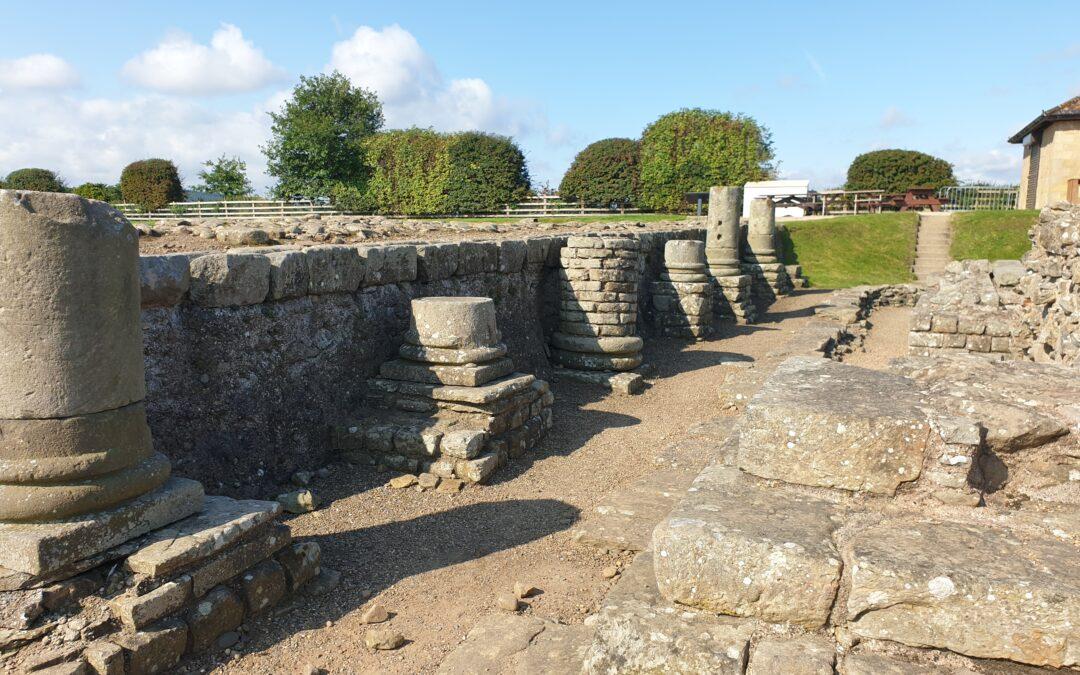
Today's Image: A street of the Roman town of Corbridge
Location: Corbridge Roman Town
The remains at Corbridge are largely those of a Roman town, 2½ miles south of Hadrian's Wall, which developed after AD 160 around a base for legionary soldiers. This replaced a succession of forts on the site, built from about AD 85 where one of the main routes northwards crossed the River Tyne.
To Read the Interactive Text Below Without a Dictionary-
On a Computer: you hover over a word and get all the possible parts of speech; declensions; and conjugations of every word.
The words in red and green are found among the 3057 Most Common Words in the Classical Latin texts that we will explore on CentumVerba.com and are essential to your understanding of the texts of Caesar, Vergil and Cicero. The green words appear frequently (at least five times) among Vergil's Aeneid (books I-VI), Caesar de bello Gallico (books I-V) and in Cicero's works - in Catilinam (books I-IV), de lege Manilia (also known as de Imperio Cn. Pompei), and pro Achia. These works constituted the curriculum for Latin over 4 years in American High Schools at the start of the 20th Century. The bulk of my information is taken from The Vocabulary of High School Latin by Gonzalez Lodge. I have added to these 2000 words from varioius other sources to compile my own list of The 3057 Most Common Latin Words.
The black words do not appear frequently in Classical Latin.
The red words are the first occurrences of these words in this author and this word will appear as green the next time you encounter it.
If you are serious about building your vocabulary then you should learn the red words as they occur and you should already know the green ones!
I have provided a FLASHCARD set to help - see below.
facile - easy does it!
The Latin adverb facile translates to 'easily' in English and stems from the adjective facilis, meaning 'easy.' It is used to describe the manner in which an action is performed, emphasizing the ease or simplicity of the task. As an adverb, facile is versatile and appears frequently in classical Latin texts, providing nuance and detail to descriptions of actions and events.
The root adjective "facilis" also gives rise to several related words, including facilitas (ease, facility) and facilitare (to make easy). These derivatives highlight the importance of the concept of ease in Latin language and culture.
In terms of usage, facile can modify a variety of verbs to indicate that the action is performed without difficulty. For example, in the sentence vincere facile, it means 'to win easily.' Similarly, facile can be used to describe mental or physical tasks, such as intellegere facile (to understand easily) or currere facile (to run easily).
facile is also found in comparative and superlative forms, facilius (more easily) and facillime (most easily), respectively. These forms allow for a more precise expression of the degree of ease associated with an action.
Understanding facile and its related forms is useful for grasping the nuances of Latin adverbs and their role in sentence structure. Its frequent appearance in classical literature and inscriptions underscores its importance in conveying the effortless nature of certain actions.
Today's Image: A street of the Roman town of Corbridge
Location: Corbridge Roman Town
The remains at Corbridge are largely those of a Roman town, 2½ miles south of Hadrian's Wall, which developed after AD 160 around a base for legionary soldiers. This replaced a succession of forts on the site, built from about AD 85 where one of the main routes northwards crossed the River Tyne.
The words in red and green are found among the 3057 Most Common Words in the Classical Latin texts that we will explore on CentumVerba.com and are essential to your understanding of the texts of Caesar, Vergil and Cicero. The green words appear frequently (at least five times) among Vergil's Aeneid (books I-VI), Caesar de bello Gallico (books I-V) and in Cicero's works - in Catilinam (books I-IV), de lege Manilia (also known as de Imperio Cn. Pompei), and pro Achia. These works constituted the curriculum for Latin over 4 years in American High Schools at the start of the 20th Century. The bulk of my information is taken from The Vocabulary of High School Latin by Gonzalez Lodge. I have added to these 2000 words from varioius other sources to compile my own list of The 3057 Most Common Latin Words.
The black words do not appear frequently in Classical Latin.
The red words are the first occurrences of these words in this author and this word will appear as green the next time you encounter it.
If you are serious about building your vocabulary then you should learn the red words as they occur and you should already know the green ones!
I have provided a FLASHCARD set to help - see below.
To Read the Interactive Text Below Without a Dictionary-
On a Phone or Tablet: don't 'hover' -'tap' the word. To remove the 'definition box' you 'tap' to the side of the text box.
INTERACTIVE DICTIONARY FREE TEXT
Id hoc facilius iis persuasit, quod undique loci natura Helvetii continentur una ex parte flumine Rheno latissimo atque altissimo,
You Need to Sign Up as a Trial Member to Access the Interactive Dictionary
qui agrum Helvetium a Germanis dividit;
altera ex parte monte Iura altissimo, qui est inter Sequanos et Helvetios; tertia lacu Lemanno et flumine Rhodano, qui provinciam nostram ab Helvetiis dividit.
His rebus fiebat ut et minus late vagarentur et minus facile finitimis bellum inferre possent; qua ex parte homines bellandi cupidi magno dolore adficiebantur.
Pro multitudine autem hominum et pro gloria belli atque fortitudinis angustos se fines habere arbitrabantur, qui in longitudinem milia passuum CCXL, in latitudinem CLXXX patebant.
I have prepared online Flashcards at CRAM.com to make learning the vocabulary much easier. I have no financial gain from you using the app as it is FREE to use.
I have created a stack of the 31 new words in this passage.
Here is the link to the FLASHCARDS
USING THE FLASHCARD APP:
To make the most of the online Flashcards use the "Click or use spacebar to begin" and the Latin word should appear. (The 'Shuffle' button will take the cards out of alphabetical order.) Type 'H' to get the conjugation / declension of the word if you want to see it. 'H' takes you back to the word. Click 'See Answer' or use the Spacebar to see the English.
If you were correct or close enough then select "I was right" or else "I was wrong". After you have completed the set it will start again but it will only display the ones you got wrong.
Continue through this process to learn all the words. I hope this is helpful!
Recent Comments